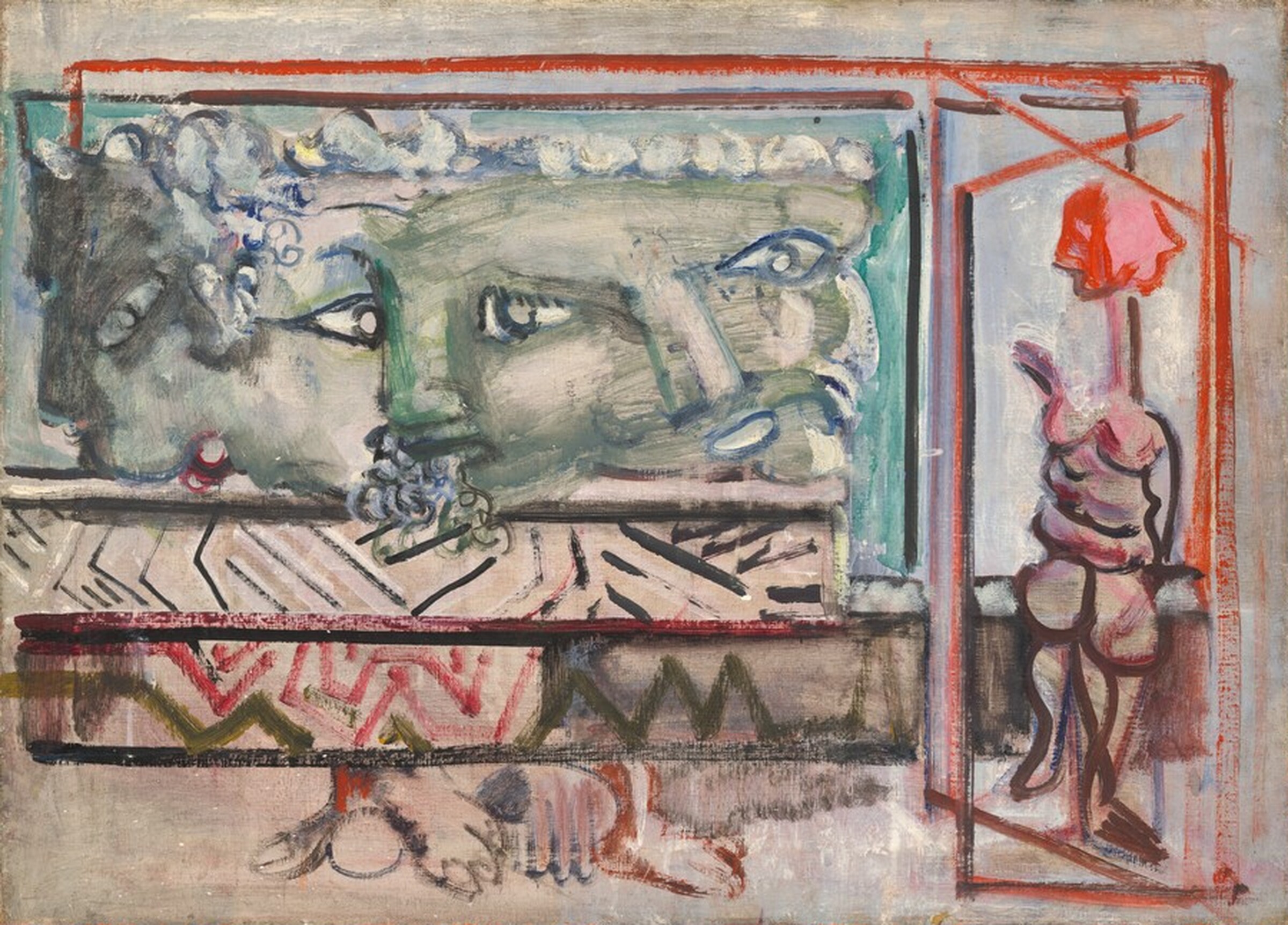
![Landscape [verso], Mark Rothko, c. 1925](https://api.nga.gov/iiif/2d7c939c-9d74-4370-9556-d7872dcf2038/full/!1600,1600/0/default.jpg)
 Mark RothkoUSA, 1903–1970
Landscape [verso]
Må man se det?
Tager ikke imod for tiden

National Gallery of Art
Washington, D.C., USA
Det hører til samlingen, men er ikke udstillet for tiden.
- Kontrolleret
- for 3 dage siden
- Uændret siden
- 19. aug. 2026
- Kilde
- Museets egne samlingsdata
Oplysninger
- Inventarnummer
- 1986.43.205.b
What it shows
I kataloget
Kilder
- National Gallery of Art: the museum's own open data · hentet for 3 dage siden
- Billede: National Gallery of Art — © the artist or rights holder
Imens i livet hos Mark Rothko
Hele livet1921–1923
Yale: a satirical magazine against snobbery
At Yale, which he entered in September 1921 on a scholarship, Rothko and Aaron Director put out a satirical magazine, The Yale Saturday Evening Pest, that lampooned the university’s stuffiness, elitism and racism. The scholarship was not renewed after his first year, so he took odd jobs to pay his way.
autumn 1923
New York: “born as an artist”
In the autumn of 1923 Rothko moved to New York and, visiting a friend at the Art Students League, watched students sketching a model: that moment, he later said, was when he was “born as an artist”. He took lessons from George Bridgman and later studied at the New School of Design, where Arshile Gorky was among his teachers.
1923
Drops out of Yale
In 1923, at the end of his second year, Rothko left the university: by one account disgusted by its elitism and racism, by another because of money troubles or boredom with his courses.
1925–1926
Max Weber: art as emotional and religious expression
Rothko attended Max Weber’s classes at the Art Students League only briefly, from October to December 1925 and from March to May 1926, but Weber strongly influenced his early work: from then on Rothko saw art as a vehicle for emotional and religious expression.






![Scenes from the Passion of Christ: The Descent into Limbo [right panel], Andrea Vanni, 1380s](https://api.nga.gov/iiif/4205a539-eadd-4486-89a7-3cff9c1ba428/full/!2400,2400/0/default.jpg)


