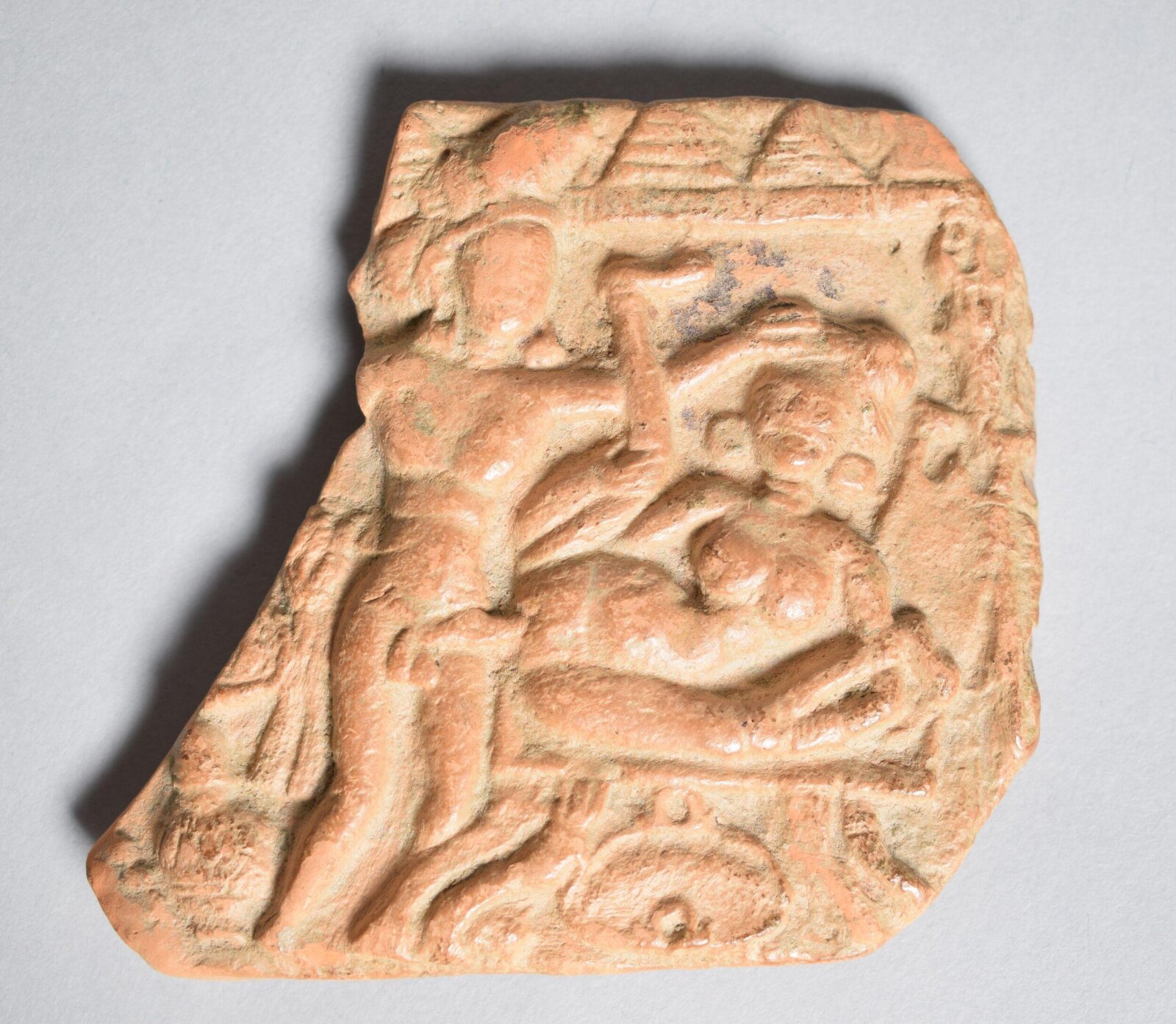
Relief
Må man se det?
Tager ikke imod for tiden

Victoria and Albert Museum
London, Storbritannien
Det hører til samlingen, men er ikke udstillet for tiden.
- Kontrolleret
- for 7 dage siden
- Uændret siden
- 25. sep. 2026
- Kilde
- Museets egne samlingsdata
About the sculpture
A small modelled terracotta panel depicting a couple engaged in energetic love-making. The woman reclines on a bed, holding her spread legs whilst the man stands as he enters her. Both figures are youthful and athletic and wear their hair tied in off-set buns, characteristic of Sunga-period fashion; both also wear large ear-plug ornaments, again a recognised accoutrement of the period. The scene is set in a interior space, with Sunga-period crenelations visible on the upper wall, reminiscent of details seen on the railing coping stones of the Buddhist stupa site of Bharhut.
Read on
Erotic clay reliefs are a important category of early Indian terracottas and may be assumed to have been intended to give expression to early notions of fertility cults. The woman's posture, with exposed genitalia, persisted as the cult image of the goddess cult in the early medieval period, where the icon was often represented as only the female genitalia and the body replaced by a flower-head. Early erotic terracottas of this type probably represent the genesis of the Lajja Gauri cult image.
Victoria and Albert Museum
Oplysninger
- Inventarnummer
- IS.145-1999
I kataloget
Kilder
- Victoria and Albert Museum: the museum's own open data · hentet for 7 dage siden
- Billede: Victoria and Albert Museum — © Victoria and Albert Museum, London