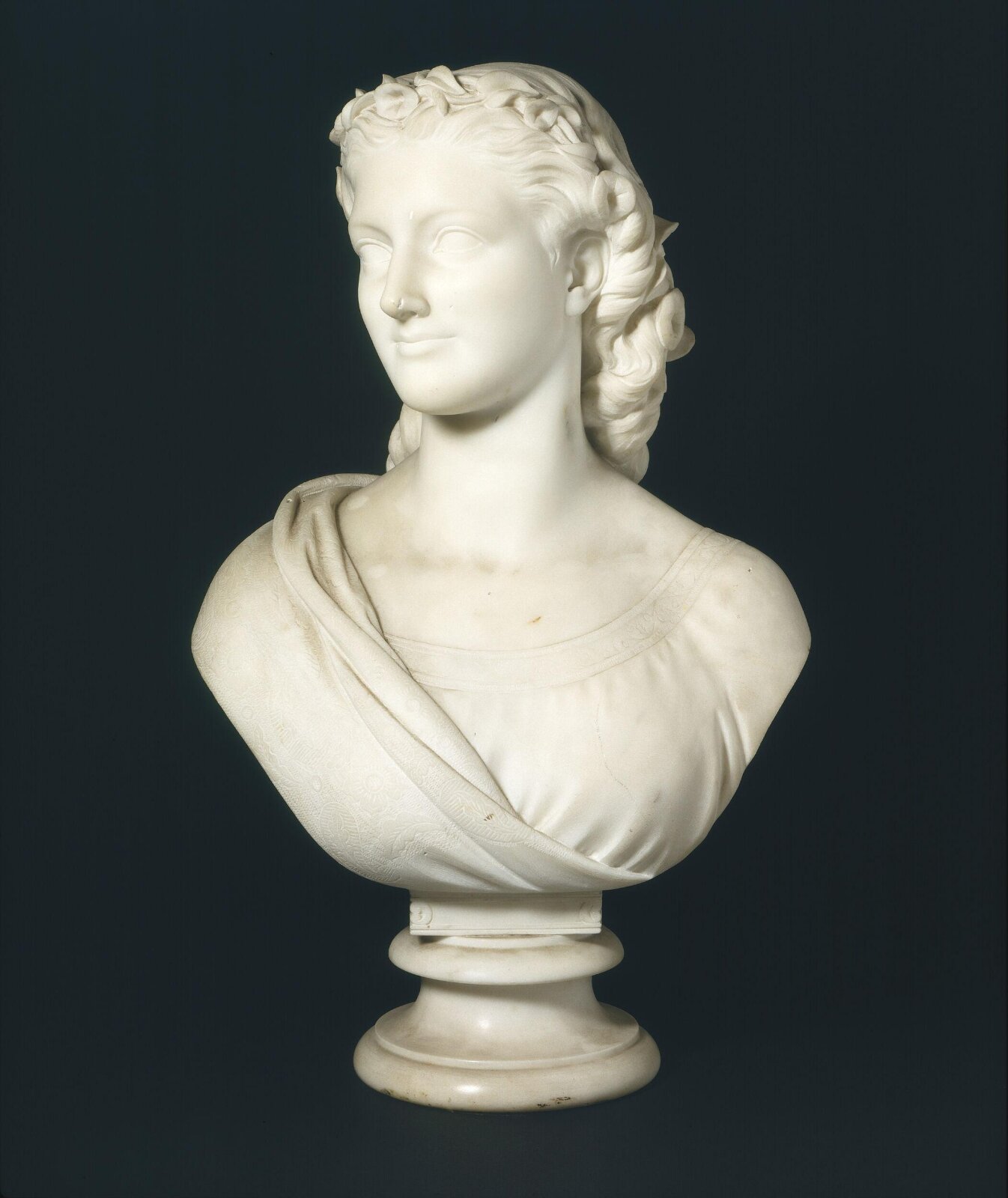
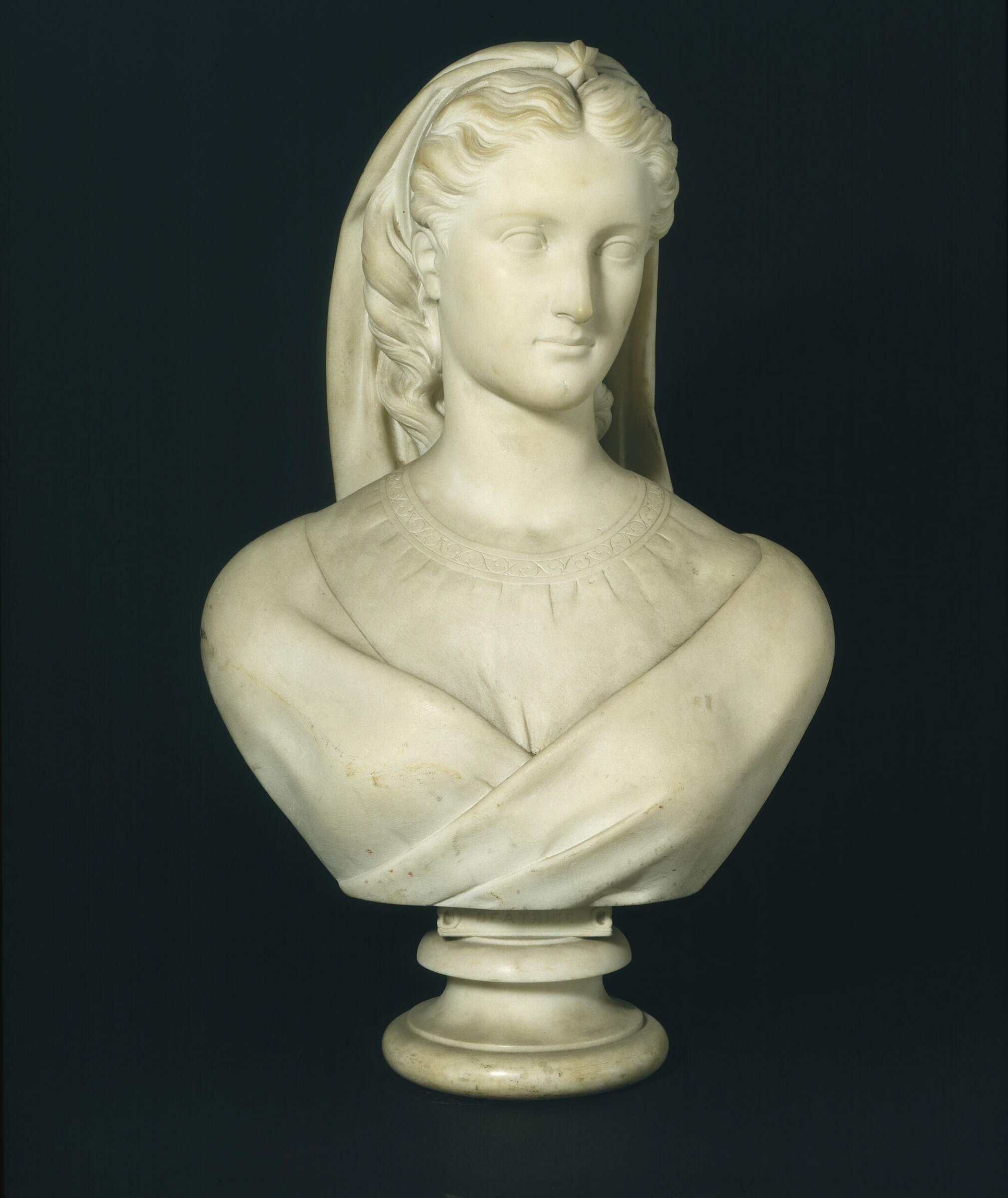
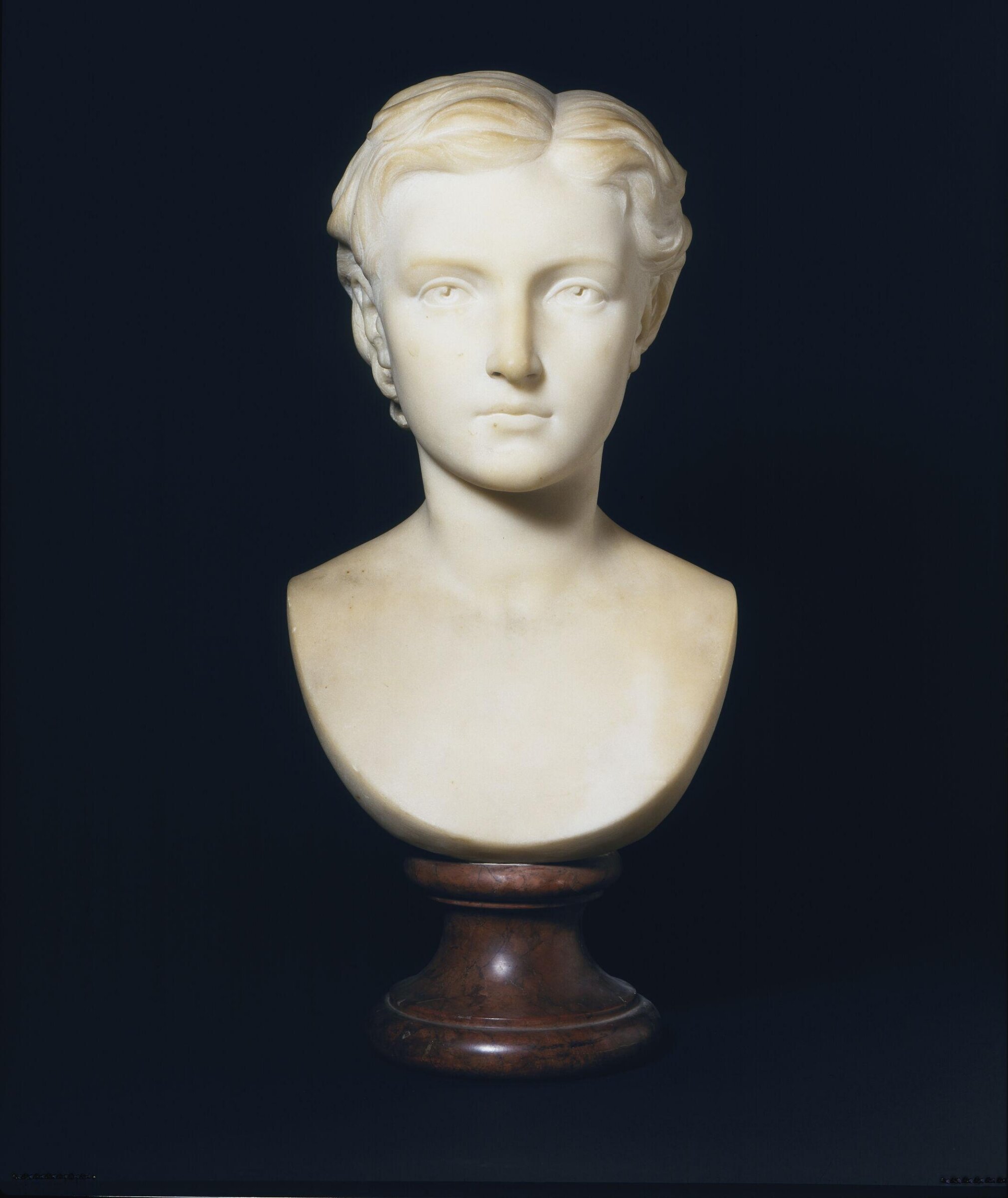
Bruce-Joy exhibited a bust of a young girl entitled Sunshine at the Royal Academy in London in 1866, presumably this piece. It was his first work to be exhibited there. It was bequeathed to the Museum by Mrs Kate Blanche Thompson in 1984, together with a further two busts by Bruce-Joy. It was previously owned by Mrs K. B. M. Bentall (the donor's daughter), who on her death in 1981 bequeathed this and the two other Bruce-Joy busts to her mother. Bruce-Joy lived at Haslemere in Surrey at periods between 1895 and 1905, as did the donor, Mrs Thompson.
Read on
Bruce-Joy trained at the South Kensington Schools, where he was a pupil of the sculptor John Henry Foley (1818-1874), at the Royal Academy Schools, and in Rome, where he stayed for three years. On the death of Foley in 1874, Bruce-Joy took over his outstanding commissions. He also completed in 1877 a statue of Robert James Graves for the Royal College of Physicians, for which Foley had previously executed three other figures of physicians.
Bruce-Joy exhibited regularly at the Royal Academy between 1866 and 1923, and at the Royal Hibernian Academy of Arts between 1870 and 1914. M. H. Spielmann, in British Sculpture and Sculptors of Today, (1901) comments on the volume of his work: 'The list of his works is so long that - the expression is used in no uncomplimentary sense - it is surprising that they are so good.' Bruce-Joy was prolific in the production of portrait busts and statues, and was also a medallist. He travelled extensively in North America, producing the Ayer Colossal Lion for Lowell, Boston, among other works. K. Parkes commented in Sculpture of To-Day that: 'Albert Bruce-Joy is not only the oldest Irish sculptor, but he is the doyen of the sculptors of the British Isles ... During a life so long as that of Bruce-Joy, an artist has ample opportunity of making some change in his outlook or style, but Bruce-Joy has been singularly consistent, and those banes of the artist, Committees, have felt safe with him, for they could count on a standard work.'