 Thomas EakinsUSA, 1844–1916
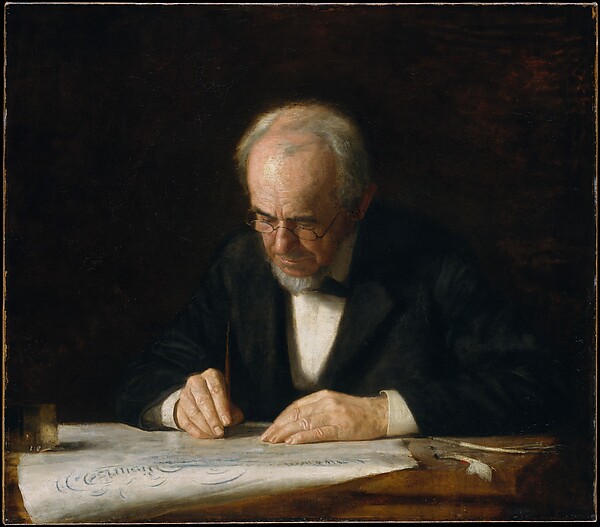
The Writing Master
Må man se det?
Ja, det tager imod

Metropolitan Museum of Art
Sal766New York City, USA
Udstillet for publikum. Hvem der står inde for det, står nedenfor.
- Kontrolleret
- for 5 timer siden
- Uændret siden
- 26. sep. 2026
- Kilde
- Museets egne samlingsdata
About the painting
The Writing Master is an oil painting on canvas executed in 1882 by the American painter Thomas Eakins. It is part of the collection of the Metropolitan Museum of Art, in New York.
The subject of the painting is Eakin's father, the calligraphist Benjamin Eakins. He is seen seated at a desk, in a dark room, fully absorbed in his writing.
The work is on view in the Metropolitan Museum's Gallery 764
Oplysninger
- Inventarnummer
- 17.173
What it shows
I kataloget
Kilder
- Metropolitan Museum of Art: the museum's own open data · hentet for 4 dage siden
- Billede: Metropolitan Museum of Art — Open Access (CC0)
Imens i livet hos Thomas Eakins
Hele livet1870–1916 · Virkested
Philadelphia
1880
Acquires a camera
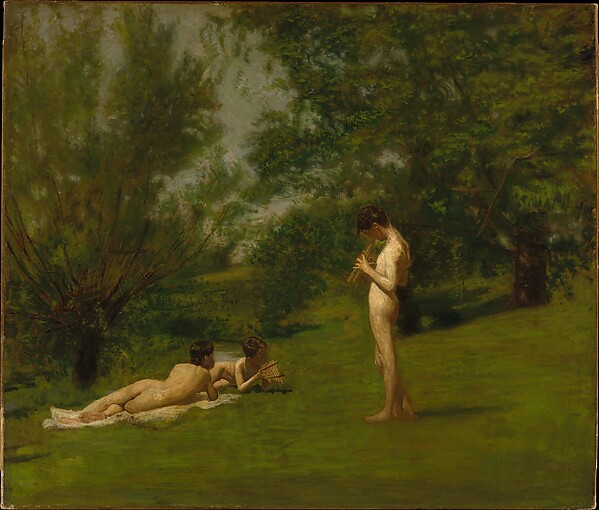
From 1880 Eakins had his own camera: paintings such as “Mending the Net” (1881) and “Arcadia” (1883) derive in part from his photographs. He is credited with having “introduced the camera to the American art studio”; some eight hundred photographs are attributed to him and his circle.
1882
Becomes director of the Pennsylvania Academy
Eakins became the Academy's director. His methods were controversial — no drawing from antique casts and no prize competitions, a quick move from charcoal to paint, anatomy through dissection and photography — yet by the early 1880s the course was called the most “liberal and advanced in the world”.
1883
Brings Eadweard Muybridge to lecture at the Academy
In the late 1870s Eakins had discovered Eadweard Muybridge's photographic motion studies, especially those of horses; in 1883 he and the University of Pennsylvania trustee Fairman Rogers arranged for Muybridge to lecture at the Academy.
1884
Marries Susan Macdowell
At 40, Eakins married his former pupil, the painter Susan Hannah Macdowell. In their childless marriage she painted only sporadically, supporting her husband's career, shared his passion for photography and stood by him in his difficult years, even when some of her family turned against him.
1884
Works alongside Muybridge
Eakins briefly worked alongside Muybridge in the latter's photographic studio at 36th and Pine streets, then developed his own technique: instead of a battery of cameras, a single camera making a series of exposures on one negative, to measure motion precisely for painting.