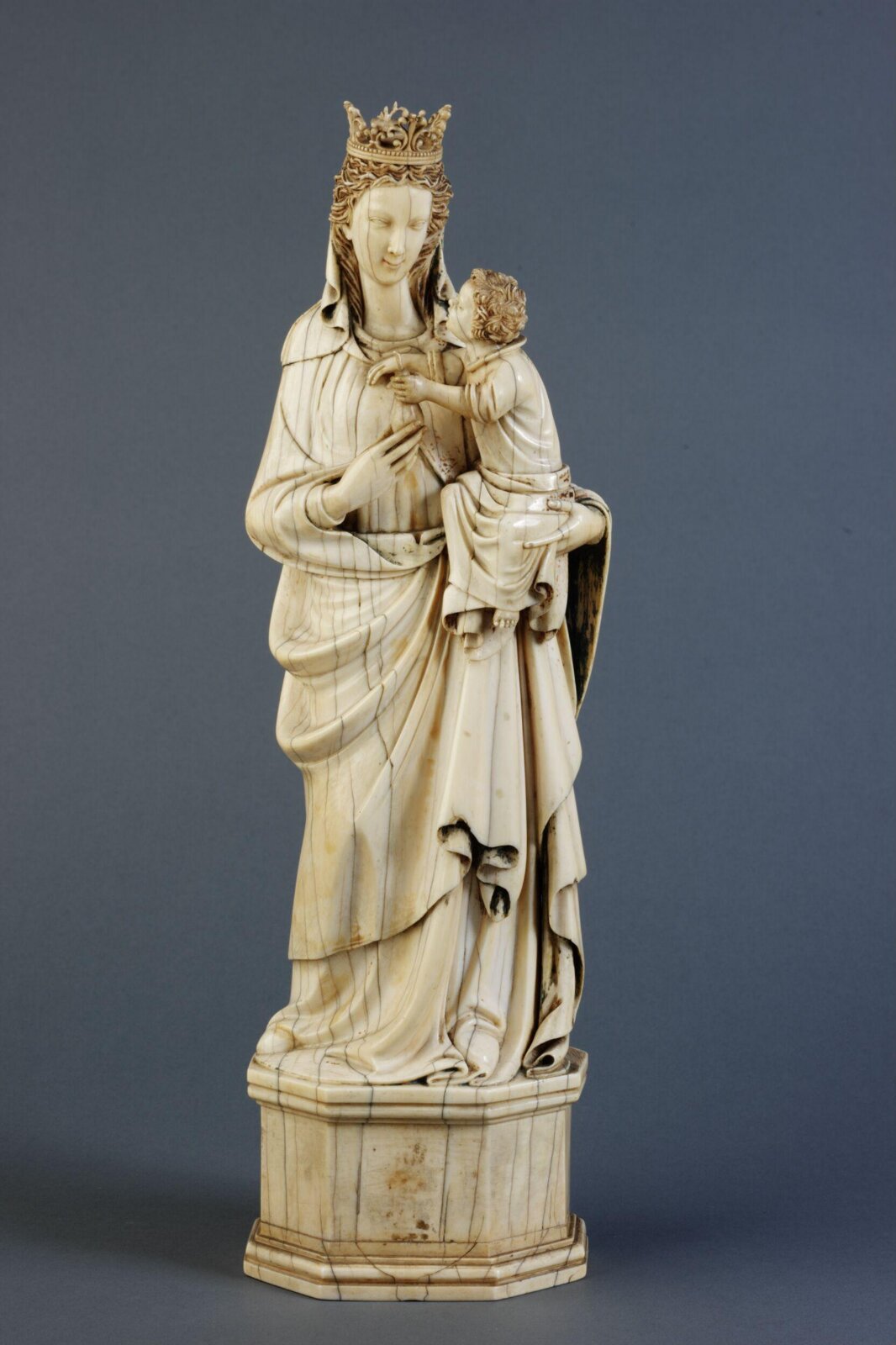
Virgin and Child
Må man se det?
Tager ikke imod for tiden

Victoria and Albert Museum
London, Storbritannien
Det hører til samlingen, men er ikke udstillet for tiden.
- Kontrolleret
- for 7 dage siden
- Uændret siden
- 25. sep. 2026
- Kilde
- Museets egne samlingsdata
About the sculpture
This statuette of the Virgin and Child, made in the mid-19th century in France or Italy, is based on a life-size marble figure of the Virgin in Trapani Sicily. The Trapani statue was made in the 14th century and soon became the focus of pilgrimages and was one of the most copied devotional images in Italy. The present Virgin was probably not intended as a fake, but a copy made for devotional purposes.
The production of ivories in historicizing styles in the 19th century flourished in a number of centres, including Cologne, Milan, Toulouse and Cordoba. Although not always made to deceive, unscrupulous dealers often sold them as genuine objects to their clients.
Read on
Three dimensional images of the Virgin and Child were ubiquitous from the twelfth to the fifteenth centuries, produced in a wide range of materials and sizes and testifying the overwhelming devotion to th Virgin. Together with the Crucifixion, statues and statuettes of the Virgin and Child were the pricipal objects of devotion in the Christian Church, and vast numbers were made for ecclesisastical, monastic and private worship.
Victoria and Albert Museum
Oplysninger
- Inventarnummer
- A.550-1910
What it shows
I kataloget
Kilder
- Victoria and Albert Museum: the museum's own open data · hentet for 7 dage siden
- Billede: Victoria and Albert Museum — © Victoria and Albert Museum, London