 Thomas EakinsVereinigte Staaten, 1844–1916
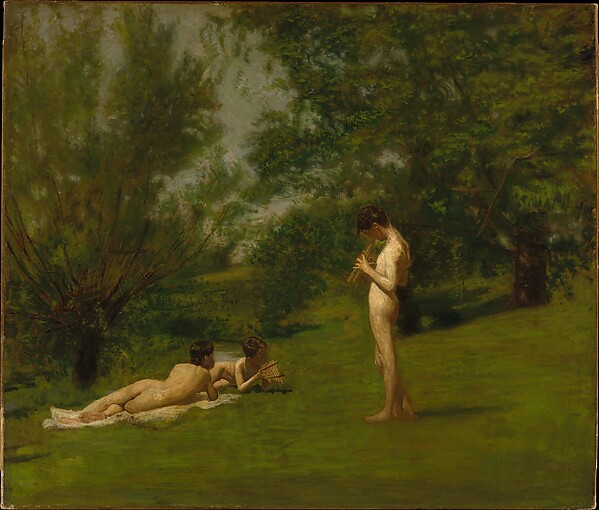
Arcadia
Darf man es sehen?
Ja, es empfängt Besucher

Metropolitan Museum of Art
Saal766New York City, Vereinigte Staaten
Öffentlich ausgestellt. Wer dafür bürgt, steht unten.
- Geprüft
- vor 6 Stunden
- Unverändert seit
- 26. Sept. 2026
- Quelle
- Sammlungsdaten des Museums selbst
About the painting
Arcadia ist ein Gemälde des US-amerikanischen Malers Thomas Eakins und zählt zu seinen wenigen Aktgemälden. Das Gemälde stammt aus der Zeit um 1883 und befindet sich heute im Metropolitan Museum of Art, New York. Das Gemälde war ein Geschenk von Thomas Eakins an seinen Freund und Kollegen William Merritt Chase. Das Gemälde blieb zunächst titellos und wurde zu Lebzeiten von Thomas Eakins niemals öffentlich gezeigt. Erst nach dem Tode von Thomas Eakins im Jahre 1916 gab seine Witwe Susan dem Gemälde die Bezeichnung Arcadia. Das Metropolitan Museum of Art erhielt das Gemälde 1967 aus dem Nachlass von Adelaide Milton de Groot.
Angaben
- Inventarnummer
- 67.187.125
What it shows
Im Katalog
Quellen
- Metropolitan Museum of Art: the museum's own open data · abgerufen vor 4 Tagen
- Bild: Metropolitan Museum of Art — Open Access (CC0)
Derweil im Leben von Thomas Eakins
Das ganze Leben1870–1916 · Wirkungsort
Philadelphia
1882
Becomes director of the Pennsylvania Academy
Eakins became the Academy's director. His methods were controversial — no drawing from antique casts and no prize competitions, a quick move from charcoal to paint, anatomy through dissection and photography — yet by the early 1880s the course was called the most “liberal and advanced in the world”.
1882
Death of his sister Margaret
Eakins's sister Margaret, who had acted as his secretary and personal servant, died of typhoid; it has been suggested that his marriage two years later was meant to replace her.
1883
Brings Eadweard Muybridge to lecture at the Academy
In the late 1870s Eakins had discovered Eadweard Muybridge's photographic motion studies, especially those of horses; in 1883 he and the University of Pennsylvania trustee Fairman Rogers arranged for Muybridge to lecture at the Academy.
1884
Marries Susan Macdowell
At 40, Eakins married his former pupil, the painter Susan Hannah Macdowell. In their childless marriage she painted only sporadically, supporting her husband's career, shared his passion for photography and stood by him in his difficult years, even when some of her family turned against him.
1884
Works alongside Muybridge
Eakins briefly worked alongside Muybridge in the latter's photographic studio at 36th and Pine streets, then developed his own technique: instead of a battery of cameras, a single camera making a series of exposures on one negative, to measure motion precisely for painting.