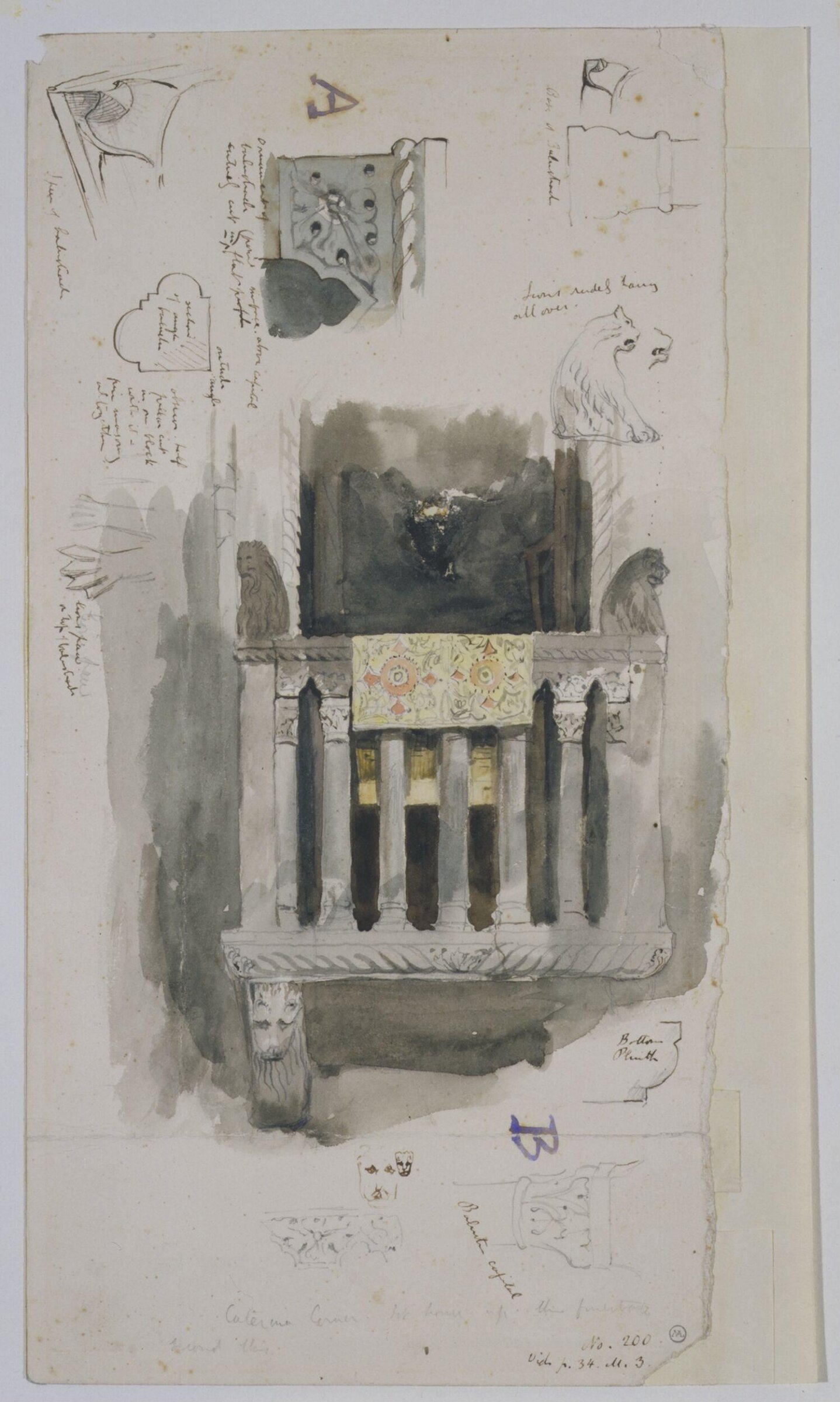
John RuskinEngland, 1819–1900
Architectural Study
Darf man es sehen?
Empfängt derzeit nicht

Harvard Art Museums
Cambridge, Vereinigte Staaten
Es gehört zur Sammlung, ist derzeit aber nicht ausgestellt.
- Geprüft
- vor 4 Tagen
- Unverändert seit
- 27. Sept. 2026
- Quelle
- Sammlungsdaten des Museums selbst
Angaben
- Inventarnummer
- 1957.187
Im Katalog
Quellen
- Harvard Art Museums: the museum's own open data · abgerufen vor 4 Tagen
- Bild: Harvard Art Museums — © President and Fellows of Harvard College
Derweil im Leben von John Ruskin
Das ganze Leben1834–1900 · Wirkungsort
Great Britain
1843
In defence of Turner: the first volume of “Modern Painters”
The first volume of “Modern Painters” — an answer to Turner's critics — is published by Smith, Elder & Co. under the name “A Graduate of Oxford”; Ruskin controversially argues that modern landscape painters, above all Turner, surpass “Old Masters” such as Gaspard Dughet, Claude and Salvator Rosa in “truth to nature”, moral as well as material. Reviews are mixed, but Charlotte Brontë and Elizabeth Gaskell are impressed, and the book cements Ruskin's relationship with Turner.
1845
“Venice is lost to me”: restoration is destruction
Alarmed by the combined effects of decay and modernisation on the city, Ruskin writes that Venice is lost to him, and becomes convinced that architectural restoration is destruction and that the only true and faithful action is preservation and conservation.
1845
First journey without his parents
At 26 Ruskin travels without his parents for the first time to study medieval art and architecture in France, Switzerland and above all Italy: in Lucca he sees the tomb of Ilaria del Carretto by Jacopo della Quercia, which he considers the finest example of Christian sculpture; he draws inspiration from the Campo Santo in Pisa, is especially struck by Fra Angelico and Giotto in Florence, and in Venice by the mosaics of St Mark's and Tintoretto's paintings in the Scuola di San Rocco.
10. April 1848
Married: Effie Gray
1851–1853
The three-volume “Stones of Venice”
Growing from a technical history of Venetian architecture, from the Byzantine to the Renaissance, into a broad cultural history, the work is a warning to contemporary England about the moral and spiritual health of society: Ruskin explains the decline of Venice by the loss of true Christian faith. The chapter “The Nature of Gothic” from the second volume — a critique of the division of labour and industrial capitalism — will be published by William Morris as a separate book.