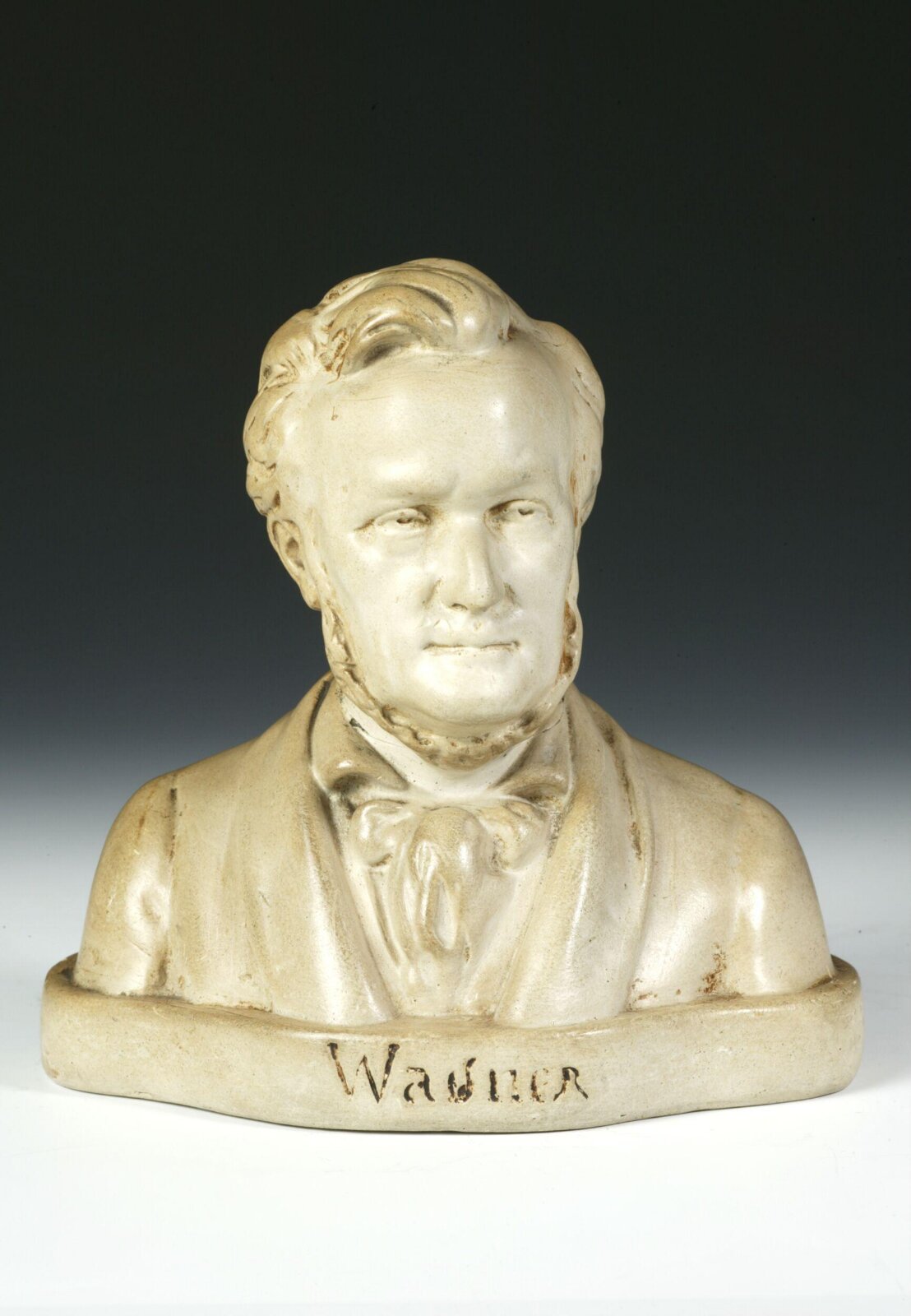
Sculpture
Darf man es sehen?
Empfängt derzeit nicht

Victoria and Albert Museum
London, Vereinigtes Königreich
Es gehört zur Sammlung, ist derzeit aber nicht ausgestellt.
- Geprüft
- vor 7 Tagen
- Unverändert seit
- 25. Sept. 2026
- Quelle
- Sammlungsdaten des Museums selbst
About the sculpture
The German composer Richard Wagner (1813-1883), who dominated 19th century opera as a composer of monumental works, saw opera as a religion or a philosophy. He aimed to compose works which abandoned the usual operatic conventions of recitative and aria, blending orchestra, voice and words into a dramatic unity.
Read on
In the later part of his career Wagner enjoyed the support of King Ludwig II of Bavaria and established his own theatre and festival at the Bavarian town of Bayreuth. He developed the use of the Leitmotiv (leading motif) as a principle of musical unity; his dramatic musical structure depending on the interweaving of melodies or fragments of melody associated with characters, incidents or ideas in the drama. His most famous works are the four operas that form the The Ring Cycle - Das Rheingold, Die Walküre (The Valkyries), Siegfried and Götterdämmerung (The Twilight of the Gods). Other operas by Wagner include Tristan und Isolde, Die Meistersinger von Nürnberg (The Mastersingers of Nuremberg), and his final work, Parsifal.
Victoria and Albert Museum
Angaben
- Inventarnummer
- S.329-1981
What it shows
Im Katalog
Quellen
- Victoria and Albert Museum: the museum's own open data · abgerufen vor 7 Tagen
- Bild: Victoria and Albert Museum — © Victoria and Albert Museum, London