Vasily KandinskyFrankreich, 1866–1944
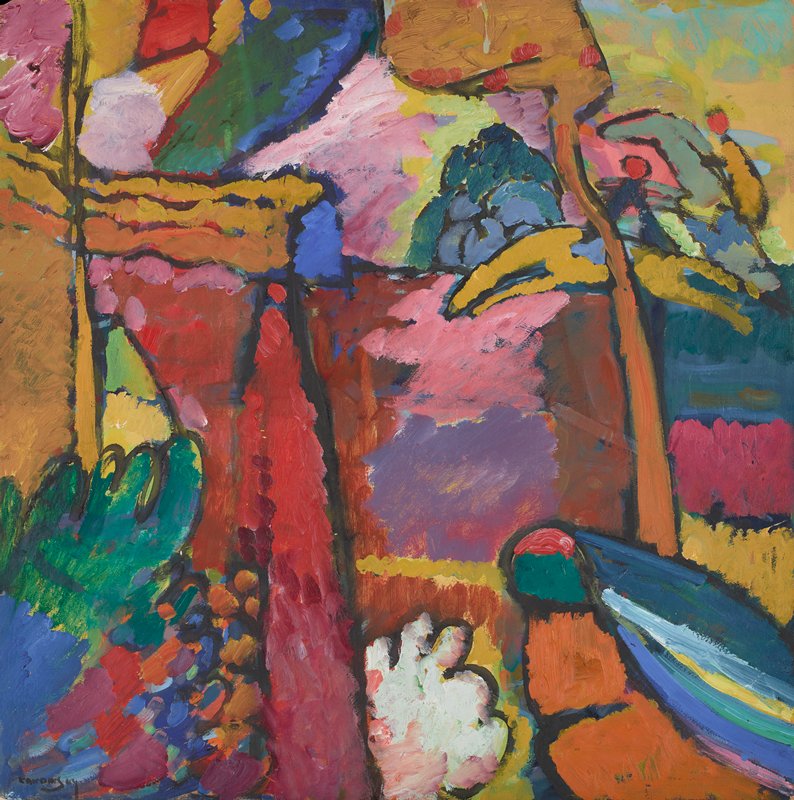
Composition VI
Darf man es sehen?
Unbekannt: Das Museum schweigt sich aus

Eremitage
Sankt Petersburg, Russland
Der Eigentümer ist bekannt. Ob es heute ausgestellt ist, sagt das Museum nicht, und Raten haben wir nicht gelernt.
- Quelle
- Sammlungsdaten des Museums selbst
About the painting
Composition VI is a 1913 oil painting on canvas by the Russian artist Wassily Kandinsky, now in the Hermitage Museum, in Saint Petersburg.
The result of 24 studies, it took the painter eight months to complete the large painting. He wanted to depict a flood, a baptism and the theme of destruction and rebirth. His assistant, Gabriele Münter - with whom he had a professional and personal relationship between 1902 and 1916 - advised him to break free from the initial outline and think about the German word 'Überflut' (flood) and the acoustic sensations it suggested to him. Kandinsky finished the painting within three days of that suggestion, intoning the word 'uberflut' for those whole three days.
Angaben
- Inventarnummer
- ГЭ-9662
Im Katalog
Quellen
- Eremitage: the museum's own open data · abgerufen vor 3 Tagen
- Bild: Eremitage — Museum open access
Derweil im Leben von Vasily Kandinsky
Das ganze Leben1910–1911
The treatise “Concerning the Spiritual in Art”
The treatise defended and promoted abstract art and affirmed that all forms of art are equally capable of reaching spirituality; colour in a painting can be autonomous, apart from the depiction of an object. Kandinsky distinguished three kinds of painting: impressions, improvisations and compositions.
1910–1912
The Izdebsky Salons and the Knave of Diamonds
With the Neue Künstlervereinigung Kandinsky took part in two international Izdebsky Salons in Russian cities, from December 1910 to May 1911; in 1910 and 1912 he also exhibited with the Knave of Diamonds.
1911
The birth of the Blue Rider
After the earlier association dissolved Kandinsky formed the Blue Rider with August Macke, Franz Marc, Albert Bloch and Gabriele Münter. The group issued an almanac and held two exhibitions; the war ended further plans.
1911
His first solo exhibition
His first solo exhibition took place in the same years, when the Blue Rider was being born.
1911
Divorce from his first wife
Kandinsky was divorced from Anna Chemyakina; his relationship with Münter was nevertheless never formalized.
1914
The war: back to Russia via Switzerland and Sweden
The outbreak of World War I ended the Blue Rider's plans for further almanacs and exhibitions and sent Kandinsky back to Russia via Switzerland and Sweden; he returned to Moscow in 1914.
_MET_DP236124.jpg?width=1280)