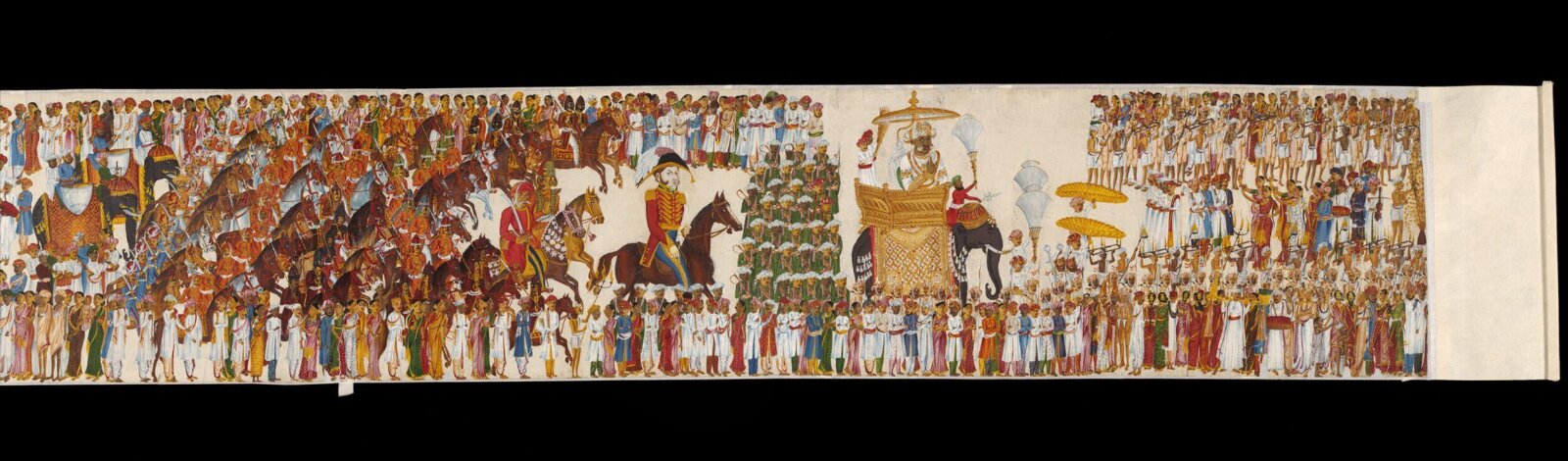
A scroll-painting
May one see it?
Not receiving at present

Victoria and Albert Museum
London, United Kingdom
It belongs to the collection, but is not on display at present.
- Checked
- 7 days ago
- In this state since
- Sep 25, 2026
- Source
- The museum's own collection data
About the painting
This detail of a scroll painting probably painted in Mysore in about 1860 shows Krishnaraja Wadiyar, Raja of Mysore (r.1799-1868) on an elephant leading a religious procession in honour of the god Shiva. (He was formerly misidentified as Raja Sarabhoji of Tanjore (1777-1832) British military commanders are also shown.
From left to right:-
Krishnaraja Wadiyar is preceded by dancing-girls, musicians, chauri-bearers and men carrying illuminations and letting of fireworks.
The Raja is followed by the British Resident, Colonel Mark Cubbon, and two Indian military commanders on horseback, elephants with kettledrums, horsemen and a great crowd with illuminations.
Read on
A wooden platform bearing an image of Shiva on a prancing horse under a canopy, followed by a crowd with dancing-girls and musicians. Four temple cars dragged by ropes bearing images of Durga on a lion, Shiva on Nandi, Shiva on an elephant and Shiva on a horse. Dancing girls and men with fireworks may also be seen. Shiva is carried in an elaborate gold and red carved car drawn by four small red horses.
It is notable that the howdah and the headdress of the elephant are all adorned with tiger stripes of the characteristic form associated with the personal possessions of Tipu Sultan. Following the defeat and death of Tipu Sultan after the Siege of Seringapatam in 1799, his treasury was seized by the British Prize Agents. The British installed the five-year old Krishnaraja Wodeyar III as Maharaja of Mysore, returning the territory to Hindu rule. They gave the young ruler some of Tipu Sultan's possessions, almost certainly including elephant howdahs and accoutrements.
Victoria and Albert Museum
Particulars
- Accession number
- IS.45-1963
What it shows
In the catalog
Sources
- Victoria and Albert Museum: the museum's own open data · fetched 7 days ago
- Image: Victoria and Albert Museum — © Victoria and Albert Museum, London