
 Eadweard MuybridgeEnglish, 1830–1904
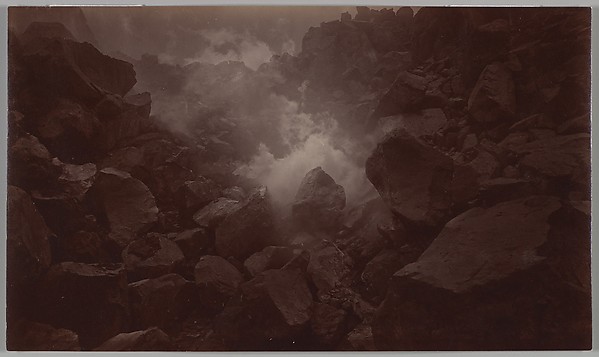
Acajutla
May one see it?
Not receiving at present

National Gallery of Art
Washington, D.C., United States
It belongs to the collection, but is not on display at present.
- Checked
- 3 days ago
- In this state since
- Aug 19, 2026
- Source
- The museum's own collection data
Particulars
- Accession number
- 2006.133.97
What it shows
In the catalog
Sources
- National Gallery of Art: the museum's own open data · fetched 3 days ago
- Image: National Gallery of Art — Museum open access
Meanwhile, in the life of Eadweard Muybridge
The whole lifeFebruary 1875
The murder trial: Muybridge is acquitted
Muybridge was tried for murder in February 1875; Stanford had arranged his defence, and the attorney W. W. Pendegast pleaded insanity because of the head injury of 1860, although the defendant himself indicated that his actions had been deliberate. The jury acquitted him as having committed justifiable homicide, explaining that if the verdict was not in accordance with the law, it was in accordance with the law of human nature.
after February 1875
Central America: nine months of “working exile”
Shortly after his acquittal Muybridge left on a previously planned nine-month photography trip to Central America, now acting as a “working exile”; in Guatemala he advertised his works under the name “Eduardo Santiago Muybridge”. It is believed that shooting aboard a constantly rolling ship helped him develop his ability to take pictures more rapidly.
June 1878
It is revealed when a galloping horse leaves the ground
The pictures showed that a running horse has all four hooves in the air at regular intervals, not with its legs extended to front and back, as illustrators imagined, but when its legs are collected beneath its body as it switches from “pulling” with the front legs to “pushing” with the back legs.
15 June 1878
A demonstration for the press: a snapping strap caught in frame
For the session of 15 June 1878 the press and a selection of turf men were invited; an accident with a snapping strap was captured on the negatives and shown to the attendees, convincing even the most skeptical witnesses. The news of this success was reported worldwide.
8 July 1878
First projection of his photographs at the San Francisco Art Association
The Daily Alta California reported that Muybridge first exhibited magic-lantern projections of his photographs at the San Francisco Art Association on 8 July 1878. Newspapers could not yet reproduce detailed photographs, so the images were widely printed as woodcut engravings, and six series were soon published as cabinet cards titled “The Horse in Motion”.
1879
24 cameras and a very limited-edition portfolio
In 1879 Muybridge continued his studies with 24 cameras and published a very limited-edition portfolio of the results.




![Scenes from the Passion of Christ: The Descent into Limbo [right panel], Andrea Vanni, 1380s](https://api.nga.gov/iiif/4205a539-eadd-4486-89a7-3cff9c1ba428/full/!2400,2400/0/default.jpg)


