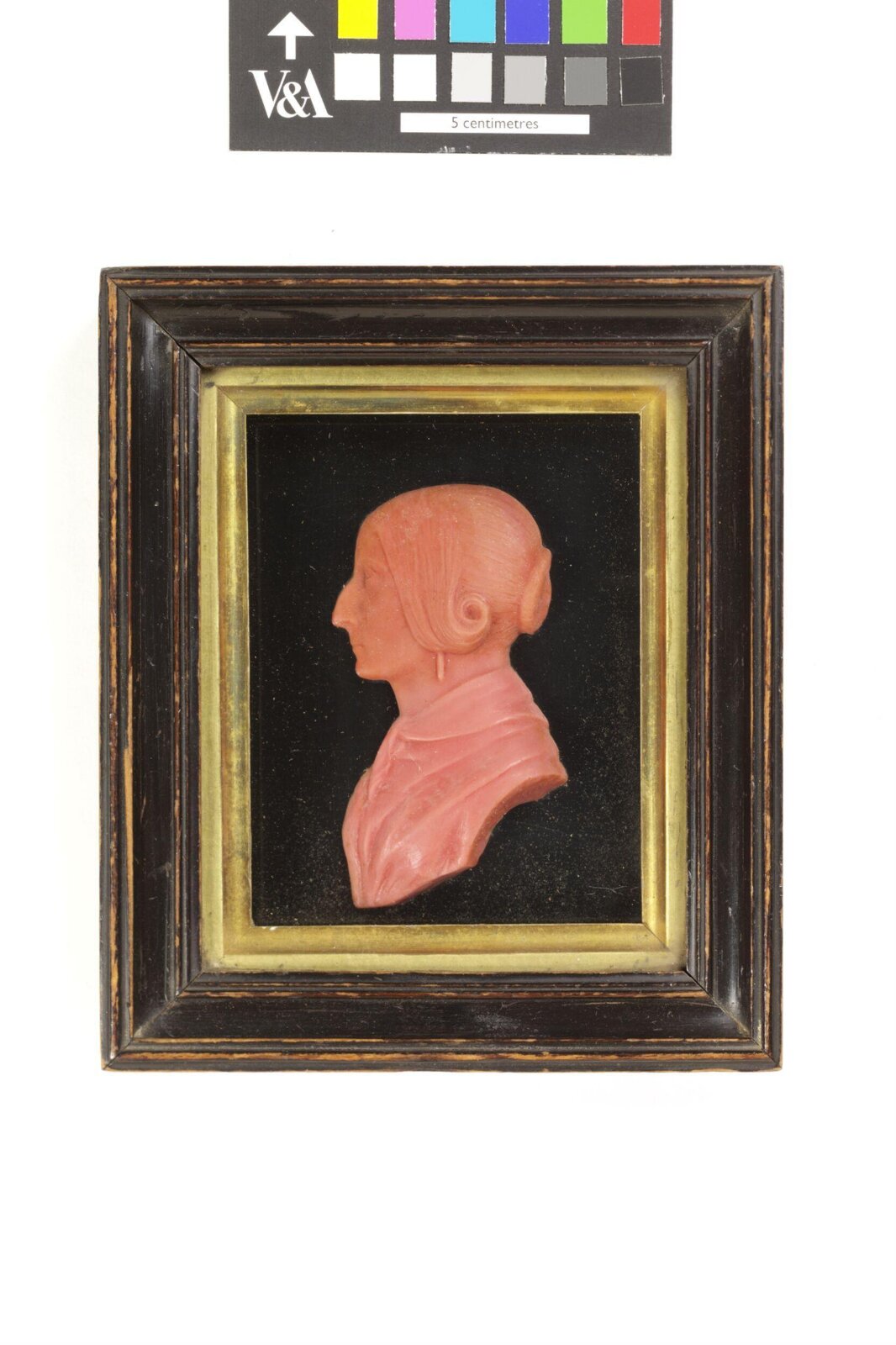
An Unknown Woman
May one see it?
Not receiving at present

Victoria and Albert Museum
London, United Kingdom
It belongs to the collection, but is not on display at present.
- Checked
- 7 days ago
- In this state since
- Sep 25, 2026
- Source
- The museum's own collection data
About the sculpture
This red wax portrait relief represents an unknown woman and is made in England in ca. 1840.
Wax is a cheap material, easily worked, as well as light and easily transportable. It is also intended as a kind of object of desire, covetable and collectible. It is the ideal kind of object for a Kunstkammer in that it is small and light enough to be held in the hand and passed from person to person, and that it is attractive to the eye. A famous sitter would also increase its attractiveness.
Read on
Wax is used as a sculpting material for preliminary models and for works in their own right. It is quick and easy to shape, yet also cheap. Once softened, it is modelled in a similar way to clay, with the composition built up gradually. To enhance the wax, pigment can be added before moulding and pearls or other jewels can be embedded in the surface afterwards. Wax was first used to make works of art, as opposed to models, in Italy around 1510. Later, Abondio became the first artist to make portrait medallions in wax.
Victoria and Albert Museum
Particulars
- Accession number
- A.25-1960
In the catalog
Sources
- Victoria and Albert Museum: the museum's own open data · fetched 7 days ago
- Image: Victoria and Albert Museum — © Victoria and Albert Museum, London