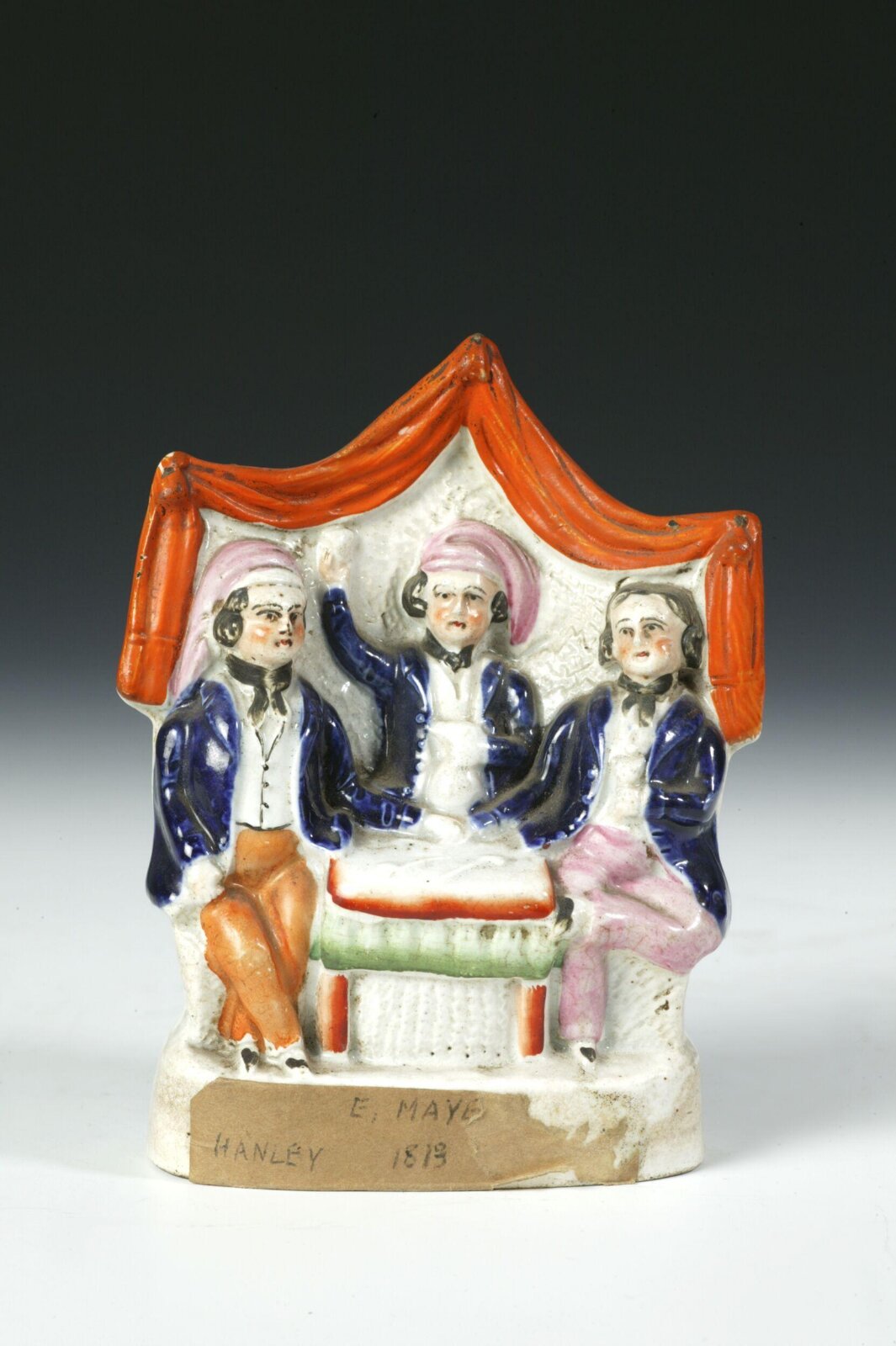
'Auld Lang Syne' figure group
May one see it?
Not receiving at present

Victoria and Albert Museum
London, United Kingdom
It belongs to the collection, but is not on display at present.
- Checked
- 7 days ago
- In this state since
- Sep 25, 2026
- Source
- The museum's own collection data
About the sculpture
This is a Staffordshire flat-back figure, a ceramic decoration given the name 'flat-back' because it was meant as a mantelpiece ornament and therefore had a flat, undecorated side which faced the wall. Flat-backs were simple and cheap to produce, needing only three moulds for a back, a front and a base. They were produced in vast quantities in the Staffordshire villages of Stoke, Fenton, Longton, Tunstall, Burslem, Hanley and Shelton, during the 19th century.
Read on
The inspiration for this figure group is taken from Robert Burns's poem Auld Lang Syne. This was a traditional Scottish song, sung for many years before the birth of Burns (1759-1796), but Burns kept the name and changed both the words and the melody. He wrote five verses but the first verse and the chorus are best known, traditionally sung in Scotland and other countries around the world to celebrate the passing of the old year and the beginning of the new. Various examples of this figure group were produced, all featuring three characters; some have a bottle on the table, and some, like this, have the central figure holding a jug or tankard.
Victoria and Albert Museum
Particulars
- Accession number
- S.903-1981
What it shows
In the catalog
Sources
- Victoria and Albert Museum: the museum's own open data · fetched 7 days ago
- Image: Victoria and Albert Museum — © Victoria and Albert Museum, London