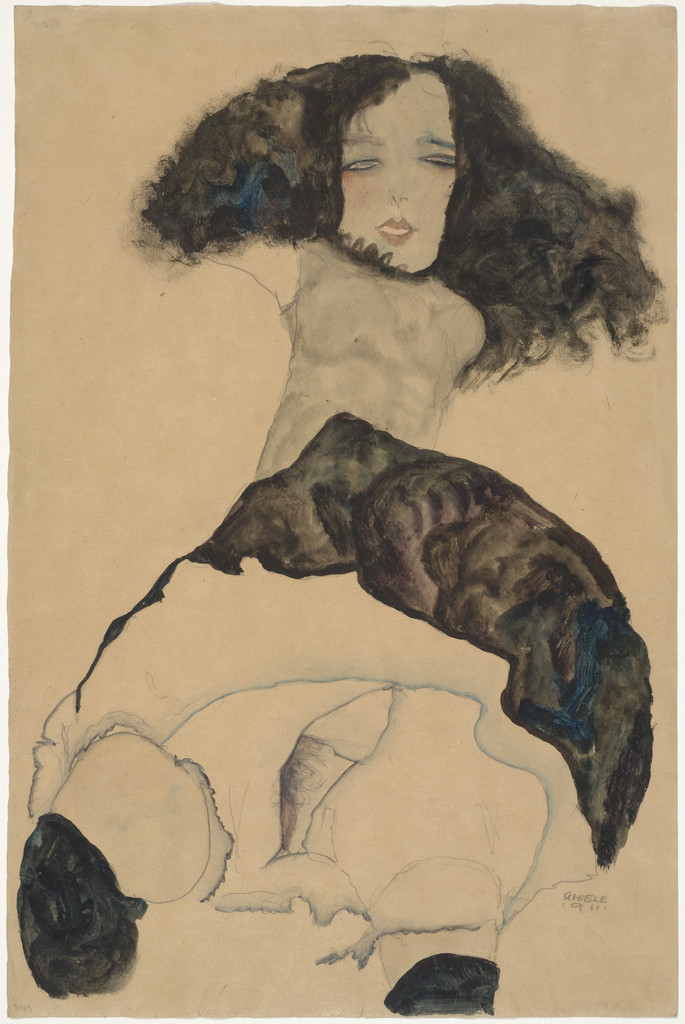
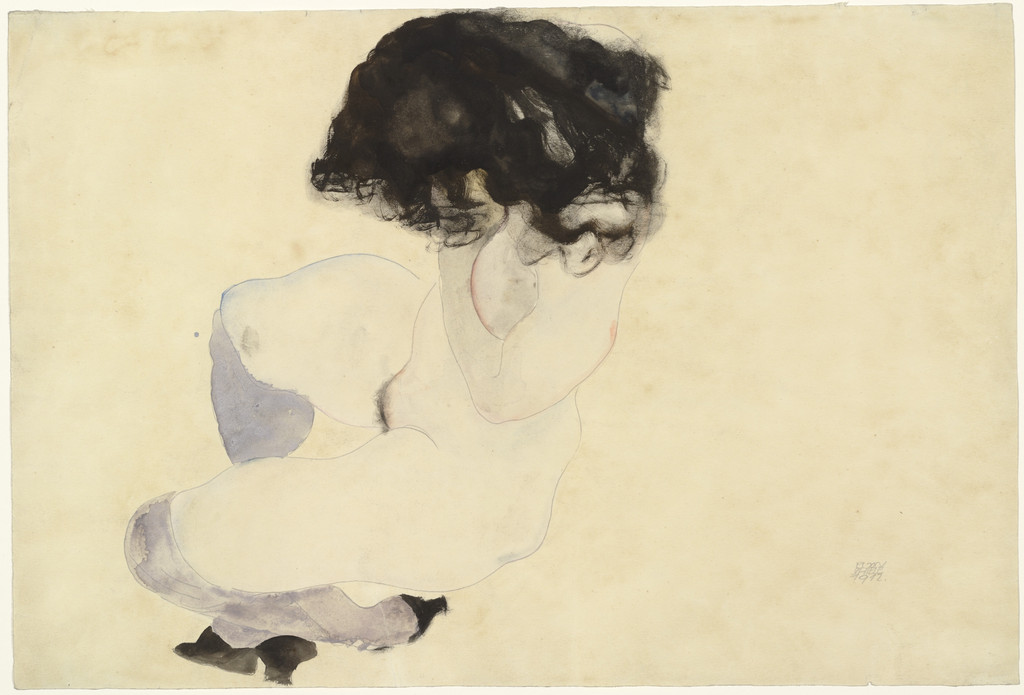
Egon SchieleAustrian, 1890–1918
Buch mit Opernglas
May one see it?
Unknown: the museum keeps its counsel

Albertina
Vienna, Austria
The owner is known. Whether it is on view today, the museum does not say, and we were not trained to guess.
- In this state since
- Sep 27, 2026
- Source
- The museum's own collection data
Particulars
Sources
- Albertina: the museum's own open data · fetched 3 days ago
- Image: Albertina — Public Domain Mark 1.0
Meanwhile, in the life of Egon Schiele
The whole lifec. 1905
His father’s death and the family’s ruin
When Schiele was 14 his father died of syphilis, and the family, which had been fairly wealthy, was left impoverished: before his death the father, in a fit of insanity, had burned the railway stocks that would have supported them. His elder sister Melanie, hired as a ticket clerk at the local station, became the sole breadwinner.
after 1905
His uncle Czihaczek’s guardianship and the tutor Strauch
Schiele and his sister Gerti became wards of Leopold Czihaczek, the husband of their aunt and also a railway official: he wanted his nephew to follow in his footsteps but, recognising Schiele’s talent for drawing, allowed him a tutor, the artist Ludwig Karl Strauch. Later the uncle renounced his guardianship and Schiele depended on his mother’s support until it was cut off because his sister Melanie objected to the expense, which caused a rift in the family.
1906
The School of Arts and Crafts, then the Academy
In 1906 Schiele entered the Kunstgewerbeschule (School of Arts and Crafts) in Vienna, where Gustav Klimt had once studied, and tried his hand at sculpture, making small clay and plaster pieces; within his first year, at the insistence of several faculty members, he was sent to the more traditional Academy of Fine Arts.
1906–1909
The Academy: the strict Griepenkerl
Schiele’s main teacher at the Academy was Christian Griepenkerl, a painter whose strict doctrine and ultra-conservative style frustrated and dissatisfied Schiele so much that he left after three years.
1907
Gustav Klimt: mentor and patron
In 1907 Schiele sought out Gustav Klimt, who generously mentored younger artists: Klimt bought his drawings, offered to exchange them for some of his own, arranged models for him and introduced him to potential patrons and to the Wiener Werkstätte. Schiele’s earliest works of 1907–1909 show strong similarities with Klimt’s, as well as influences from Art Nouveau.