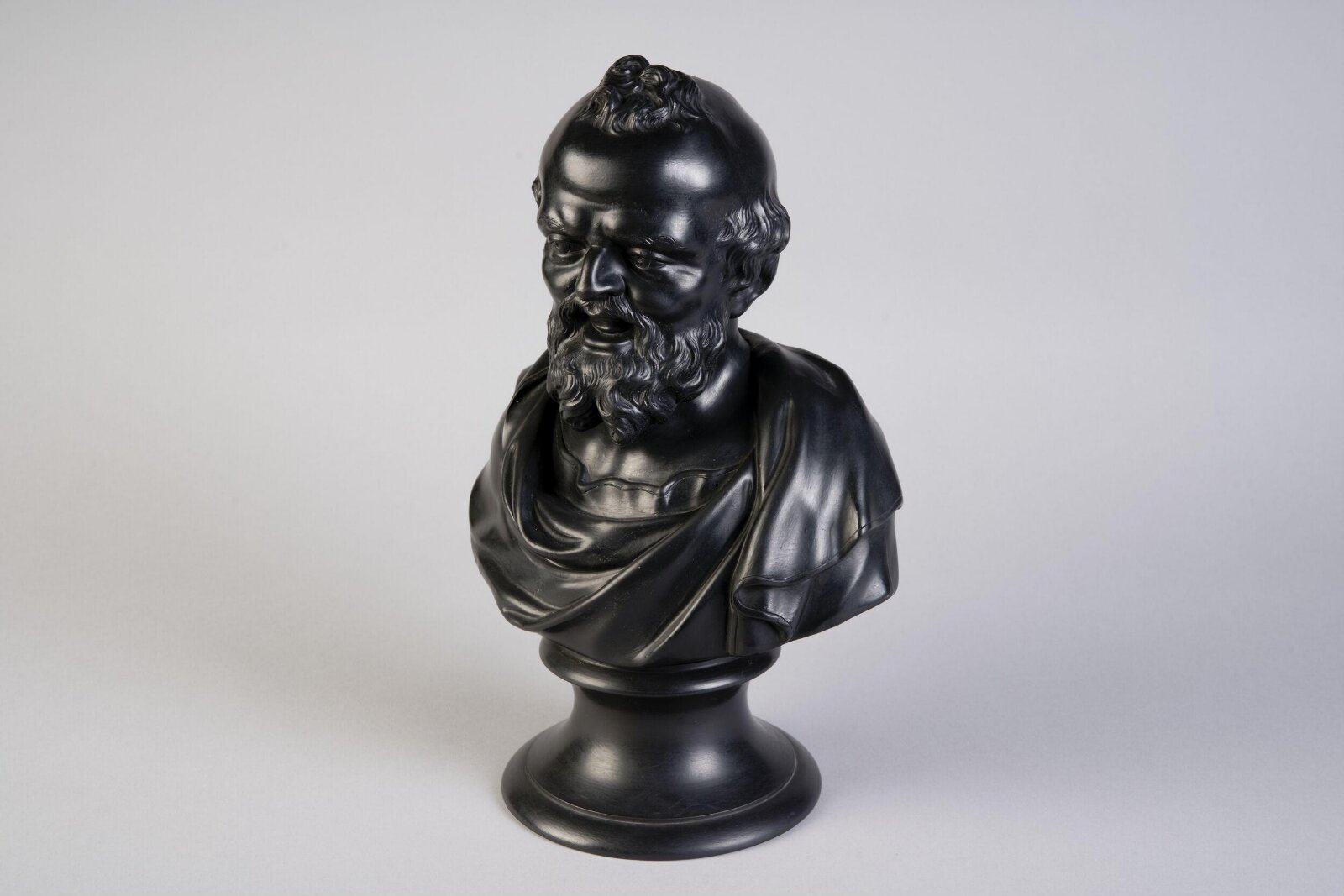
Bust
May one see it?
Unknown: the museum keeps its counsel

Victoria and Albert Museum
London, United Kingdom
The owner is known. Whether it is on view today, the museum does not say, and we were not trained to guess.
- In this state since
- Sep 25, 2026
- Source
- The museum's own collection data
About the sculpture
Socrates (469-399 B.C) was a celebrated Greek philosopher born in Athens, the son of a sculptor who was trained in that profession. He was exceedingly influential and taught people by asking a series of carefully framed questions. He became so influential that in 399 B.C he was accused of corrupting the youth of Athens and trying to replace the divinities of the State with his own. He was sentenced to death, and died by drinking a cup of hemlock. This black basalt bust was cast from a bust supplied by Hoskins & Grant in 1775. Hoskins & Grant, earlier known as Hoskins & Oliver, supplied Wedgwood with both plaster moulds and casts of figures and busts until 1779. Black basalt was a black stoneware first introduced in 1768 by Josiah Wedgwood I (1730-95). It is a fine grained black stoneware, composed of ball clay, calcined ochre and manganese oxide.
Read on
It was developed by Josiah I as an improvement of the earlier ‘Black Egyptian’ ware produced in Staffordshire in the mid 18th century. Wedgwood said of his newly refined black basalt body that ‘the Black is Sterling and will last forever’. Ornamental wares became a popular feature of Georgian country house décor during the neo-classical movement of the mid to late 18th century. Contemporaries in Britain increasingly sought to decorate their houses in a style that emulated the classics and ancients of Greek and Rome in an attempt to reflect their own highly educated status. Josiah and business partner Thomas Bentley (1730-80) sought to take advantage of this trend, producing ornamental busts depicting Greek philosophers like Socrates in the neo-classical style. Josiah and business partner Thomas Bentley (1730-80) produced ornamental wares in partnership as 'Wedgwood & Bentley' from 1767 to 1780.
Victoria and Albert Museum
Particulars
- Accession number
- WE.7750-2014
Sources
- Victoria and Albert Museum: the museum's own open data · fetched 3 days ago
- Image: Victoria and Albert Museum — © Victoria and Albert Museum, London