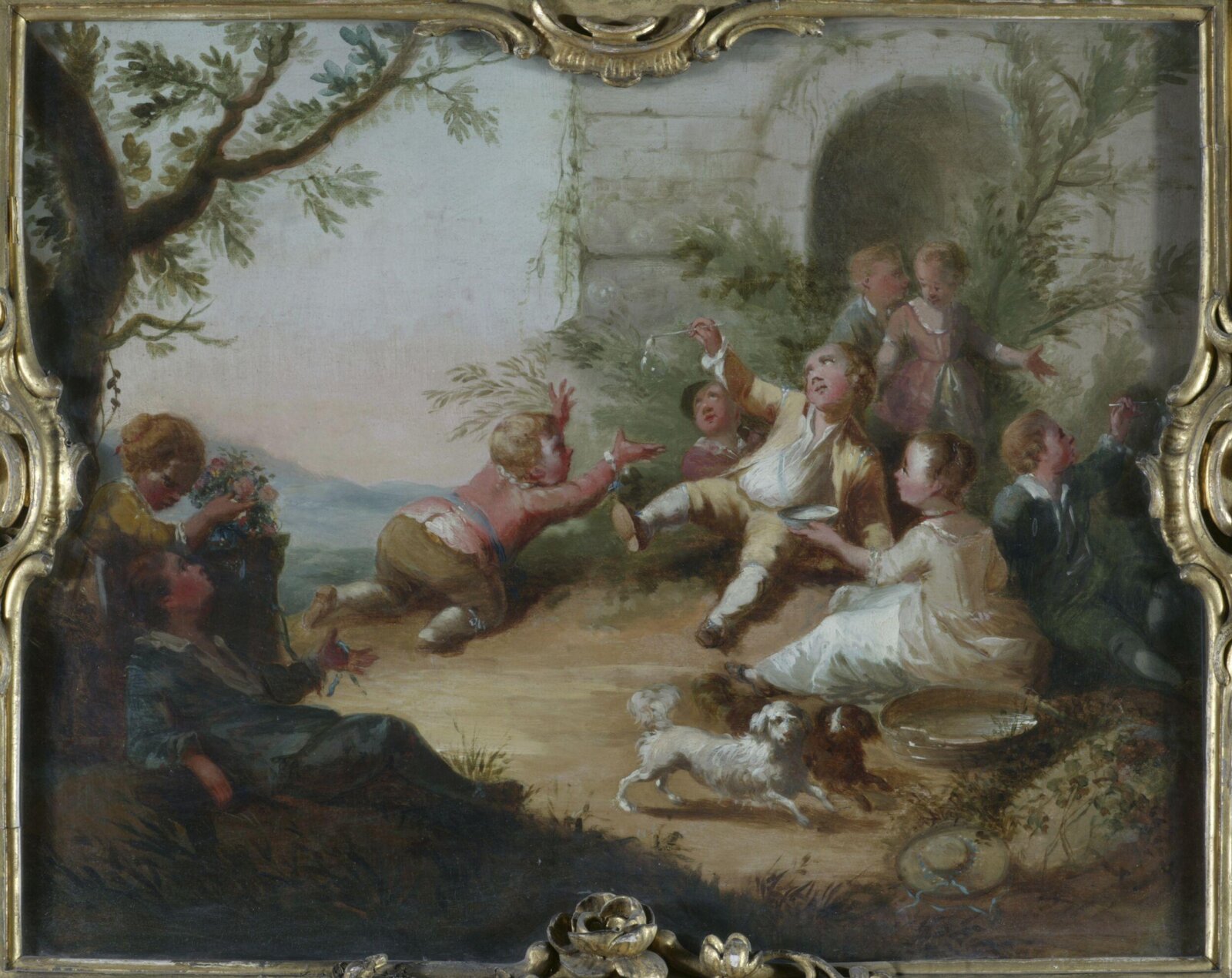
Children blowing bubbles
May one see it?
Not receiving at present

Victoria and Albert Museum
London, United Kingdom
It belongs to the collection, but is not on display at present.
- Checked
- 7 days ago
- In this state since
- Sep 25, 2026
- Source
- The museum's own collection data
About the painting
Originally thought to be French, 570-1882 has subsequently been reattributed to the Italian School based on its poplar support -a wood most commonly used on the peninsula while oak was used in the North. The subject derives from the Dutch 17th century Genre and Vanitas traditions such as Caspar Netscher's Two Boys Blowing Bubbles ca. 1670 (London, National Gallery). Children blowing bubbles are often a symbol of the transience of human life according to the ancient motto 'homo bulla' (man is a bubble). The motto was reintroduced in the sixteenth century by the Dutch philosopher Erasmus in his “Adagia”, a collection of sayings published in 1572. As bubbles are are fragile and have a brief moment of beauty before they burst, artists painted children blowing bubbles to convey the brevity of human life, the transience of beauty and the inevitability of death, sometimes making the sentiment more explicit through the inclusion of skulls or a snuffed out candle.
Read on
570-1882 brings the tradition into the next century in a scene purporting to be all about lightness and frivolity as the children play unawares in an arcadian lanscape replete with flowers, ribbons, little dogs and sunshine; the crumbling ruin in the background however alludes to the passing of time. The blonde-pastel palette used seems to reinforce this sense of lightness and play and recalls contemporary French and Swiss works such as Jean-Etienne Liotard's (1702-1789) painting Children blowing bubbles which uses similar palette of blues, pale pinks whites and grey.
Victoria and Albert Museum
Particulars
- Accession number
- 570-1882
What it shows
In the catalog
Sources
- Victoria and Albert Museum: the museum's own open data · fetched 7 days ago
- Image: Victoria and Albert Museum — © Victoria and Albert Museum, London