Honoré Gonon
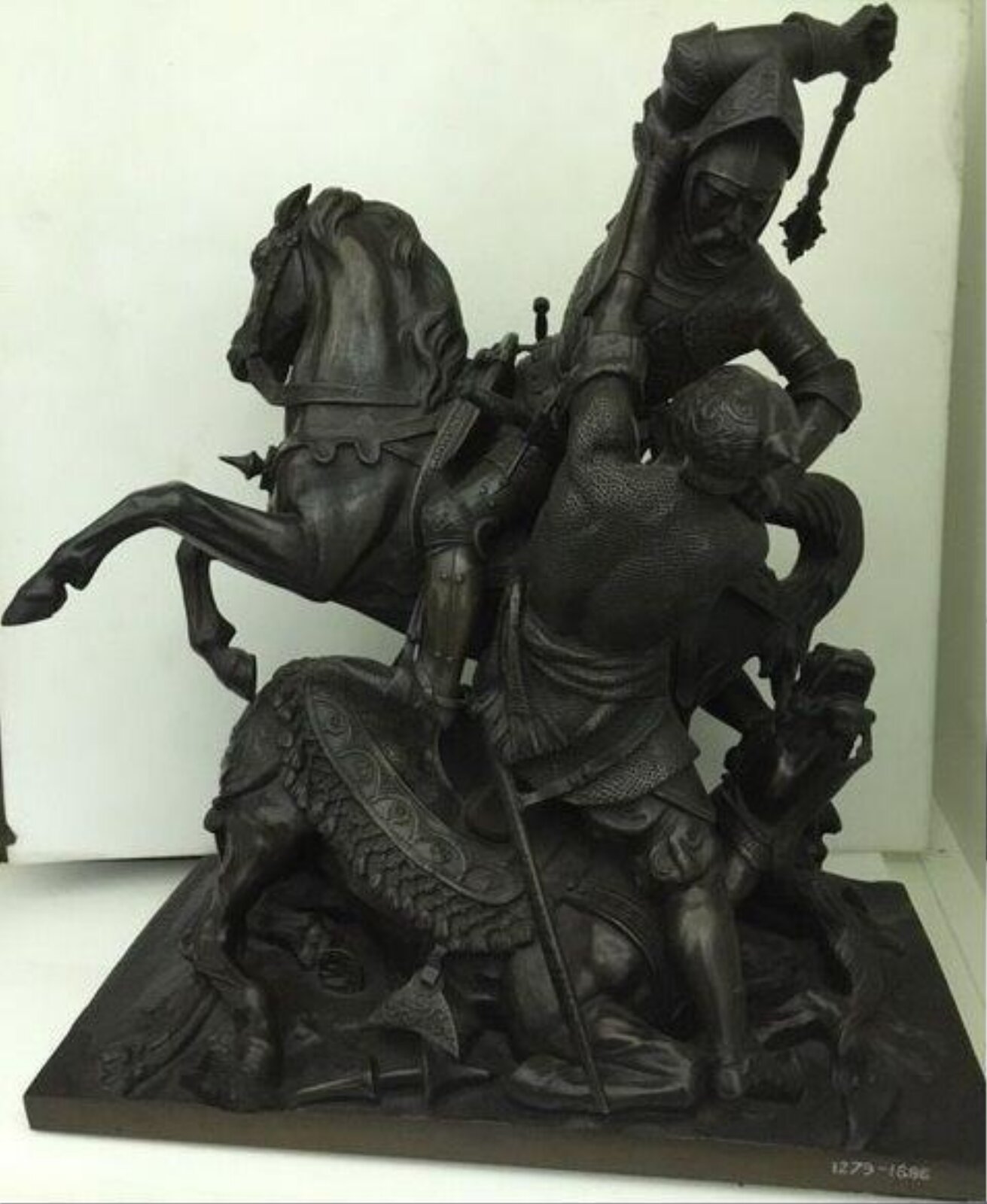
Combat between two mounted knights
May one see it?
Not receiving at present

Victoria and Albert Museum
London, United Kingdom
It belongs to the collection, but is not on display at present.
- Checked
- 7 days ago
- In this state since
- Sep 25, 2026
- Source
- The museum's own collection data
About the sculpture
Théodore Gechter exhibited ‘Combat de Charles Martel et d’Abdérame, roi des Sarrasins’ in plaster at the Salon in 1833 (no 2589). He was commissioned to cast this in bronze by the Ministry of Commerce and Industry, and this was cast with the lost wax technique by H. Gonon et his two sons in 1833 (sculpture now at the Louvre Museum, Paris, ref. ENT.1991.11, h. 0.62m; l. 0.54m). This V&A bronze is a version of the Louvre sculpture.
Read on
The subject is taken from the Battle of Tours (aka Battle of Poitiers), fought on October 10, 732 between forces under the Frankish leader Charles Martel and a massive invading Islamic army led by Emir Abdul Rahman Al Ghafiqi Abd al Rahman. The Franks were victorious and Emir Abd er Rahman was killed. The importance of the battle is debated but in the 19th century it was firmly seen as decisive in halting the northward advance of Islam from Spain, and preserving Christianity as the controlling faith in Europe. The final combat between the leaders had great appeal for Gechter with his tendency for a Romantic depiction of historical events.
Trained in the conventions of Neoclassical sculpture, Théodore Gechter later rejected 'ideal' subjects in this style for bronze groups illustrating medieval and particularly chivalrous themes in a dramatic and romantic manner. During this period interest in such subjects was reflected in the collecting of medieval sculpture in France. He also produced bronzes of animals during the 1830s. Gechter exhibited in Paris 1824-40 and collaborated in the execution of friezes for the Arc de Triomphe, the major public sculpture project of the decade, sculpting a large-scale relief of the Battle of Austerlitz (for which he was awarded the Legion d’Honneur).
Victoria and Albert Museum
Particulars
- Accession number
- 1279-1886
What it shows
In the catalog
Sources
- Victoria and Albert Museum: the museum's own open data · fetched 7 days ago
- Image: Victoria and Albert Museum — © Victoria and Albert Museum, London