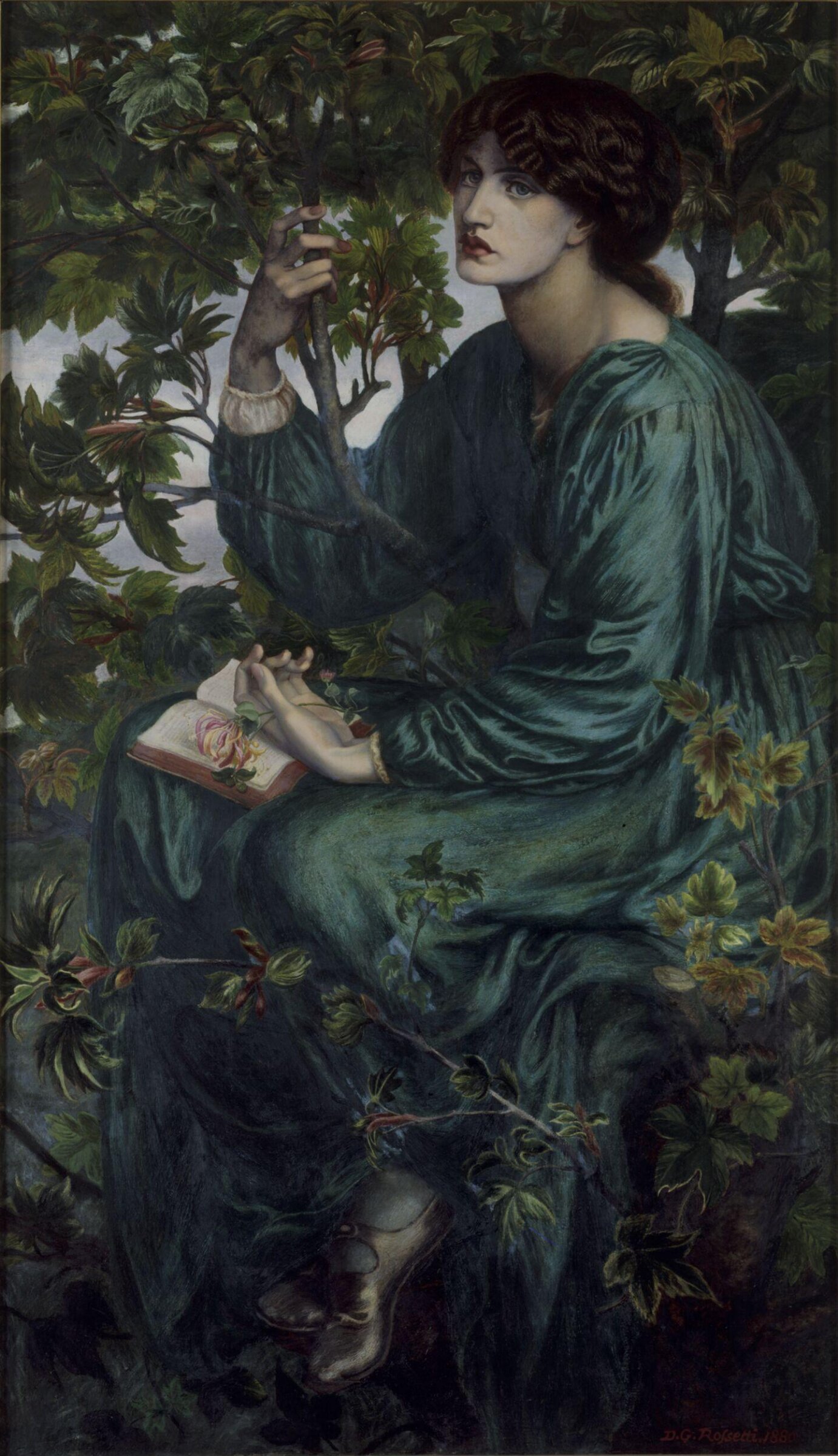
Dante Gabriel RossettiEnglish, 1828–1882
Dantis Amor
May one see it?
Unknown: the museum keeps its counsel

The National Gallery
London, United Kingdom
The owner is known. Whether it is on view today, the museum does not say, and we were not trained to guess.
- In this state since
- Sep 29, 2026
- Source
- The museum's own collection data
Particulars
- Accession number
- NG3532
Sources
- Wikidata · fetched 3 days ago
- Image: The National Gallery — Dante Gabriel Rossetti · Public domain · Wikimedia Commons
Meanwhile, in the life of Dante Gabriel Rossetti
The whole life1850s
A new watercolour and pen-and-ink technique
Translations of Italian poetry and Malory’s “Le Morte d’Arthur” inspired Rossetti’s art of the 1850s: he created a method of painting in watercolours with thick pigments mixed with gum to give rich effects like medieval illuminations, and developed a novel pen-and-ink drawing technique.
c. 1860
A new course: powerful close-ups of women
Around 1860 Rossetti returned to oil painting, abandoning the dense medieval compositions of the 1850s in favour of powerful close-up images of women in flat pictorial spaces of dense colour; these drew not on medievalism but on the Venetian High Renaissance artists Titian and Veronese, and became a major influence on European Symbolism.
23 May 1860
Married: Elizabeth Siddal
1861
Founding partner of Morris, Marshall, Faulkner & Co.
In 1861 Rossetti, together with Morris, Burne-Jones, Ford Madox Brown, Philip Webb, Charles Faulkner and Peter Paul Marshall, became a founding partner of the decorative arts firm Morris, Marshall, Faulkner & Co., contributing designs for stained glass and other decorative objects.
May 1861
A stillborn child
In May 1861 Elizabeth gave birth to a stillborn child; her health was finally broken and she began to take laudanum in large quantities.
11 February 1862
Death of Elizabeth Siddal and his manuscripts in her grave
On 11 February 1862, two years after the wedding, Elizabeth Siddal died of an overdose of laudanum, the alcoholic tincture of opium; Rossetti sank ever deeper into depression and, when she was buried at Highgate Cemetery, interred the bulk of his unpublished poems with her, though he later had them dug up.