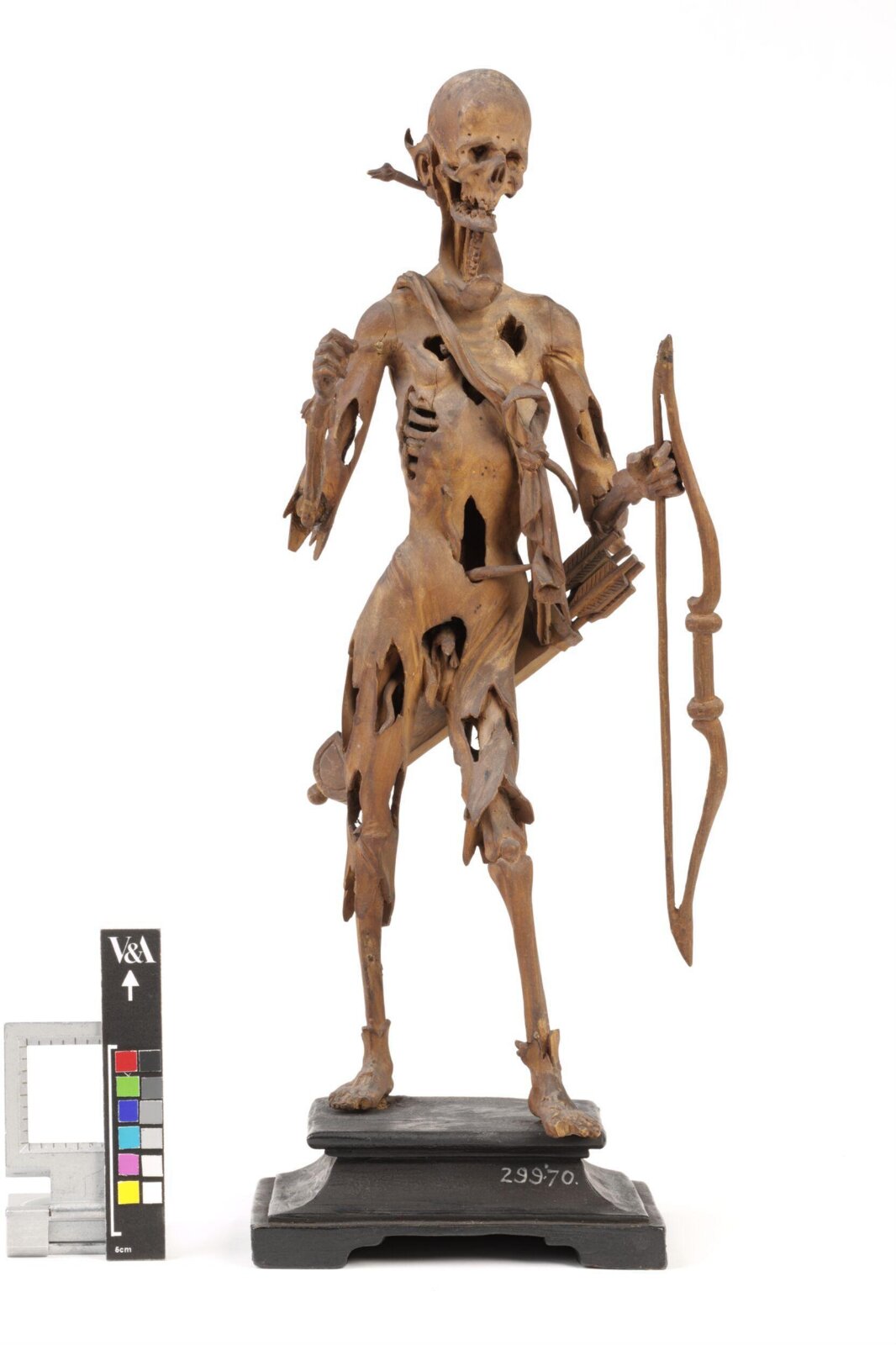
Death
May one see it?
Yes, receiving visitors

Victoria and Albert Museum
RoomSculpture, Room 111, The Gilbert Bayes GalleryLondon, United Kingdom
On public display.
- Checked
- 7 days ago
- In this state since
- Sep 25, 2026
- Source
- The museum's own collection data
About the sculpture
This is a limewood sculpture, representing Death, made in Bavaria in about 1670. This skeleton-figure, a remembrance of death (memento mori) was a subject frequently represented in small-scale sculptures, which were displayed in cabinets of curiosities from the sixteenth century onward. The virtuoso carving of the wood was also characteristic of such pieces.
The techniques used in carving in wood and stone were fundamentally the same. First the sculptor carved the rough shape of the piece, a process known as 'blocking out'. Then, he would work the surface with knives or chisels and abrasives. The figure was generally held horizontally at a workbench and attached to cylindrical shafts, so the sculptor could turn the piece as he carved. Small-scale pieces were generally carved at a workbench.
Read on
Before the 15th century people would have considered an unpainted sculpture to be unfinished. But around 1460 wood-carvers in northern Europe began to leave their work deliberately undecorated, as with the skilfully carved figure here. It is not certain why they did this.
Victoria and Albert Museum
Particulars
- Accession number
- 299-1870
What it shows
In the catalog
Sources
- Victoria and Albert Museum: the museum's own open data · fetched 7 days ago
- Image: Victoria and Albert Museum — © Victoria and Albert Museum, London