 William ChambersScottish, 1723–1796
Drawing
May one see it?
Not receiving at present

Victoria and Albert Museum
London, United Kingdom
It belongs to the collection, but is not on display at present.
- Checked
- 7 days ago
- In this state since
- Sep 25, 2026
- Source
- The museum's own collection data
About the work
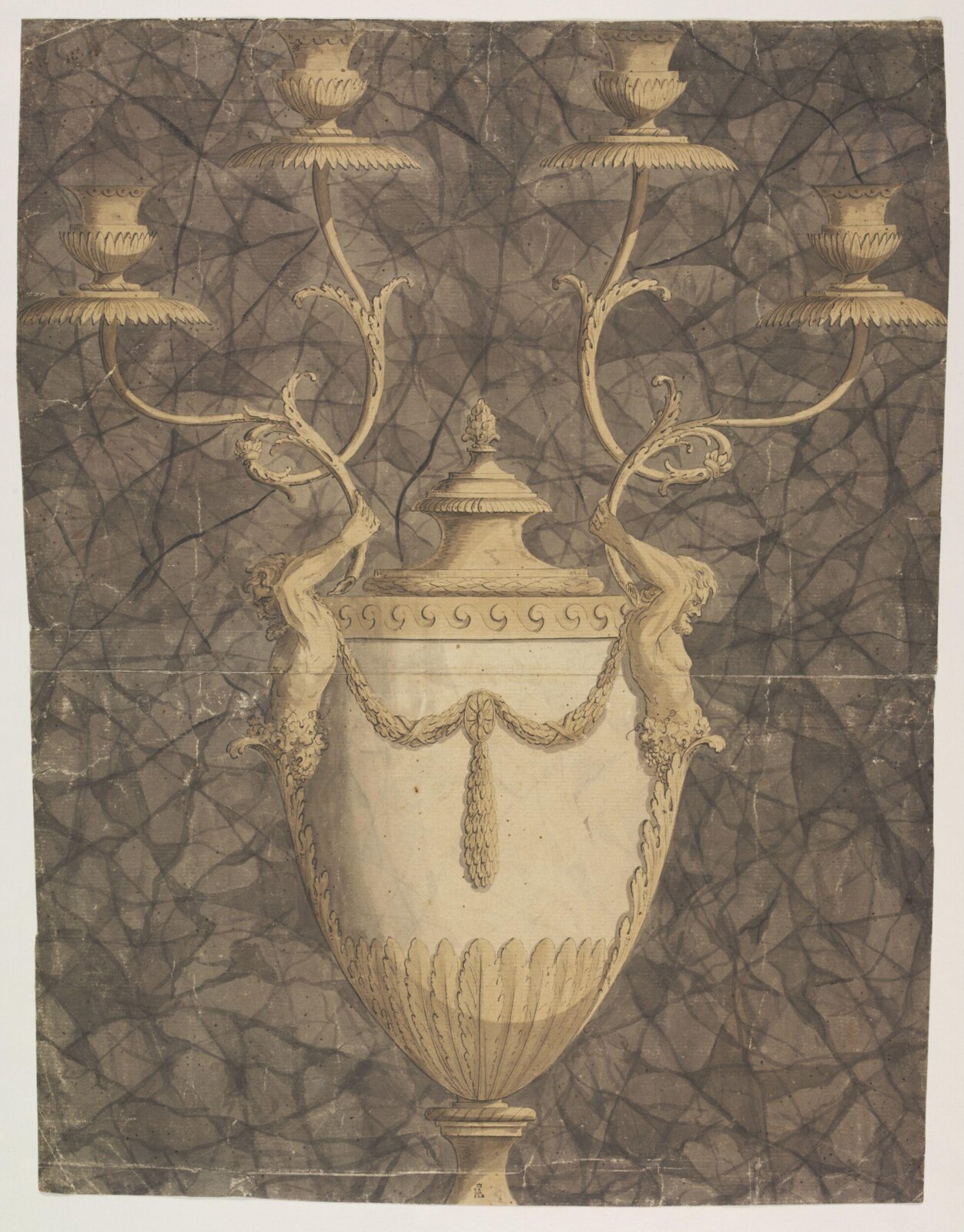
Elevation of a candle vase by John Yenn, office of the leading architect and designer Sir William Chambers (1723-1796). In 1770, Matthew Boulton was commissioned by King George III to make at least two pairs of ormolu-mounted blue-john vases. Chambers designed them and they were completed in 1770-1771. This drawing shows the vase design process at an early stage, there being many differences between this and the finished examples. It has been roughly trimmed, but the high level of finish suggests that the drawing might be one of the ‘Various vases, etc. to be executed in ormolu, by Mr Boulton, for their Majesties’ that Chambers exhibited at The Royal Academy in 1770. The vase is shown against a dark-veined marbled background. The lower part of the stand has been trimmed off. It is clear that this drawing, which has come down to us as finished presentation drawings by the young John Yenn, is Chambers’s conception.
Read on
Chambers was born in Sweden and died in London. He travelled widely, visiting China, and studied architecture at the Ecole des Arts, Paris, from 1749 and in Italy from 1750 to 1755. Many of his drawings from this period are contained in his important 'Franco-Italian' album, held in the V&A. Chambers moved to London in 1755 and published his influential Treatise on Civil Architecture in 1759. Chambers demonstrated the breadth of his style in buildings such as Gower (later Carrington) House and Melbourne House, London, in such country houses as Duddingston, Scotland, and in the garden architecture he designed for Wilton House, Wiltshire, and at Kew Gardens. He became head of government building in 1782, and in this capacity built Somerset House, London.
Victoria and Albert Museum
Particulars
- Accession number
- 3436:408
What it shows
In the catalog
Sources
- Victoria and Albert Museum: the museum's own open data · fetched 7 days ago
- Image: Victoria and Albert Museum — © Victoria and Albert Museum, London