 Andy WarholAmerican, 1928–1987
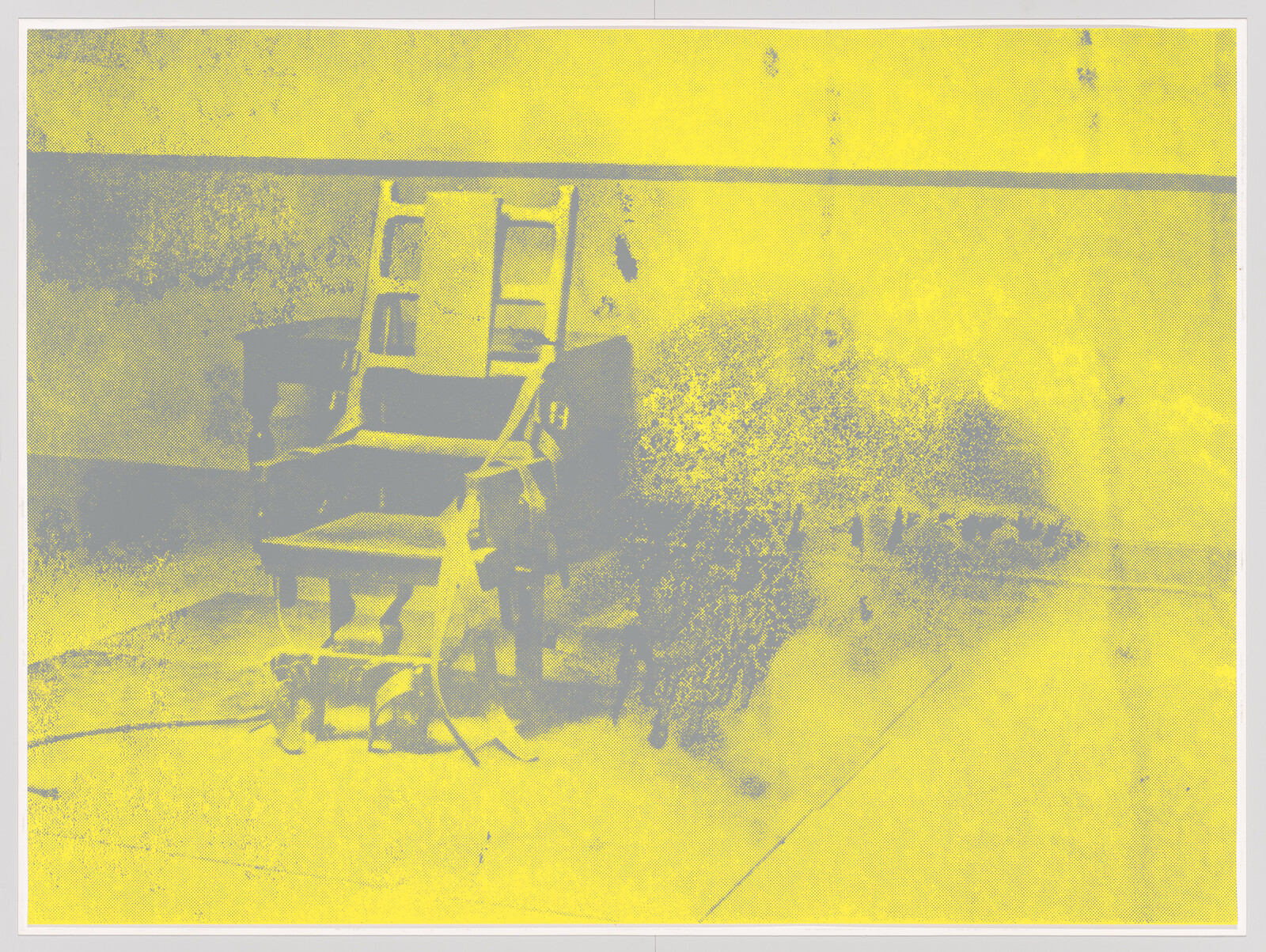
Electric Chair
May one see it?
Not receiving at present

Whitney Museum of American Art
New York, United States
It belongs to the collection, but is not on display at present.
- Checked
- 7 days ago
- Source
- The museum's own collection data
Particulars
- Accession number
- 73.92.1
Sources
- Whitney Museum of American Art: the museum's own open data · fetched 7 days ago
- Image: Whitney Museum of American Art — © the artist or rights holder
Meanwhile, in the life of Andy Warhol
The whole lifeautumn 1969
Founding Interview magazine
Together with the British journalist John Wilcock, Warhol founded Interview magazine, at first published as inter/VIEW: A Monthly Film Journal. It was revamped a few years later and came to reflect Warhol's social life and fascination with celebrity.
1969
Complications after a second operation
Complications after a second operation left Warhol's abdominal muscles improperly repaired, and he had to wear a surgical corset so that his stomach would not distend when he ate.
May 1969
Polaroid as a convalescence diary
Warhol used a Polaroid camera to document his recovery after the shooting; a few of the photographs appeared in Esquire in May 1969. He later became well known for always carrying his Polaroid, and when he resumed painting in the 1970s he made instant photographs the basis of his silkscreen portraits.
1970–1971
The retrospective from Pasadena to the Whitney
In 1970 the Pasadena Art Museum organised a Warhol retrospective that travelled on to Chicago, Eindhoven, Paris, London and, in 1971, the Whitney Museum in New York. At the Whitney the Cow wallpaper (1966) served as the backdrop for the paintings.
c. 1971 – 1974
More and more often in Paris
Warhol began travelling to Europe more often and grew especially fond of Paris after filming L'Amour (1972); he kept an apartment on the Left Bank, on Rue du Cherche-Midi, shared with Fred Hughes. In Paris his circle socialised with Karl Lagerfeld, Yves Saint Laurent, Loulou de la Falaise and Paloma Picasso.
1973
Diagnosis: a gallstone
In 1973 Warhol was diagnosed with a gallstone but adamantly refused surgery because he feared hospitals. His physician Denton Cox tried to obtain an experimental medication from Japan, while a chiropractor and a nutritionist suggested he wear a small crystal.

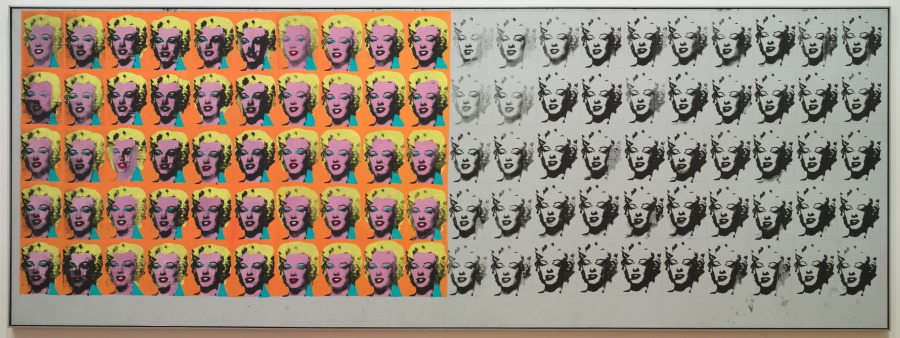
![Liz #3 [Early Colored Liz], Andy Warhol, 1963](/api/img?u=https%3A%2F%2Fwww.artic.edu%2Fiiif%2F2%2F362c0c2a-4576-2207-4ba9-2b87e6d0bad0%2Ffull%2F1200%2C%2F0%2Fdefault.jpg)