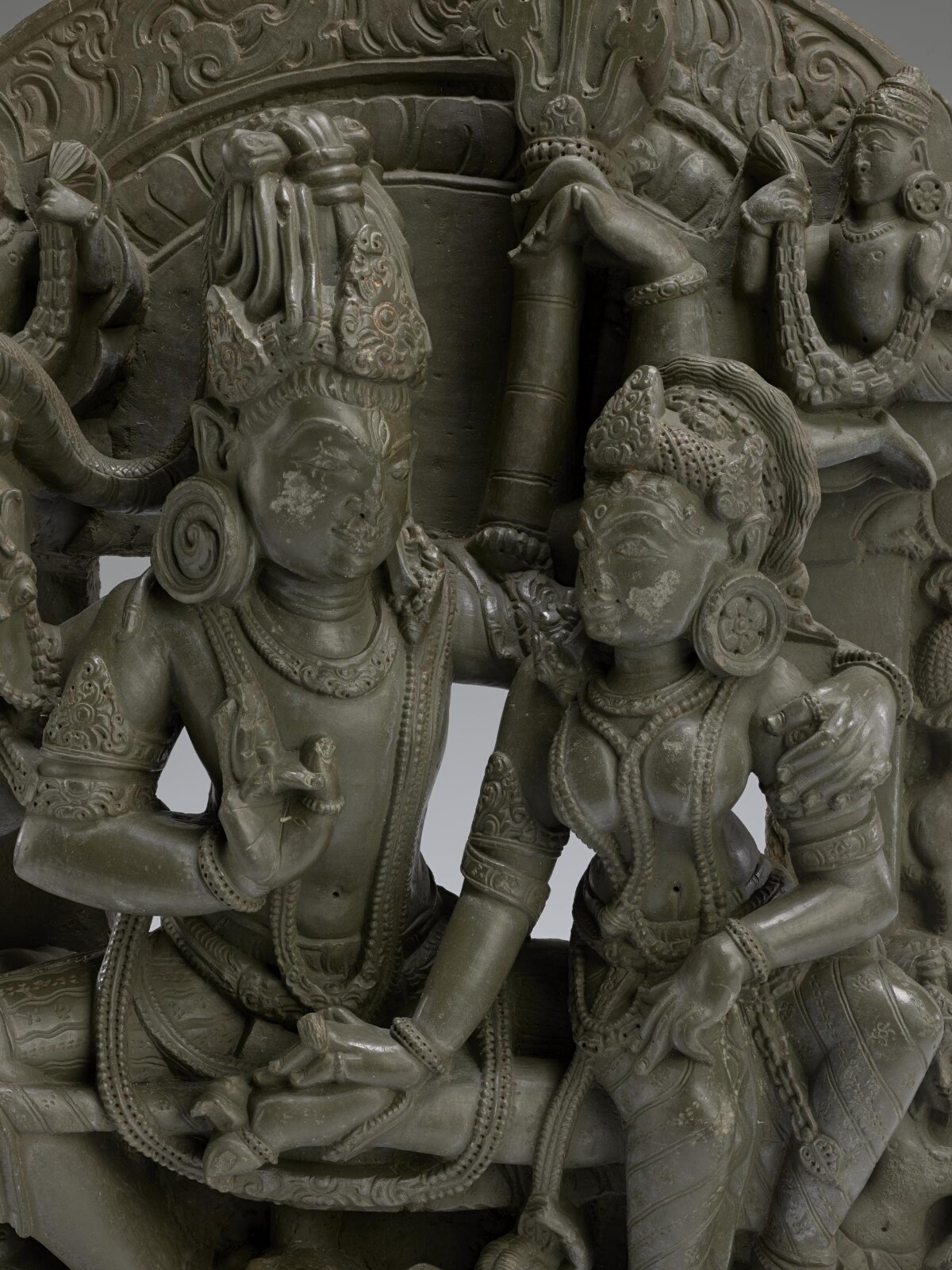
Figure group
May one see it?
Not receiving at present

Victoria and Albert Museum
London, United Kingdom
It belongs to the collection, but is not on display at present.
- Checked
- 7 days ago
- In this state since
- Sep 25, 2026
- Source
- The museum's own collection data
About the sculpture
Shiva and Parvati, with Shiva represented as Vyakhyana-Daksinamurti, the divine exponent of the shastras, seated together on a lotus throne. The divine couple embody in gesture and expression the tender ‘loving glance’ of the snigdha mood. In this form Shiva is the great exponent of the shastras, teaching the sages the meaning of yoga and jnana (knowledge). This subject was more popular in southern India than the north, and its specific appearance in 9th century northern Uttar Pradesh may be linked to the presence, at that time, of the great Tamil Saiva guru Sankara, who established a Hindu monastery (matha) at Joshimath, in Kumaon.
Read on
Shiva is seen seated in lalitasana, with a meditation cord (yogapatta) around his legs. With his lower hands he expounds the divine knowledge (vyakhyana-mudra) whilst embracing Parvati with the other; in his upper hands he holds a rosary (mala) and his weapon, the trisula. His pendant foot is supported by a lotus, beside which Nandi sits restfully. Parvati gently rests her extended hand on Shiva’s foot, whilst apparently pointing with the other to their son Kartikeya who tugs at her pendant belt. Her feet are supported by a lotus, her lion below her left foot. Both gods are richly bejewelled, including tripartite diadems, and wear finely patterned skirt-cloths.
Beneath the lotus-throne appear the dancing skeletal figure of Camunda, Kartikeya on his peacock, and a seated obese figure, now damaged, but probably representing their second son, Ganesha. The composition is filled with other attendant and laudatory figures, including leonine beasts and makara throne uprights supporting a framing prabha of exuberant scrolling foliage, further enlivened with garland-bearing devas. A diminutive kneeling female figure, partly concealed behind Parvati’s foot, may be accepted to represent the donor of this image. That a woman was the patron is not surprising – it is a remarkably skilfully conceived scene of intimate and tender domesticity.
Victoria and Albert Museum
Particulars
- Accession number
- IS.113-1986
What it shows
In the catalog
Sources
- Victoria and Albert Museum: the museum's own open data · fetched 7 days ago
- Image: Victoria and Albert Museum — © Victoria and Albert Museum, London