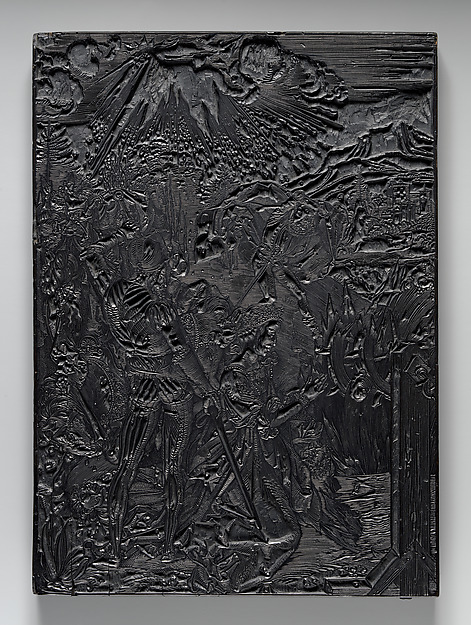
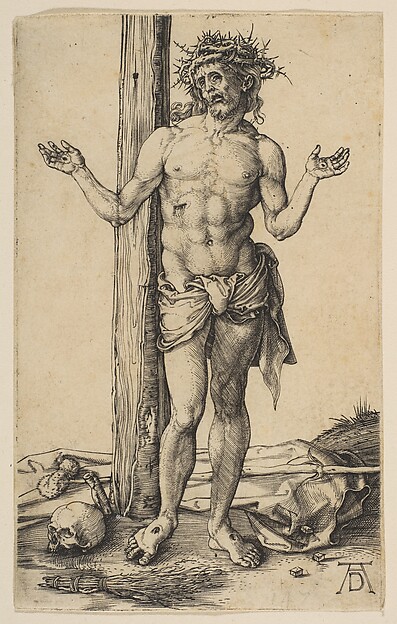
Albrecht DürerGerman, 1471–1528
Holy Trinity
May one see it?
Not receiving at present

Harvard Art Museums
Cambridge, United States
It belongs to the collection, but is not on display at present.
- Checked
- 3 days ago
- In this state since
- Sep 27, 2026
- Source
- The museum's own collection data
Particulars
- Accession number
- G6992
In the catalog
Sources
- Harvard Art Museums: the museum's own open data · fetched 3 days ago
- Image: Harvard Art Museums — © President and Fellows of Harvard College
Meanwhile, in the life of Albrecht Dürer
The whole life1507–1528 · Workplace
Nuremberg
1509
Elected to Nuremberg's Greater Council
Dürer was elected a nominated member of Nuremberg's Greater Council; in that role he may have taken part in the city's artistic projects.
1511
Paints the “Adoration of the Trinity”
For the Nuremberg merchant Matthäus Landauer, Dürer painted the Adoration of the Trinity altarpiece, devising its programme himself after Augustine's City of God. Yet fame did not change patrons' view of the painter as a craftsman: the Frankfurt merchant Jakob Heller fretted over the time spent on his Assumption of the Virgin, and the fee barely covered the materials.
1511
Publishes the Great Passion and the Life of the Virgin
Dürer published two woodcut series as books, the Great Passion and the Life of the Virgin, with a second edition of the Apocalypse and the 37 woodcuts of the Little Passion. His post-Venetian woodcuts developed chiaroscuro modelling.
1512
Emperor Maximilian I becomes his chief patron
From 1512 Emperor Maximilian I was Dürer's chief patron. For him Dürer and his workshop produced the Triumphal Arch, a giant woodcut 295 × 357 cm printed from 192 blocks and modelled on the triumphal arches of ancient Rome.
1513
Engraves “Knight, Death and the Devil”
The first of Dürer's three most famous engravings, probably inspired by Erasmus's Handbook of a Christian Knight.
![Madonna and Child [obverse], Albrecht Dürer, c. 1496/1499](https://api.nga.gov/iiif/878db7e6-10ae-4cae-ba5d-6d6f5c413ae8/full/!2400,2400/0/default.jpg)
![Lot and His Daughters [reverse], Albrecht Dürer, c. 1496/1499](https://api.nga.gov/iiif/7565a449-f82a-414b-9bda-c93f55a51b4d/full/!2400,2400/0/default.jpg)