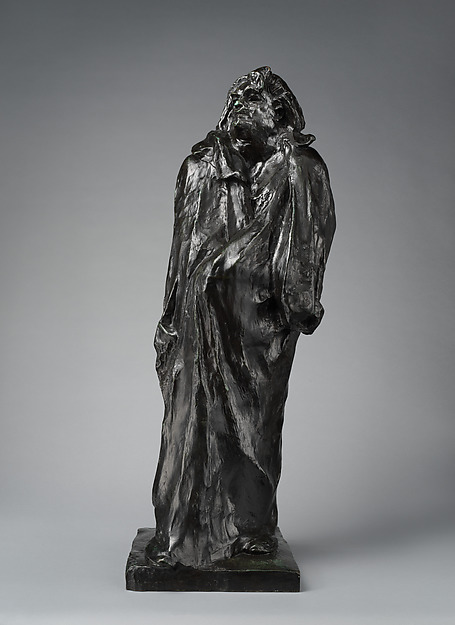
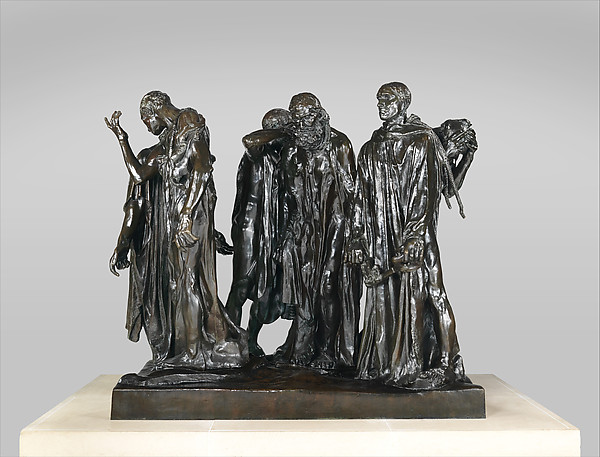
Auguste RodinFrench, 1840–1917
John the Baptist
May one see it?
Not receiving at present

Harvard Art Museums
Cambridge, United States
It belongs to the collection, but is not on display at present.
- Checked
- 3 days ago
- In this state since
- Sep 27, 2026
- Source
- The museum's own collection data
Particulars
- Accession number
- 1943.1147
In the catalog
Sources
- Harvard Art Museums: the museum's own open data · fetched 3 days ago
- Image: Harvard Art Museums — © President and Fellows of Harvard College
Meanwhile, in the life of Auguste Rodin
The whole life1875–1876
Italy: Michelangelo, Donatello and Reims
Having saved some money, Rodin travelled to Italy — Genoa, Florence, Rome, Naples and Venice — to study the Renaissance, above all Michelangelo and Donatello. On the way, at Reims, he first saw a Gothic cathedral, and the shock stayed with him for life.
1877
Back in Paris after six years in Belgium
Rodin and Rose settled in a small flat on the Left Bank; his mother was dead and his father blind and senile. Rodin's father and his eleven-year-old son Auguste, whom he had essentially abandoned for six years, moved in with the couple, and Rose looked after them.
1877–1878
Accused of casting “The Age of Bronze” from life
The figure looked so lifelike that Rodin was accused of casting it from a live model. He wrote to the newspapers, produced photographs of the model and demanded an inquiry, and a committee of sculptors cleared him; later many of his works were deliberately made larger or smaller than life.
1880
Receives the commission for “The Gates of Hell”
His first state commission was a sculptural portal for a planned Museum of Decorative Arts; with it Rodin received two studios on the Rue de l'Université. The museum was never built and “The Gates of Hell” remained unfinished: they were first cast in bronze after the master's death.
c. 1880 – 1881
Juliette Adam's salon and first recognition
Rodin was received at the salon of the writer Juliette Adam, where he was presented to Gambetta; Gambetta recommended him to Antonin Proust, the minister of fine arts, who bought “St. John the Baptist” for the state. It was the first recognition to reach a sculptor who was already forty.
1883
Meets Camille Claudel
Standing in for Alfred Boucher, who was away, Rodin supervised his students' course and met the eighteen-year-old Camille Claudel. She became his assistant, model, lover and creative rival.