
 Bernard, EmileFrench, 1868–1941
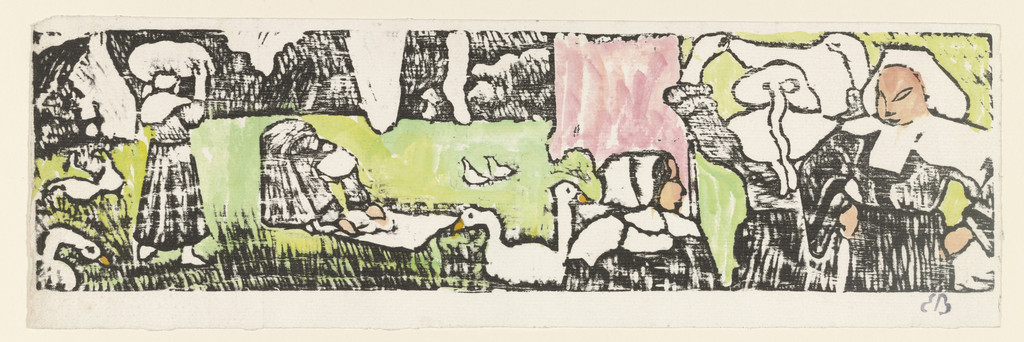
La Promenade
May one see it?
Not receiving at present

National Gallery of Art
Washington, D.C., United States
It belongs to the collection, but is not on display at present.
- Checked
- 3 days ago
- In this state since
- Aug 19, 2026
- Source
- The museum's own collection data
Particulars
- Accession number
- 1964.8.339
What it shows
In the catalog
Sources
- National Gallery of Art: the museum's own open data · fetched 3 days ago
- Image: National Gallery of Art — Museum open access
Meanwhile, in the life of Bernard, Emile
The whole lifeAugust 1886
First meeting with Gauguin in Pont-Aven
In August 1886 in Pont-Aven Bernard meets Gauguin for the first time; they exchange little about art but look forward to meeting again. Looking back, Bernard said his own talent was already fully developed, and he believed that his style played a considerable part in the development of Gauguin's mature style.
1887
Cloisonnism, developed together with Anquetin
In 1887 Bernard and Louis Anquetin develop cloisonnism — bold forms separated by dark contours; in the spring they “turn against Neo-Impressionism”. Many, however, credit Anquetin with the technique, and Bernard was probably also influenced by the works of Cézanne he had seen.
1887–1888
An exhibition in the restaurant on the Avenue de Clichy
Back in Paris, Bernard attends the Académie Julian and meets van Gogh, who is impressed by his work. He finds a restaurant on the Avenue de Clichy where his work is shown alongside that of van Gogh, Anquetin and Toulouse-Lautrec; van Gogh calls the group the “School of the Petit Boulevard”.
1888
On foot to Pont-Aven: friendship with Gauguin
A year later Bernard again sets out for Pont-Aven on foot and sees Gauguin; their friendship and artistic partnership quickly grow strong — Bernard wants an art of the most extreme simplicity, accessible to all and practised collectively, and Gauguin is impressed by his ability to put his ideas into words. Russian Wikipedia speaks of his living in Pont-Aven in 1886–1888 and joining the Pont-Aven group.
1890
A religious crisis and a turn to the Middle Ages
In 1890 Bernard goes through a religious crisis and turns to the subjects and themes of medieval art. In the same year he sets out to revive symbolism, which he saw as Christian in essence — the invisible expressed through the visible.
1891
The break with Gauguin
In 1891 Bernard breaks off his friendship with Gauguin. It was always his great frustration that Gauguin never named him as an influence on pictorial symbolism; one writer says his rivalry with Gauguin led him “out of spite” towards classicism.






![Scenes from the Passion of Christ: The Descent into Limbo [right panel], Andrea Vanni, 1380s](https://api.nga.gov/iiif/4205a539-eadd-4486-89a7-3cff9c1ba428/full/!2400,2400/0/default.jpg)


