 Auguste RodinFrench, 1840–1917
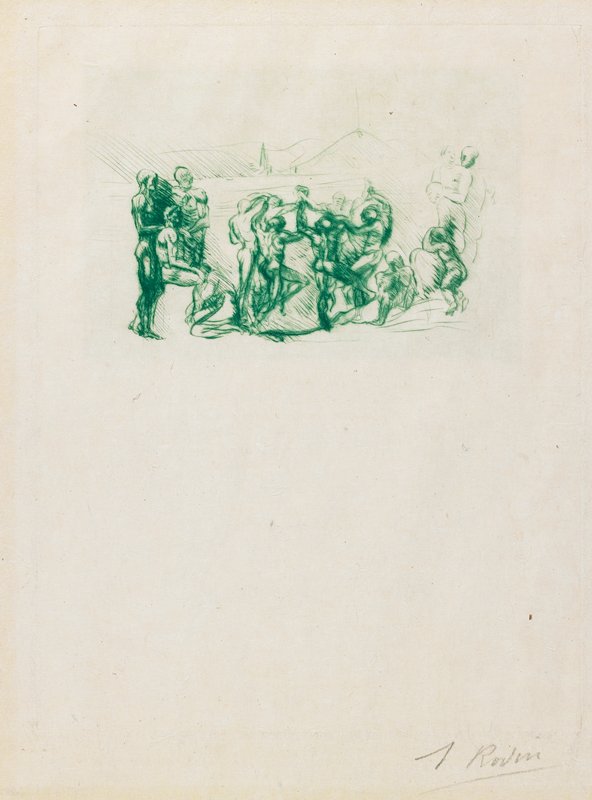
La Ronde
May one see it?
Not receiving at present

Minneapolis Institute of Art
Minneapolis, United States
It belongs to the collection, but is not on display at present.
- Checked
- 3 days ago
- In this state since
- Sep 25, 2026
- Source
- The museum's own collection data
About the work
Auguste Rodin got the feel of incising tools during a job decorating porcelain at the Sèvres factory. That likely led to experiments with drypoint, a process whereby tiny pools of ink are trapped in the furls of metal that are displaced by the etching needle. When the plate is inked and printed, the trapped ink produces soft, blurry lines, an effect that adds to the sense of movement in La Ronde. One of just twelve drypoints Rodin made, this print was novel in the 1880s for showing dancing nude men. Rodin's sculptural genius is apparent in the strong contours and muscular modeling. Scholars attribute the sober mood to the influence of Dante's Divine Comedy, which Rodin had been reading as background for his sculpture The Gates of Hell.
Minneapolis Institute of Art
Particulars
- Accession number
- P.3, 308
In the catalog
Sources
- Minneapolis Institute of Art: the museum's own open data · fetched 3 days ago
- Image: Minneapolis Institute of Art — public domain
Meanwhile, in the life of Auguste Rodin
The whole lifec. 1880 – 1881
Juliette Adam's salon and first recognition
Rodin was received at the salon of the writer Juliette Adam, where he was presented to Gambetta; Gambetta recommended him to Antonin Proust, the minister of fine arts, who bought “St. John the Baptist” for the state. It was the first recognition to reach a sculptor who was already forty.
1881
London: meeting William Ernest Henley
Rodin's friend Alphonse Legros introduced him in London to the poet William Ernest Henley, who did more than anyone to win him a British audience. Through Henley Rodin met Robert Louis Stevenson and Robert Browning.
1882
“St. John the Baptist” at the Royal Academy
A bust of St. John the Baptist, a version of the statue bought by the French government, was shown with success at the Royal Academy. A year earlier Henley, who had become editor of the Magazine of Art, had published several articles on Rodin there.
1883
Meets Camille Claudel
Standing in for Alfred Boucher, who was away, Rodin supervised his students' course and met the eighteen-year-old Camille Claudel. She became his assistant, model, lover and creative rival.
1884
Commission for “The Burghers of Calais”
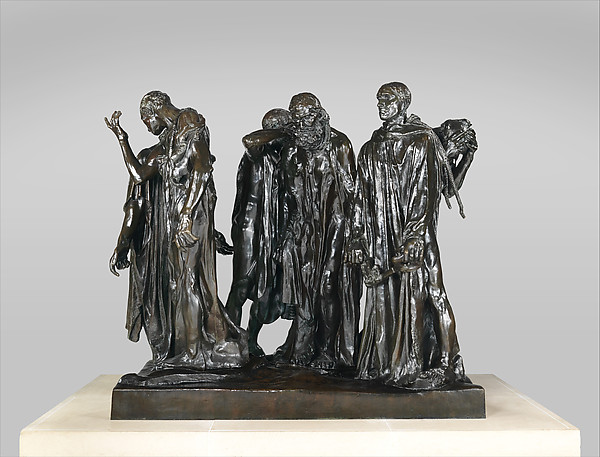
Rodin pursued the commission for a monument to the town of Calais, but instead of a lone hero, Eustache de Saint-Pierre, he conceived six citizens, each with his own emotions. A year later the committee was unimpressed with his progress; Rodin was ready to abandon the project rather than change his design, and the town told him to carry on.
1885
Camille Claudel: assistant and lover
From 1885 Claudel worked as an assistant in Rodin's studio and posed for him, and soon they became lovers. The affair lasted nine years, and Rodin did not break with Rose Beuret, who knew her role as “the other woman”.