 Albrecht DürerGerman, 1471–1528
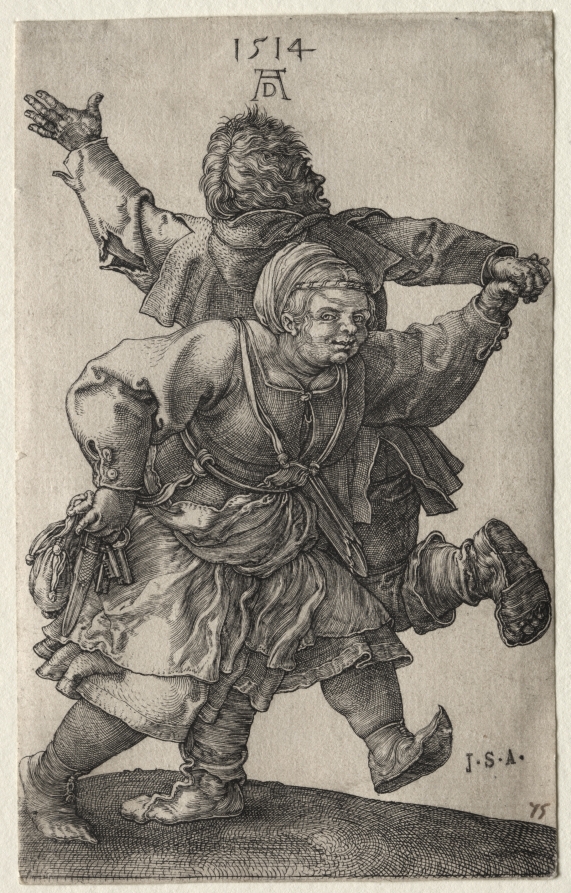
Peasant Couple Dancing
May one see it?
Not receiving at present

The Cleveland Museum of Art
Cleveland, United States
It belongs to the collection, but is not on display at present.
- Checked
- 3 days ago
- In this state since
- Sep 29, 2026
- Source
- The museum's own collection data
Particulars
- Accession number
- 1993.190
What it shows
In the catalog
Comings and goings
Not on view at present
The Cleveland Museum of Art · Sep 29, 2026 — now · Verified
Was not on view
National Gallery of Art · Sep 29, 2026 — Sep 29, 2026 · Verified
Was not on view
The Cleveland Museum of Art · Sep 28, 2026 — Sep 29, 2026 · Verified
Was not on view
National Gallery of Art · Sep 28, 2026 — Sep 28, 2026 · Verified
Was not on view
The Cleveland Museum of Art · Sep 27, 2026 — Sep 28, 2026 · Verified
Was not on view
National Gallery of Art · Sep 26, 2026 — Sep 27, 2026 · Verified
Was not on view
The Cleveland Museum of Art · Sep 26, 2026 — Sep 26, 2026 · Verified
Was not on view
National Gallery of Art · Sep 25, 2026 — Sep 26, 2026 · Verified
Was not on view
The Cleveland Museum of Art · Aug 19, 2026 — Sep 25, 2026 · Verified
Sources
- The Cleveland Museum of Art: the museum's own open data · fetched 3 days ago
- Image: The Cleveland Museum of Art — Museum open access
Meanwhile, in the life of Albrecht Dürer
The whole life1507–1528 · Workplace
Nuremberg
1512
Emperor Maximilian I becomes his chief patron
From 1512 Emperor Maximilian I was Dürer's chief patron. For him Dürer and his workshop produced the Triumphal Arch, a giant woodcut 295 × 357 cm printed from 192 blocks and modelled on the triumphal arches of ancient Rome.
1513
Engraves “Knight, Death and the Devil”
The first of Dürer's three most famous engravings, probably inspired by Erasmus's Handbook of a Christian Knight.
1514
Engraves “Melencolia I” with its magic square
With Knight, Death and the Devil and St Jerome in His Study, Melencolia I forms the three “master engravings”. It shows a 4 × 4 “magic square” summing to 34 in every direction, whose two middle numbers in the bottom row give the date, 1514; the meaning of these prints remains a puzzle to this day.
1514
Death of his mother
In the year of Melencolia I and St Jerome in His Study, the artist's mother, Barbara Holper, died.
1515
Makes the “Rhinoceros”
Working from a written description and a sketch by another artist of the animal that had reached Lisbon, Dürer made his woodcut Rhinoceros without ever seeing the beast. The image proved so powerful that it was still used in German school textbooks in the last century.
![Madonna and Child [obverse], Albrecht Dürer, c. 1496/1499](https://api.nga.gov/iiif/878db7e6-10ae-4cae-ba5d-6d6f5c413ae8/full/!2400,2400/0/default.jpg)
![Lot and His Daughters [reverse], Albrecht Dürer, c. 1496/1499](https://api.nga.gov/iiif/7565a449-f82a-414b-9bda-c93f55a51b4d/full/!2400,2400/0/default.jpg)