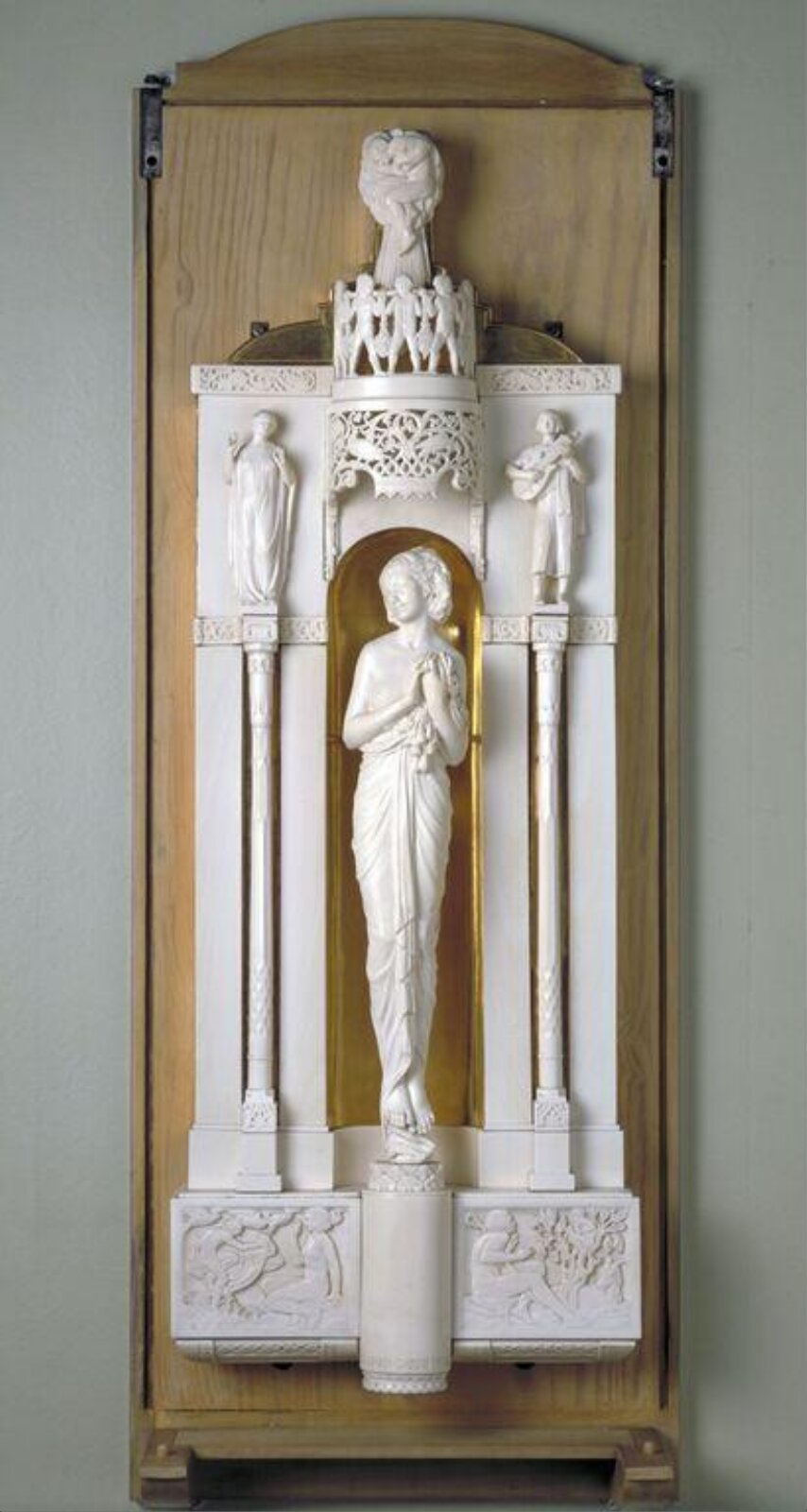
Richard Garbe
Primavera
May one see it?
Yes, receiving visitors

Victoria and Albert Museum
RoomSculpture, Room 21, The Dorothy and Michael Hintze GalleriesLondon, United Kingdom
On public display.
- Checked
- 7 days ago
- In this state since
- Sep 25, 2026
- Source
- The museum's own collection data
About the sculpture
Primavera (Spring) is probably Louis Richard Garbe's (1876-1957) most ambitious work in ivory. It combines free-standing figures with low reliefs, pierced panels and architectural elements.
By the early 20th century the art of ivory-carving was held in low esteem. The Studio magazine in 1906 considered ivory suitable only for 'billiard balls, false teeth and cutlery'. Garbe was instrumental in reviving the use of the material for both decorative objects and independent sculptures. From around 1924 his ivory sculptures were regularly exhibited at the Royal Academy: Primavera being shown there in 1926. These works contributed to the gradual acceptance in establishment circles of direct carving and truth to materials, aims associated with the Modern Movement.
Read on
Garbe taught at the Central School of Art, in London, between 1901 and 1929 and at the Royal College of Art from 1929 to 1946. His versatile style and technique were influential on many younger sculptors.
Victoria and Albert Museum
Particulars
- Accession number
- CIRC.592-1976
What it shows
In the catalog
Sources
- Victoria and Albert Museum: the museum's own open data · fetched 7 days ago
- Image: Victoria and Albert Museum — © Victoria and Albert Museum, London