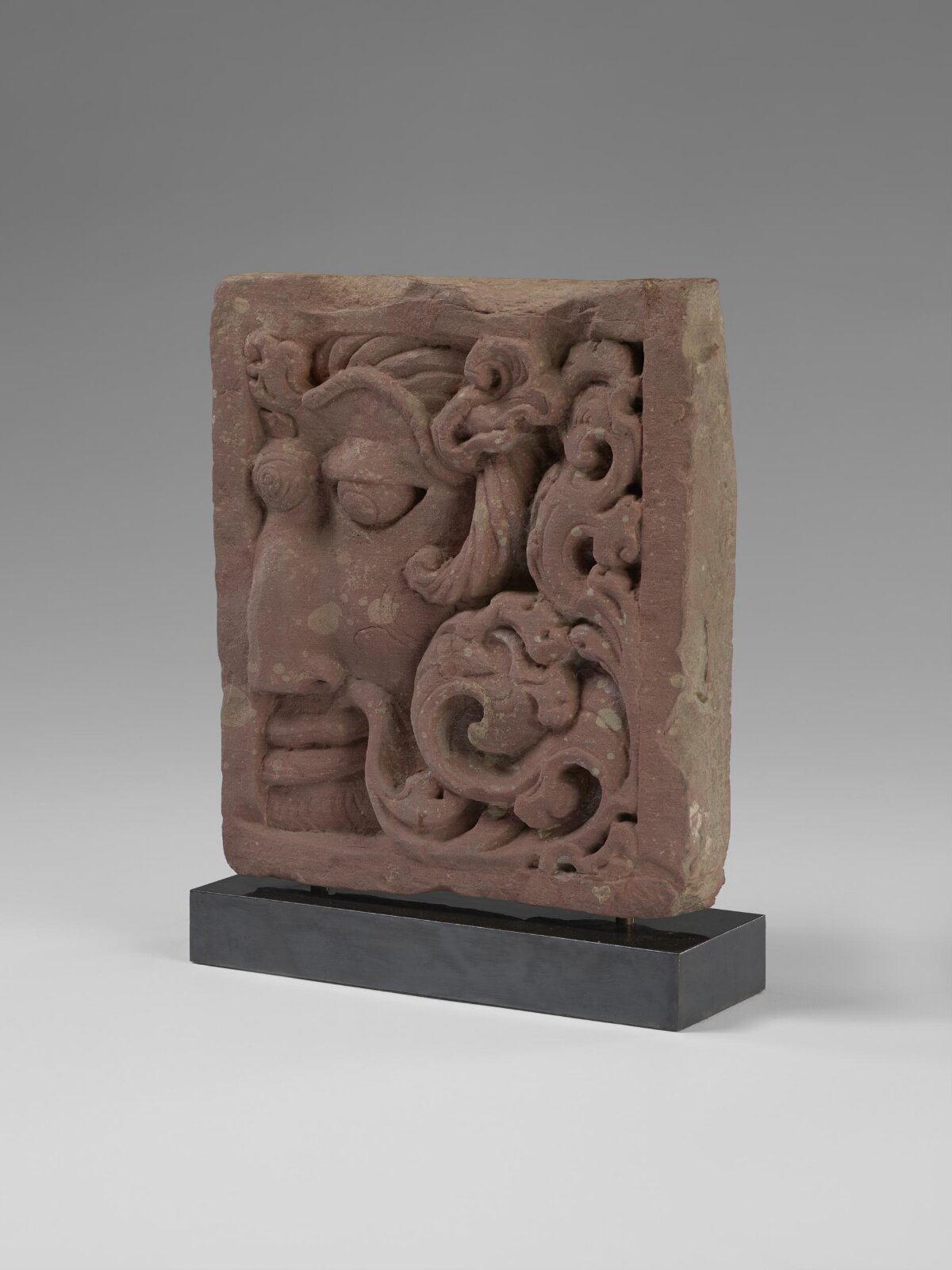
Relief
May one see it?
Not receiving at present

Victoria and Albert Museum
London, United Kingdom
It belongs to the collection, but is not on display at present.
- Checked
- 7 days ago
- In this state since
- Sep 25, 2026
- Source
- The museum's own collection data
About the sculpture
The motif on this sandstone relief is a ‘kirttimukha’ ('face of glory'). The grotesque, lion-like face has flaring eyes and prominent fangs. It is usually represented with tendrils and vapour or pearls issuing from its jawless mouth. The character shown here is presumably a nature-spirit (‘yaksha’), possibly a water-spirit judging from the turbulent foliage.
In architecture the ‘kirttimukha’ frequently appears above doorways and on capitals, usually as a protective presence. Relief panels like this one appear on the square-section capitals of Gupta columns and elsewhere in Gupta period (320-about 540 AD) temples. We do not know where this panel with half a grotesque face was originally placed. However, it does compare closely with a column in a ruined Hindu temple at Pipariya in Madhya Pradesh.
Read on
The ‘kirttimukha’ motif became prominent during the Gupta period in the 4th and 5th centuries AD. By the 6th century it had attained its standard form in India. No precise Indian model is known, though it does relate to some of the mythological faces of the Kushan period (1st century AD-320 AD), such as the ‘makara’. Its origins may relate to Hellenistic heads of gorgons. In Greek mythology, these were women with snakes for hair.
Victoria and Albert Museum
Particulars
- Accession number
- IS.29-1987
What it shows
In the catalog
Sources
- Victoria and Albert Museum: the museum's own open data · fetched 7 days ago
- Image: Victoria and Albert Museum — © Victoria and Albert Museum, London