 Constantin BrancusiRomanian, 1876–1957
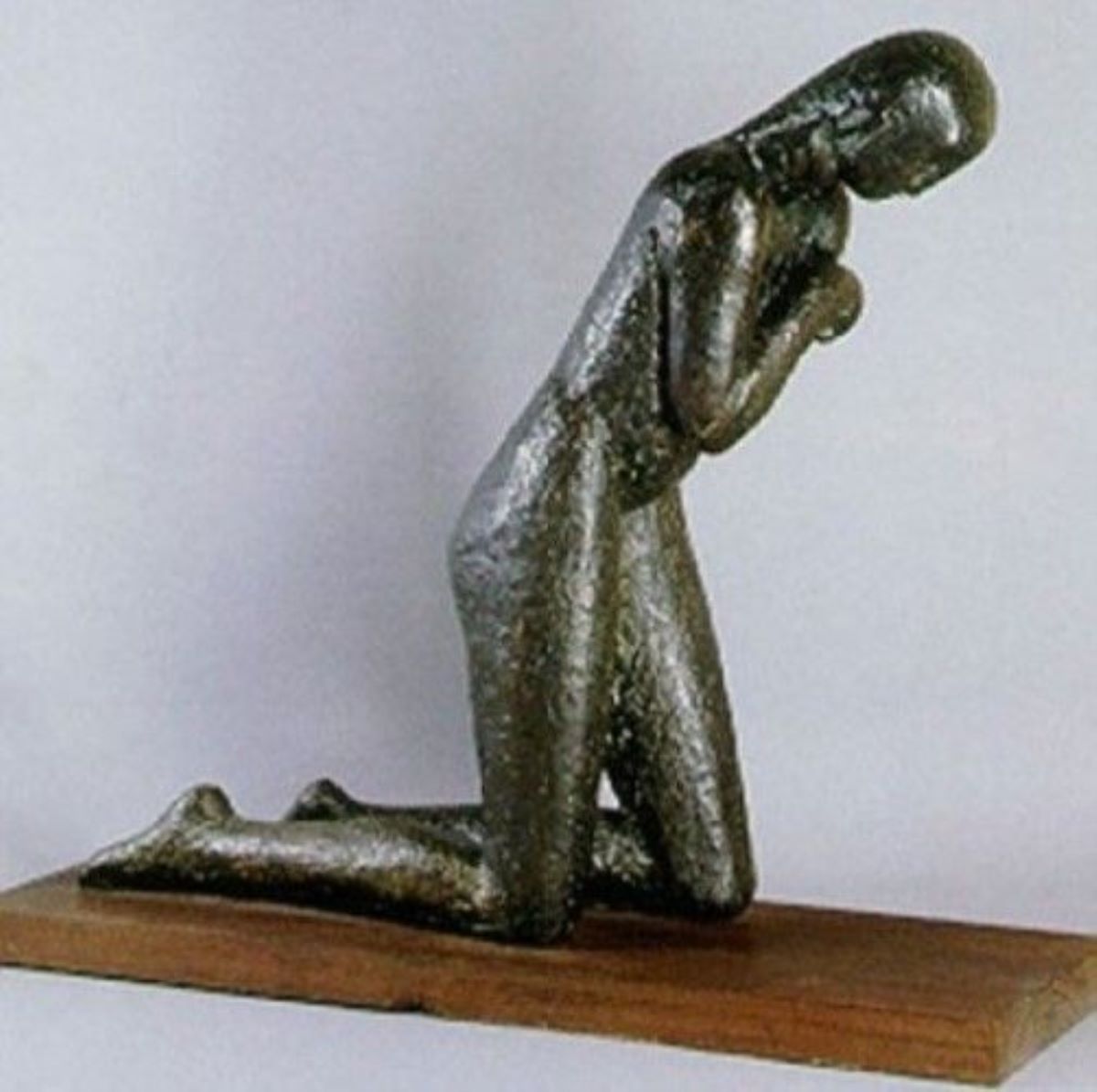
Rugăciunea
May one see it?
Unknown: the museum keeps its counsel

National Museum of Art of Romania
Bucharest, Romania
The owner is known. Whether it is on view today, the museum does not say, and we were not trained to guess.
- In this state since
- Sep 27, 2026
- Source
- The museum's own collection data
About the sculpture
Sculptură sugerand o femeie care se roaga, o femeie care se reculege in genunchi, nu o femeie care se tanguie, conferindu-i in felul acesta un simtamant de smerenie si de puritate.
National Museum of Art of Romania
Particulars
Sources
- National Museum of Art of Romania: the museum's own open data · fetched 3 days ago
- Image: National Museum of Art of Romania — CC BY-SA 4.0
Meanwhile, in the life of Constantin Brancusi
The whole lifeJune 1905
The École des Beaux-Arts: Mercié’s class and a scholarship
In June 1905 Brâncuși passes the entrance examination for the École des Beaux-Arts in Paris and enters the sculpture class of Antonin Mercié. From 1905 to 1908 he receives an annual scholarship from the Romanian Ministry of Education.
1906
His first Paris salons
In 1906 Brâncuși exhibits for the first time at the salon of the Société Nationale des Beaux-Arts and at the Salon d’Automne; his works include the plaster sculptures “L’Enfant” and “L’Orgueil”. At the following salon of the Société Nationale he shows “Le Supplice”, a portrait of Nicolae Dărăscu and two heads of children.
1907
The turn to direct carving in stone
In 1907 Brâncuși moves away from modelling in clay, the method used to prepare sculpture for casting, and begins carving stone directly, adding wood soon afterward; he continues to make plaster and bronze versions as well. The methods he learned in Romania remain present in his handling of tools and his sustained contact with the material.
March 1907
A brief stint with Rodin, and the break
In March 1907 Brâncuși begins working as an assistant to Auguste Rodin but stays in his studio for only a few weeks (Russian Wikipedia speaks of two months): he prefers to find his own path and sums up the decision with the words “Nothing grows in the shade of large trees.”
from 1908
His Paris circle: Léger, Duchamp, Rousseau, Apollinaire
From 1908 Brâncuși spends time with artists and writers working in Paris, including Amedeo Modigliani, Fernand Léger, Marcel Duchamp, Henri Rousseau, Guillaume Apollinaire, Alexander Archipenko and Henri Matisse. He also stays in touch with Romanians living in France — George Enescu, Theodor Pallady, Benjamin Fondane, Panait Istrati — speaks Romanian in his studio and welcomes visitors from Romania.
1909
Meeting Modigliani
In 1909 the collector Paul Alexandre introduces Brâncuși to Amedeo Modigliani; the two become friends, and the Italian draws his portrait in black and red pencil that year. From 1909 to 1914 Modigliani works chiefly in sculpture, and his elongated limestone heads, with simplified forms and polished surfaces, are related to Brâncuși’s sculpture.