 Caspar David FriedrichGerman, 1774–1840
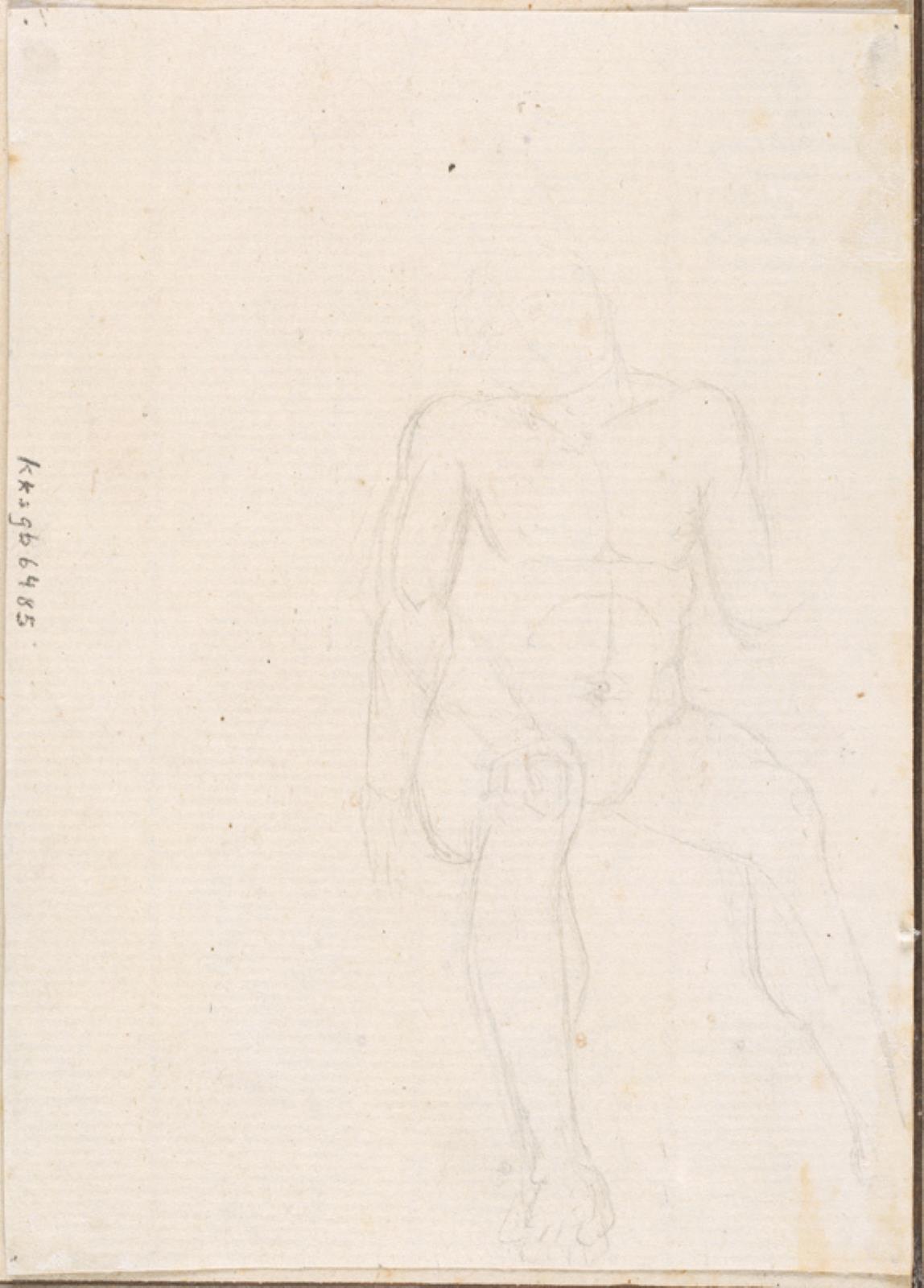
Siddende mandlig model
May one see it?
Not receiving at present

SMK — National Gallery of Denmark
Copenhagen, Denmark
It belongs to the collection, but is not on display at present.
- Checked
- 3 days ago
- In this state since
- Aug 19, 2026
- Source
- The museum's own collection data
Particulars
- Accession number
- KKSgb6485 verso
Sources
- SMK: the museum's own open data · fetched 3 days ago
- Image: SMK — National Gallery of Denmark — public domain
Meanwhile, in the life of Caspar David Friedrich
The whole life1790–1794
Kosegarten: nature as a revelation of God
As a private student of Quistorp, who takes his pupils out to draw in the open air, Friedrich is encouraged from an early age to sketch from life. Through his teacher he meets the theologian Ludwig Gotthard Kosegarten, who taught that nature was a revelation of God, and comes to know the work of Adam Elsheimer.
1794–1798
Copenhagen: casts, life drawing and Dutch landscape painters
At the prestigious Copenhagen Academy Friedrich begins by copying casts of antique sculpture before moving on to drawing from life, and the Royal Picture Gallery opens up to him 17th-century Dutch landscape painting. His teachers Lorentzen and Juel, inspired by Sturm und Drang, stand at a midpoint between the budding Romantic aesthetic and the waning neoclassical ideal.
after 1798
The Dresden Romantics: Tieck, Novalis, Kleist, Runge
Friedrich grows close to a circle of Romantics that includes Ludwig Tieck, Novalis, Heinrich von Kleist and Philipp Otto Runge, and he is also a friend of the natural philosopher and painter Carl Gustav Carus. Together with Runge he is regarded as the foremost representative of early German Romanticism and the leader of the Dresden Romantics.
1798 · Workplace
Dresden
1798–1804
Etchings and woodcuts
In Dresden Friedrich experiments with etching and makes designs for woodcuts that his furniture-maker brother cuts: by 1804 he has produced 18 etchings and four woodcuts, apparently in small numbers and distributed only to friends. His main media remain ink, watercolour and sepia, and he does not work extensively in oils until his reputation is more established.