 Beatrix Potter1866–1943
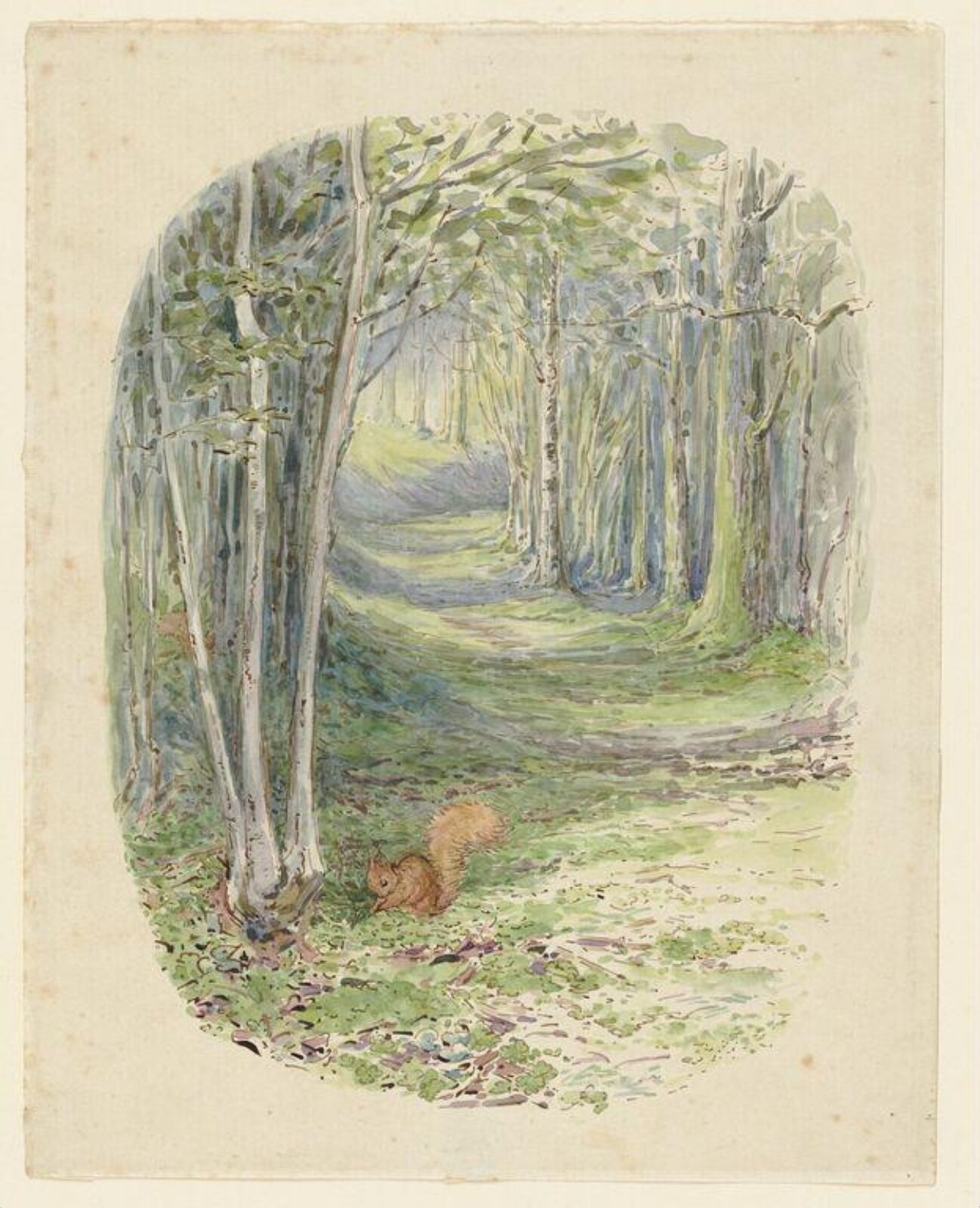
Squirrel in a wood
May one see it?
Not receiving at present

Victoria and Albert Museum
London, United Kingdom
It belongs to the collection, but is not on display at present.
- Checked
- 7 days ago
- In this state since
- Sep 25, 2026
- Source
- The museum's own collection data
About the work
This watercolour is thought to depict the woods near Derwentwater. Between 1885 and 1903 Potter spent six of her long family summer breaks, first at Lingholm and then at Fawe Park, large houses overlooking Derwentwater. Beatrix's love of the varied surroundings of the woods and lakeland is revealed in their detailed depictions in The Tale of Squirrel Nutkin (1903).
Beatrix Potter (1866-1943) is one of the world's best-loved children's authors and illustrators. She wrote the majority of the twenty-three original Peter Rabbit books between 1901 and 1913. The Tale of Peter Rabbit (Frederick Warne, 1902) is her most famous and best-loved tale.
Victoria and Albert Museum
Particulars
- Accession number
- BP.475
What it shows
Sources
- Victoria and Albert Museum: the museum's own open data · fetched 7 days ago
- Image: Victoria and Albert Museum — © Victoria and Albert Museum, London
Meanwhile, in the life of Beatrix Potter
The whole life1900–1901
A dummy book of the rabbit tale, printed at her own expense
In 1900 Beatrix revised her tale of the four little rabbits and made a dummy book of it — it has been suggested, in imitation of Helen Bannerman’s 1899 bestseller; no one would buy it. So in December 1901 she had it printed at her own expense for family and friends — in black and white, with a coloured frontispiece.
2 October 1902
“The Tale of Peter Rabbit” is published
Several publishers had turned the manuscript down, Frederick Warne & Co among them, but the firm, eager to enter the booming market for small-format children’s books, reconsidered on the advice of the artist L. Leslie Brooke; it declined Rawnsley’s verse version in favour of Beatrix’s own prose, and she agreed to colour her illustrations, choosing the new Hentschel three-colour process. “The Tale of Peter Rabbit” appeared on 2 October 1902 and was an immediate success.
1903
A patented Peter Rabbit toy: the birth of character merchandising
In 1903 Beatrix made and patented a Peter Rabbit doll — he became the first fictional character made into a patented soft toy, and so the oldest licensed character. Painting books, board games, wallpaper, figurines, baby blankets and china tea-sets followed under licence from her publisher Warne, earning her an independent income, and Harrods catalogues list Peter merchandise from at least 1910.
1905
Engagement to Norman Warne, and his death
In 1905 Beatrix and her publisher Norman Warne became unofficially engaged; her parents objected because Warne was “in trade” and so socially unsuitable. The engagement lasted only a month: Warne died of a blood disease at the age of 37.
1905
Buys Hill Top Farm in Near Sawrey
In 1905, with the proceeds of her books and a small legacy from an aunt, Beatrix bought Hill Top Farm in Near Sawrey in the Lake District, six miles west of Lake Windermere. She and Warne may have hoped it would be their holiday home, but after his death she went ahead with the purchase, as she had always wanted to own that farm and live in “that charming village”.
1905–1913 · Education
governance