
 Georges SeuratFrench, 1859–1891
Study after "The Models"
May one see it?
Not receiving at present

National Gallery of Art
Washington, D.C., United States
It belongs to the collection, but is not on display at present.
- Checked
- 3 days ago
- In this state since
- Aug 19, 2026
- Source
- The museum's own collection data
Particulars
- Accession number
- 1991.217.69
What it shows
In the catalog
Sources
- National Gallery of Art: the museum's own open data · fetched 3 days ago
- Image: National Gallery of Art — Museum open access
Meanwhile, in the life of Georges Seurat
The whole lifesummer 1884 – 1886
Two years in the park: studies for “La Grande Jatte”
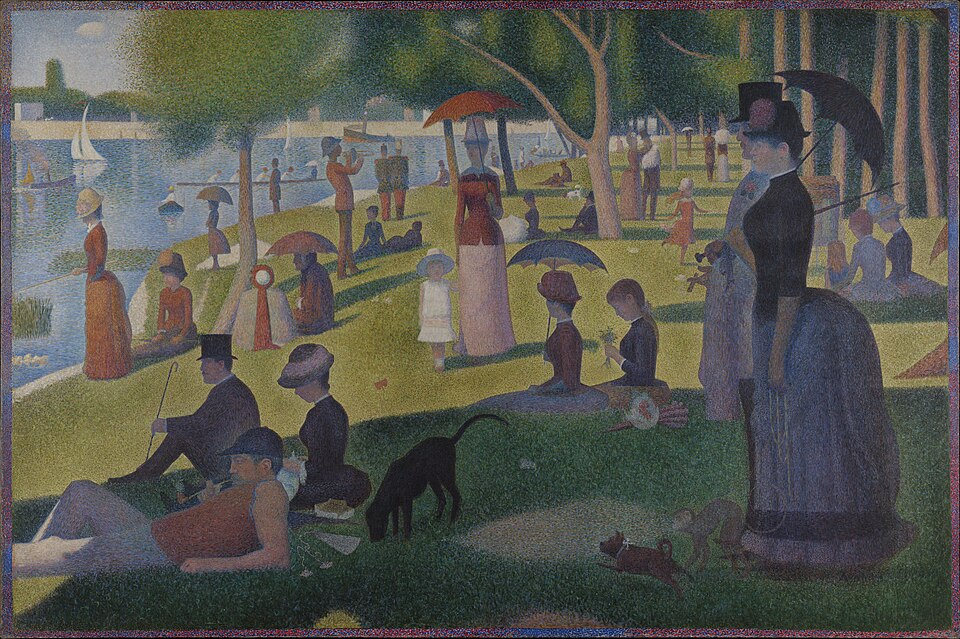
In summer 1884 Seurat begins “A Sunday Afternoon on the Island of La Grande Jatte”: the roughly three-metre-wide canvas, showing members of every social class at various park activities, with tiny juxtaposed dots of multi-coloured paint that the viewer's eye blends optically, takes two years, much of which he spends in the park sketching. There are about 60 studies for the painting, including a smaller version made in 1884–85.
1886
Nine works, the public's mockery and the critics' defence
At the last Impressionist exhibition Seurat presents nine works; the critics R. Marx and Félix Fénéon write favourable reviews, but the public ridicules the “pictures painted in dots”, and the Swiss critic Émile Hennequin finds them grey and poor in light. The Impressionists are sceptical: when Pissarro says that “La Grande Jatte” is very interesting, Degas replies that he would have noticed, but it is so large; Seurat himself blames the hall for being too dark and cramped to give the picture the necessary distance.
15 May – 15 June 1886
“La Grande Jatte” is first shown at the eighth Impressionist exhibition
“A Sunday Afternoon on the Island of La Grande Jatte” is shown to the public for the first time at the eighth Impressionist exhibition, held from 15 May to 15 June 1886. The painting will initiate Neo-Impressionism and alter the direction of modern art.
19 September 1886
Fénéon names “Neo-Impressionism” and defends Seurat
Félix Fénéon, who gives the new movement the name “Neo-Impressionism”, defends the artist in an article for the Belgian paper “L'Art Moderne” of 19 September 1886: here, he argues, no virtuosity of brushwork or impasto is needed, but the eye must be quick, sharp and perceptive.
1889
Madeleine Knobloch moves into Seurat's studio
Seurat conceals his relationship with the artist's model Madeleine Knobloch (1868–1903); in 1889 she moves in with him in his studio on the seventh floor of 128 bis boulevard de Clichy.
16 February 1890
The birth of his son Pierre-Georges
When Madeleine becomes pregnant the couple move to a studio at 39 passage de l'Élysée-des-Beaux-Arts (now rue André Antoine), where on 16 February 1890 she gives birth to their son, who is named Pierre-Georges.




![Scenes from the Passion of Christ: The Descent into Limbo [right panel], Andrea Vanni, 1380s](https://api.nga.gov/iiif/4205a539-eadd-4486-89a7-3cff9c1ba428/full/!2400,2400/0/default.jpg)


