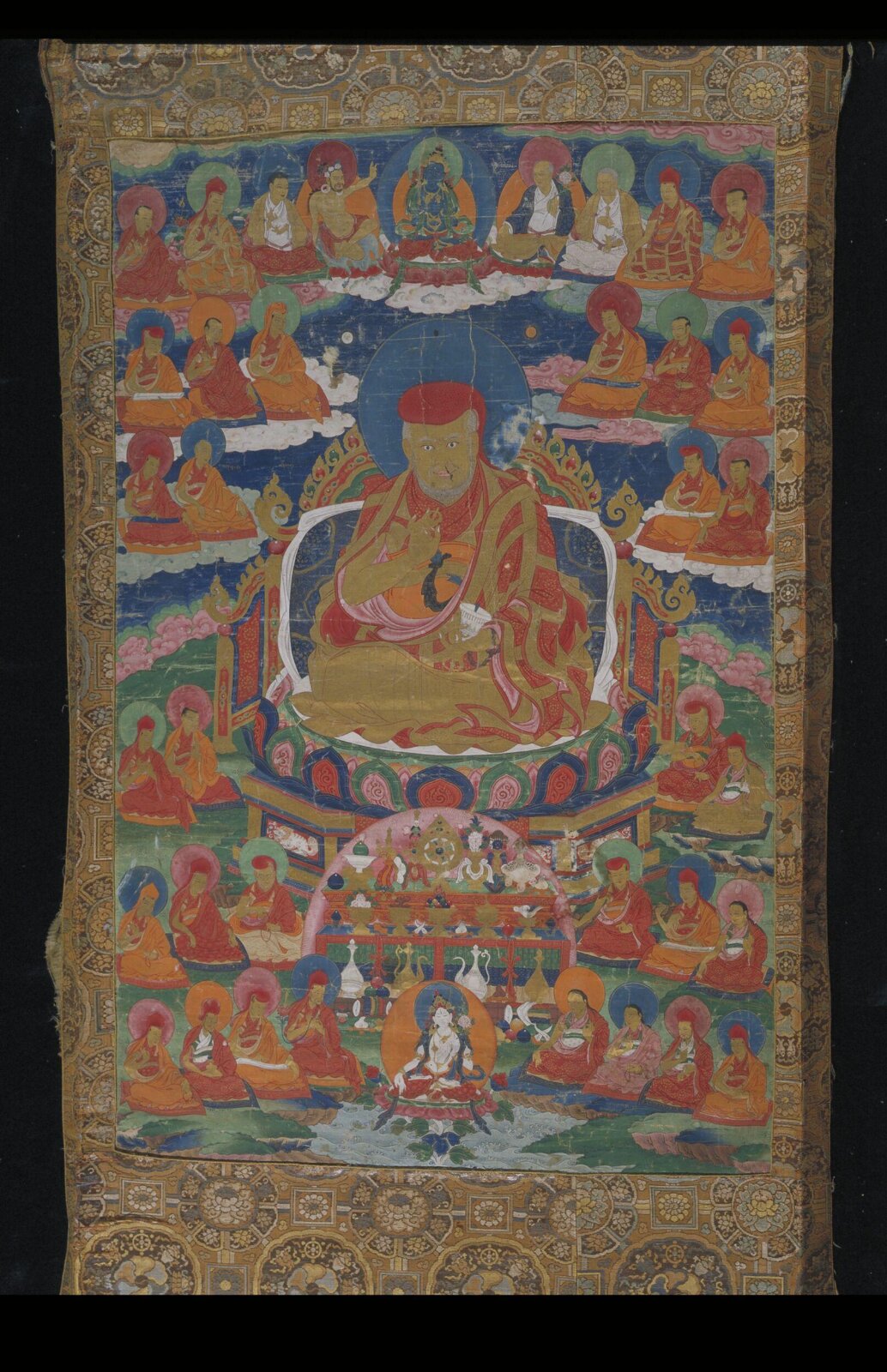
Tangka painting
May one see it?
Not receiving at present

Victoria and Albert Museum
London, United Kingdom
It belongs to the collection, but is not on display at present.
- Checked
- 7 days ago
- In this state since
- Sep 25, 2026
- Source
- The museum's own collection data
About the painting
This tangka or scroll painting depicts the combined lineages of the Sakya and Ngor orders of Tibetan Buddhism. The central figure is an unidentified abbot holding a ‘dorje’ or ‘diamond sceptre’ in his right hand and, in his left hand, another dorje and a bell or ‘dril bu’, signifying the conjunction of wisdom and compassion in the enlightened state.
Read on
During the 13th century and the first half of the 14th century the Sakya order became the richest and most powerful in Tibet through an alliance with Tibet’s Mongol overlords. In 1249 Sakya Pandita, shown second from left on the top row of figures, made a treaty with the Mongol leader Godan Khan by which internal political control of Tibet, though ultimately in Mongol hands, was handed over to the order. Sakya Pandita’s nephew and sucessor, Phag pa, shown second from right on the top row, became the religious advisor to Kublai Khan, further cementing the alliance.
Victoria and Albert Museum
Particulars
- Accession number
- IM.319:1, 2-1920
What it shows
In the catalog
Sources
- Victoria and Albert Museum: the museum's own open data · fetched 7 days ago
- Image: Victoria and Albert Museum — © Victoria and Albert Museum, London