 Sandro BotticelliItalian, 1445–1510
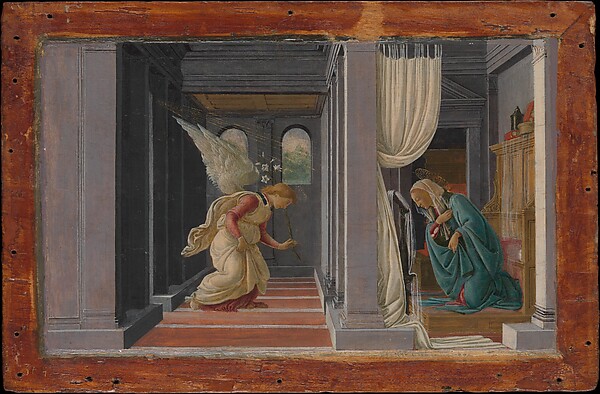
The Annunciation
May one see it?
Yes, receiving visitors

The Metropolitan Museum of Art
Room952New York, United States
On public display.
- Checked
- 3 days ago
- In this state since
- Sep 26, 2026
- Source
- The museum's own collection data
About the painting
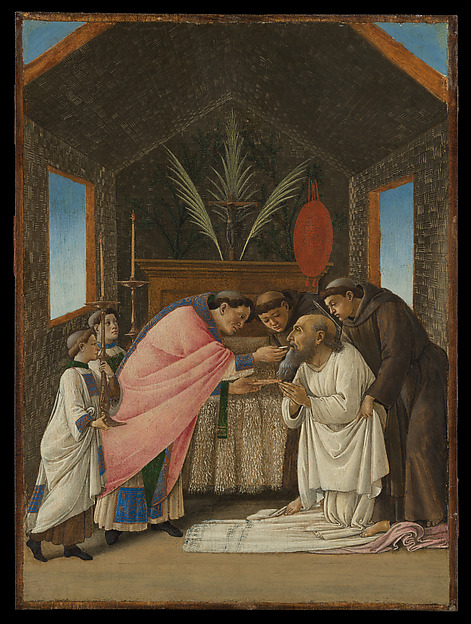
The Annunciation (c. 1485–1492) is a small painting of the Annunciation by the Italian Renaissance artist Sandro Botticelli. It is now in the collection of the Metropolitan Museum of Art in New York. The Metropolitan believe the work was painted as a single image for private devotional use, rather than as one of a set of predella scenes below the main panel of an altarpiece.
The work is known to have been in the Barberini family collection in Rome in the 17th century, and later became part of the Robert Lehman Collection that was donated to the Metropolitan Museum of Art in 1969.
Boticelli also painted the Cestello Annunciation about the same time for Santa Maria Maddalena dei Pazzi, and also an Annunciation for San Barnaba, Florence, now in the Kelvingrove Art Gallery and Museum in Glasgow, Scotland.
Particulars
- Accession number
- 1975.1.74
What it shows
Sources
- The Metropolitan Museum of Art: the museum's own open data · fetched 3 days ago
- Image: The Metropolitan Museum of Art — Open Access (CC0)
Meanwhile, in the life of Sandro Botticelli
The whole life1480s
Lorenzo's circle: Ficino, Pico, Poliziano
Botticelli frequented Lorenzo the Magnificent's Platonic Academy, where he met the humanists, poets and philosophers Marsilio Ficino, Pico della Mirandola and Angelo Poliziano; the influence of Neoplatonism shows in his secular paintings.
1490–1498
Savonarola's preaching and Botticelli
From 1490 Savonarola preached in Florence; according to Vasari, Botticelli became his follower, gave up painting and fell into hardship. Modern historians reject this, and the extent of the preacher's influence remains uncertain — Botticelli's brother Simone was the clearer follower.
1491
The committee on the cathedral façade
In 1491 Botticelli served on the committee deciding on a façade for the Cathedral of Florence; the next year he received three payments for a design, eventually abortive, to put mosaics on some of the cathedral's interior vaults.