
 Edgar DegasFrench, 1834–1917
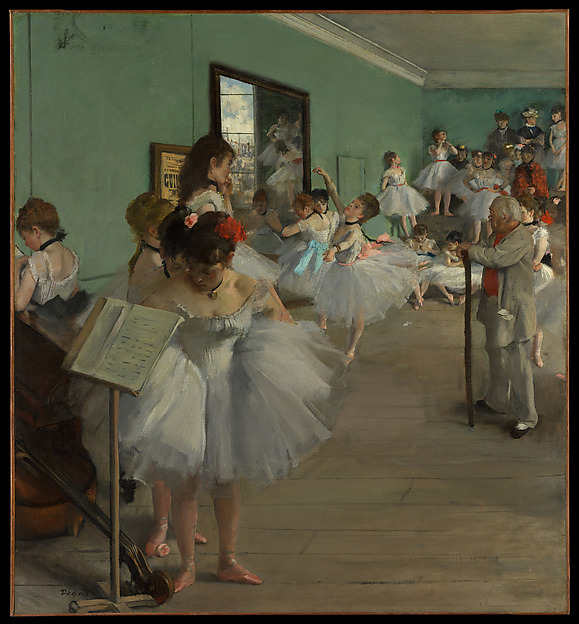
The Dance Class
May one see it?
Yes, receiving visitors

National Gallery of Art
Room83 · West Building, Main FloorWashington, D.C., United States
On public display.
- Checked
- 3 days ago
- In this state since
- Aug 19, 2026
- Source
- The museum's own collection data
Particulars
- Accession number
- 2014.79.710
What it shows
In the catalog
Sources
- National Gallery of Art: the museum's own open data · fetched 3 days ago
- Image: National Gallery of Art — Museum open access
Meanwhile, in the life of Edgar Degas
The whole lifeearly 1870s
Meets Durand-Ruel
Degas met the dealer Durand-Ruel, later the most prominent of the trusted dealers with whom he planned his strategy at auctions.
1872–1873
Creates “A Cotton Office in New Orleans”
Staying at the home of his uncle Michel Musson, Degas produced a number of works in New Orleans, many depicting family members. “A Cotton Office” garnered favourable attention in France and remained the only work of his bought by a museum in his lifetime — the museum at Pau.
October 1872 – March 1873 · Residence
New Orleans
1873–1874
His brother's debts: he sells his house and collection
After his father's death Degas learned that his brother René had run up enormous business debts. To save the family's reputation he sold his house and an inherited art collection and for the first time in his life depended on sales of his own work.
1874
The first Impressionist exhibition
Disenchanted with the Salon, Degas joined a group of young artists organizing an independent exhibiting society. He took a leading role in organizing the eight shows of 1874–1886 and exhibited in all but one, despite constant conflicts with the group.
1875
Creates “Place de la Concorde”
A portrait of Ludovic Lepic and his daughters in a city setting, in which chance passers-by have the same compositional weight as the main figures. The painting is in the Hermitage.


![Scenes from the Passion of Christ: The Descent into Limbo [right panel], Andrea Vanni, 1380s](https://api.nga.gov/iiif/4205a539-eadd-4486-89a7-3cff9c1ba428/full/!2400,2400/0/default.jpg)


