 William BlakeBritish, 1757–1827
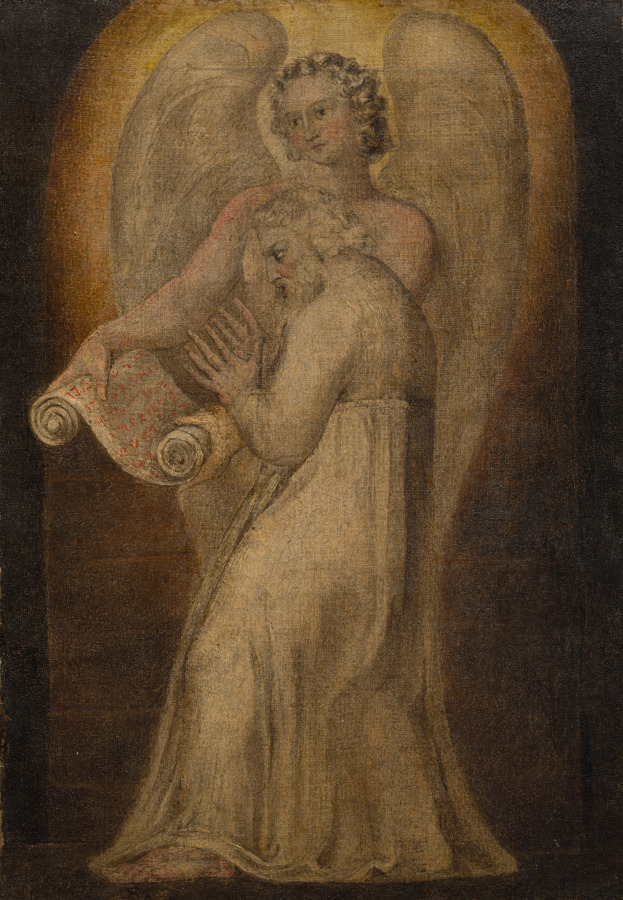
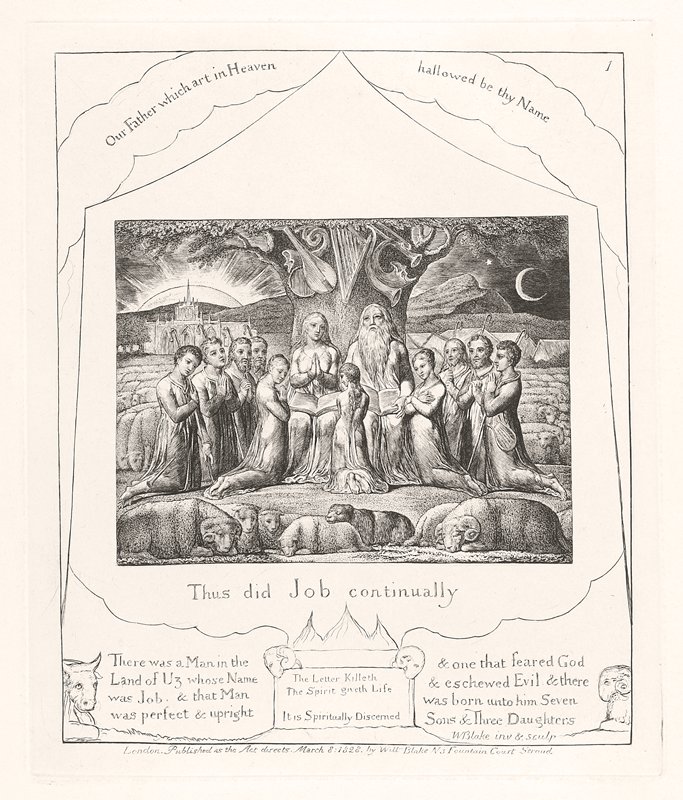
Thus did Job continually
May one see it?
Not receiving at present

Minneapolis Institute of Art
Minneapolis, United States
It belongs to the collection, but is not on display at present.
- Checked
- 3 days ago
- In this state since
- Sep 25, 2026
- Source
- The museum's own collection data
About the work
In plate one, Job and his family are still in the pastoral state of Innocence and shown at their evening prayers. Job is basically a good man, although he never recognized the true God. A Gothic church to the left represents his spiritual wealth; to the right, the flocks and barns represent his material wealth. Job fears God instead of loving him as a friend and deepest of all is his secret pride which must be humbled.
Minneapolis Institute of Art
Particulars
- Accession number
- P.5, 863
In the catalog
Sources
- Minneapolis Institute of Art: the museum's own open data · fetched 3 days ago
- Image: Minneapolis Institute of Art — public domain
Meanwhile, in the life of William Blake
The whole lifeв 65 лет (1822 – 1823)
Illustrations to the “Book of Job”
Aged 65, Blake began work on illustrations for the Book of Job; he completed the engravings just before his death.
1826
A commission for engravings to Dante's “Divine Comedy”
In 1826, through Linnell, Blake received a commission for a series of engravings for Dante's “Divine Comedy”; his death in 1827 cut the enterprise short, with only a handful of watercolours completed and seven engravings in proof. Even near death he worked feverishly on the illustrations to the “Inferno”, and is said to have spent one of his last shillings on a pencil.
к моменту смерти (1827)
Fewer than thirty copies of the “Songs” sold
At the time of his death Blake had sold fewer than 30 copies of “Songs of Innocence and of Experience”: he was largely unrecognised during his life.
12 August 1827
His last day: a portrait of Catherine and hymns
On 12 August 1827 Blake worked relentlessly on his Dante series until the end; then, it is reported, he asked his weeping wife to stay as she was and drew her portrait (“you have ever been an angel to me”; the portrait is lost), began to sing hymns and verses, and at six that evening, after promising her that he would be with her always, died.
12 August 1827
Died