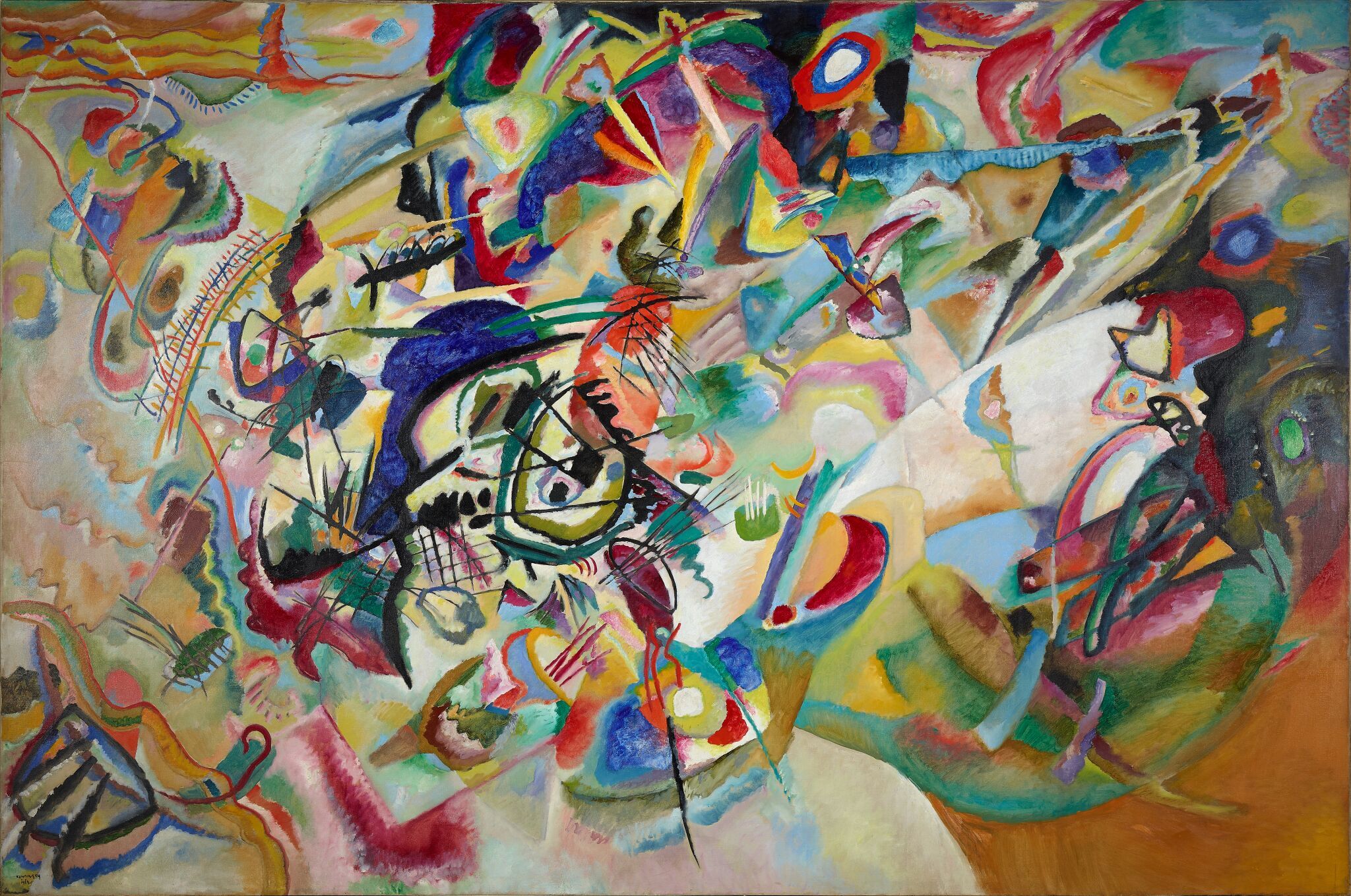
 Vasily KandinskyFrench, 1866–1944
Композиция VII
May one see it?
Unknown: the museum keeps its counsel

Tretyakov Gallery
Moscow, Russia
The owner is known. Whether it is on view today, the museum does not say, and we were not trained to guess.
- Source
- The museum's own collection data
Particulars
- Accession number
- 13230
Sources
- Tretyakov Gallery: the museum's own open data · fetched 3 days ago
- Image: Tretyakov Gallery — © State Tretyakov Gallery
Meanwhile, in the life of Vasily Kandinsky
The whole life1908–1914
“Composition VI”: the incantation “deluge”
After nearly six months of preparing “Composition VI”, Kandinsky became blocked in front of the mural-sized wood panel he had outlined: he was trapped in his intellect. Münter advised him to repeat the word “deluge” (Überflut), attending to its sound and not its meaning — and, repeating it like a mantra, he painted the monumental work in three days.
1910–1911
The treatise “Concerning the Spiritual in Art”
The treatise defended and promoted abstract art and affirmed that all forms of art are equally capable of reaching spirituality; colour in a painting can be autonomous, apart from the depiction of an object. Kandinsky distinguished three kinds of painting: impressions, improvisations and compositions.
1911
The turn to pure abstraction
Kandinsky developed a novel concept of the “rhythmic” use of colour and moved from figurative painting to pure abstraction.
1911
The birth of the Blue Rider
After the earlier association dissolved Kandinsky formed the Blue Rider with August Macke, Franz Marc, Albert Bloch and Gabriele Münter. The group issued an almanac and held two exhibitions; the war ended further plans.
1911
His first solo exhibition
His first solo exhibition took place in the same years, when the Blue Rider was being born.
1914
The war: back to Russia via Switzerland and Sweden
The outbreak of World War I ended the Blue Rider's plans for further almanacs and exhibitions and sent Kandinsky back to Russia via Switzerland and Sweden; he returned to Moscow in 1914.
_MET_DP236124.jpg?width=1280)