 André DerainFrancia, 1880–1954
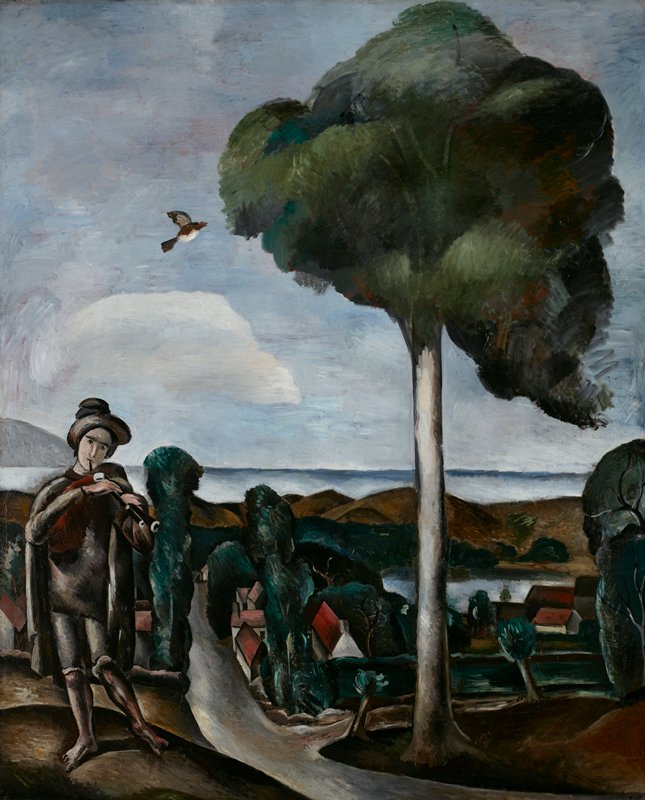
The Bagpiper
¿Se puede contemplar?
Sí, recibe visitas

Instituto de Artes de Mineápolis
SalaG371Minneapolis, Estados Unidos
Expuesta al público. Quién lo avala figura más abajo.
- Comprobado
- hace 5 horas
- En este estado desde
- 25 sept 2026
- Fuente
- Los datos de colección del propio museo
About the painting
Although Derain had helped found Fauvism and had been an early adherent of Cubism, he increasingly fell away from both aesthetics, feeling their obsession with technique had supplanted the content of their work. Derain, instead, began to turn toward the Old Masters, even as he kept pace with the spirit of his own time. Thus, while The Bagpiper at Camiers owes much to Cézanne in color, brushwork and composition, a great debt to the Old Masters is also evident, especially the arcadian scenes peopled with shepherds and musicians by Titian, and Derain's countryman, Claude Lorrain. The Bagpiper at Camiers became one of Derain's best known pre-war pictures and its lyrical and romantic feeling established him as an artist in the grand tradition of large formats and timeless subjects.
Instituto de Artes de Mineápolis
Ficha
- Número de inventario
- 61.36.10
En el catálogo
Fuentes
- Instituto de Artes de Mineápolis: the museum's own open data · obtenido hace 4 días
- Imagen: Instituto de Artes de Mineápolis — public domain
Mientras tanto, en la vida de André Derain
La vida entera1909
Woodcuts for Apollinaire's First Book
He made woodcuts in a primitivist style for the edition of Guillaume Apollinaire's first prose book, The Rotting Magician (L'enchanteur pourrissant).
1910
Exhibition of the Neue Künstlervereinigung in Munich
He showed works at the exhibition of the Neue Künstlervereinigung in Munich.
1912
Participation in the Blaue Reiter Exhibition
He exhibited at the show of the secessionist group Der Blaue Reiter; in the same year he illustrated a collection of poems by Max Jacob.