 Thomas EakinsÉtats-Unis, 1844–1916
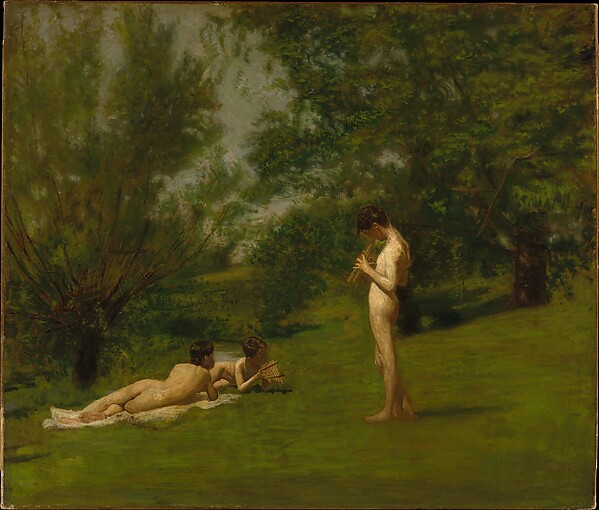
Arcadia
Peut-on la contempler ?
Oui, elle reçoit

Metropolitan Museum of Art
Salle766New York, États-Unis
Présentée au public. Qui s’en porte garant est indiqué ci-dessous.
- Vérifié
- il y a 8 heures
- Dans cet état depuis
- 26 sept. 2026
- Source
- Les données de collection du musée lui-même
About the painting
Arcadia est une peinture réalisée en peinture à l'huile sur toile par le peintre américain Thomas Eakins et constitue l'une de ses rares peintures de nus. Datée d'environ 1883, la toile est conservée au Metropolitan Museum of Art de New York. Le tableau était un cadeau de Thomas Eakins à son ami peintre William Merritt Chase. Le tableau est initialement resté sans titre et n'a jamais été montré publiquement du vivant de Thomas Eakins. Ce n'est qu'après la mort de l'artiste en 1916 que sa veuve Susan baptisa le tableau Arcadia. Le Metropolitan Museum of Art a reçu le tableau en 1967 de la succession d'Adélaïde Milton de Groot.
Notice
- Numéro d’inventaire
- 67.187.125
What it shows
Au catalogue
Sources
- Metropolitan Museum of Art: the museum's own open data · obtenue il y a 4 jours
- Image : Metropolitan Museum of Art — Open Access (CC0)
Pendant ce temps, chez Thomas Eakins
La vie entière1870–1916 · Lieu de travail
Philadelphia
1882
Becomes director of the Pennsylvania Academy
Eakins became the Academy's director. His methods were controversial — no drawing from antique casts and no prize competitions, a quick move from charcoal to paint, anatomy through dissection and photography — yet by the early 1880s the course was called the most “liberal and advanced in the world”.
1882
Death of his sister Margaret
Eakins's sister Margaret, who had acted as his secretary and personal servant, died of typhoid; it has been suggested that his marriage two years later was meant to replace her.
1883
Brings Eadweard Muybridge to lecture at the Academy
In the late 1870s Eakins had discovered Eadweard Muybridge's photographic motion studies, especially those of horses; in 1883 he and the University of Pennsylvania trustee Fairman Rogers arranged for Muybridge to lecture at the Academy.
1884
Marries Susan Macdowell
At 40, Eakins married his former pupil, the painter Susan Hannah Macdowell. In their childless marriage she painted only sporadically, supporting her husband's career, shared his passion for photography and stood by him in his difficult years, even when some of her family turned against him.
1884
Works alongside Muybridge
Eakins briefly worked alongside Muybridge in the latter's photographic studio at 36th and Pine streets, then developed his own technique: instead of a battery of cameras, a single camera making a series of exposures on one negative, to measure motion precisely for painting.