 Max BeckmannGermania, 1884–1950
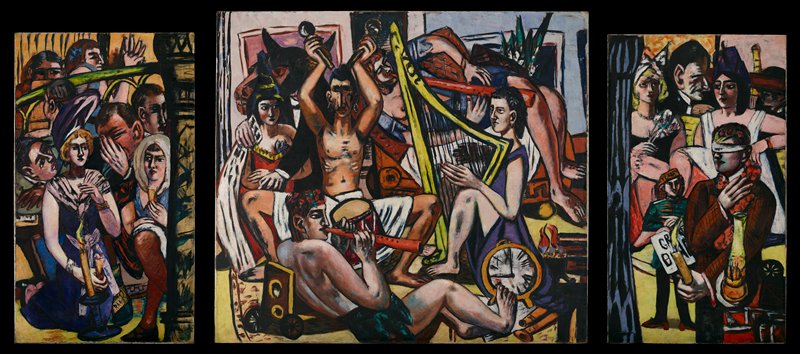
Blind Man's Buff
Si può ammirare?
Sì, riceve visite

Minneapolis Institute of Art
SalaG377Minneapolis, Stati Uniti
Esposta al pubblico. Chi lo garantisce è indicato qui sotto.
- Verificato
- 3 giorni fa
- Ultimo cambio di stato
- 25 set 2026
- Fonte
- I dati di collezione del museo stesso
About the painting
Blind Man's Buff is the most important of the five triptychs created by Max Beckmann while exiled in Holland between 1937-1947 - an exile necessitated by the Nazi's inclusion of ten of his works in their exhibition of degenerate art in 1937. Like much of his art, Blind Man's Buff is allusive and symbolic, inviting explication yet resisting explicit interpretation. Yet, the artist's use of the three-paneled format that was traditional to Medieval and Renaissance altarpieces evokes religious associations. Beckmann also drew upon classical sources, calling the figures at center the gods and the animal-headed man the minotaur. Throughout the triptych, figures engage in sensual pleasures in a place where time, represented by a clock without XII or I, has no beginning or end. In sharp contrast on each wing are the blindfolded man and kneeling woman who, like prayerful donors in a Renaissance altarpiece, turn their backs to the confusion behind them.
Minneapolis Institute of Art
Scheda
- Numero di inventario
- 55.27a-c
In catalogo
Fonti
- Minneapolis Institute of Art: the museum's own open data · acquisita 3 giorni fa
- Immagine: Minneapolis Institute of Art — © Minneapolis Institute of Art
Nel frattempo, nella vita di Max Beckmann
Tutta la vita1937–1947
Ten years of exile in Amsterdam
Beckmann lives in Amsterdam in self-imposed exile, making desperate but failed attempts to obtain a visa for the United States.
1944
The threat of conscription and a heart attack
In 1944 the Germans try to draft the sixty-year-old Beckmann into the army, although he has suffered a heart attack; he barely escapes mobilisation.
1947
Moving to the United States to teach in St. Louis
In 1947 Beckmann and his wife finally cross the ocean: at the invitation of Perry T. Rathbone, director of the Saint Louis Art Museum, he takes a teaching post at the St. Louis School of Fine Arts at Washington University, a vacancy left by Philip Guston, who had taken a leave.
1947–1949
Morton May: patron and student
In St. Louis Morton D. May, an avid amateur photographer and painter, becomes Beckmann's patron and student; the artist also helps him learn to appreciate Oceanian and African art.



![The Argonauts [middle panel], Max Beckmann, 1949/1950](https://api.nga.gov/iiif/0339f626-c218-4c68-bef9-75cfd21a1a08/full/!2400,2400/0/default.jpg)