Alexander CalderStati Uniti, 1898–1976
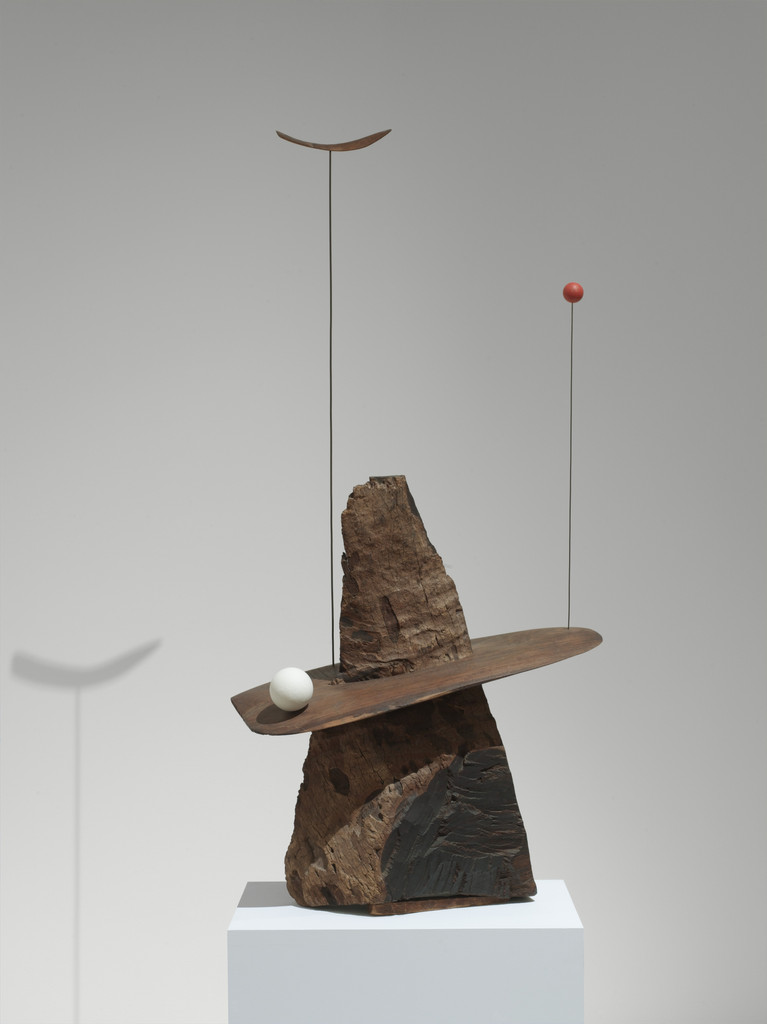
Constellation
Si può ammirare?
Al momento non riceve

Whitney Museum of American Art
New York, Stati Uniti
Appartiene alla collezione, ma al momento non è esposta.
- Verificato
- 7 giorni fa
- Fonte
- I dati di collezione del museo stesso
Scheda
- Numero di inventario
- 2015.148
Fonti
- Whitney Museum of American Art: the museum's own open data · acquisita 7 giorni fa
- Immagine: Whitney Museum of American Art — © the artist or rights holder
Nel frattempo, nella vita di Alexander Calder
Tutta la vita1939–1945
The war years: “constellations” instead of aluminium
During the Second World War Calder tries to join the Marines as a camoufleur but is rejected. Adapting to a scarcity of aluminium, he returns to carved wood in a new open form of sculpture called “constellations”.
1943
The retrospective at the Museum of Modern Art
In 1943 the Museum of Modern Art hosts a Calder retrospective curated by James Johnson Sweeney and Marcel Duchamp; the show has to be extended because of the number of visitors. Russian Wikipedia calls it the artist’s first retrospective.
1946
The Louis Carré show and Sartre’s essay
In 1946 a Calder show organised by Duchamp, made up mainly of hanging and standing mobiles, opens at Galerie Louis Carré in Paris; because of the postal service’s strict size limits he takes some works apart and sends them by mail. The show makes a huge impact, as does the catalogue essay by Jean-Paul Sartre.
1948
A Rio de Janeiro show nearly sells out
By 1948 Calder’s works are selling: his solo show in Rio de Janeiro nearly sells out, and he becomes the first internationally renowned sculptor.
summer 1949
“Sculpture International” in Philadelphia
In the summer of 1949 Calder is one of 250 sculptors in the 3rd Sculpture International at the Philadelphia Museum of Art; his “International Mobile” is the centrepiece of the exhibition.
1952
The Grand Prize of the Venice Biennale
In 1952 Calder wins the Grand Prize of the Venice Biennale. His monumental stabiles soon become part of the architectural ensembles of many cities in Europe and America.