Figure
Si può ammirare?
Al momento non riceve

Victoria and Albert Museum
Londra, Regno Unito
Appartiene alla collezione, ma al momento non è esposta.
- Verificato
- 7 giorni fa
- Ultimo cambio di stato
- 25 set 2026
- Fonte
- I dati di collezione del museo stesso
About the sculpture
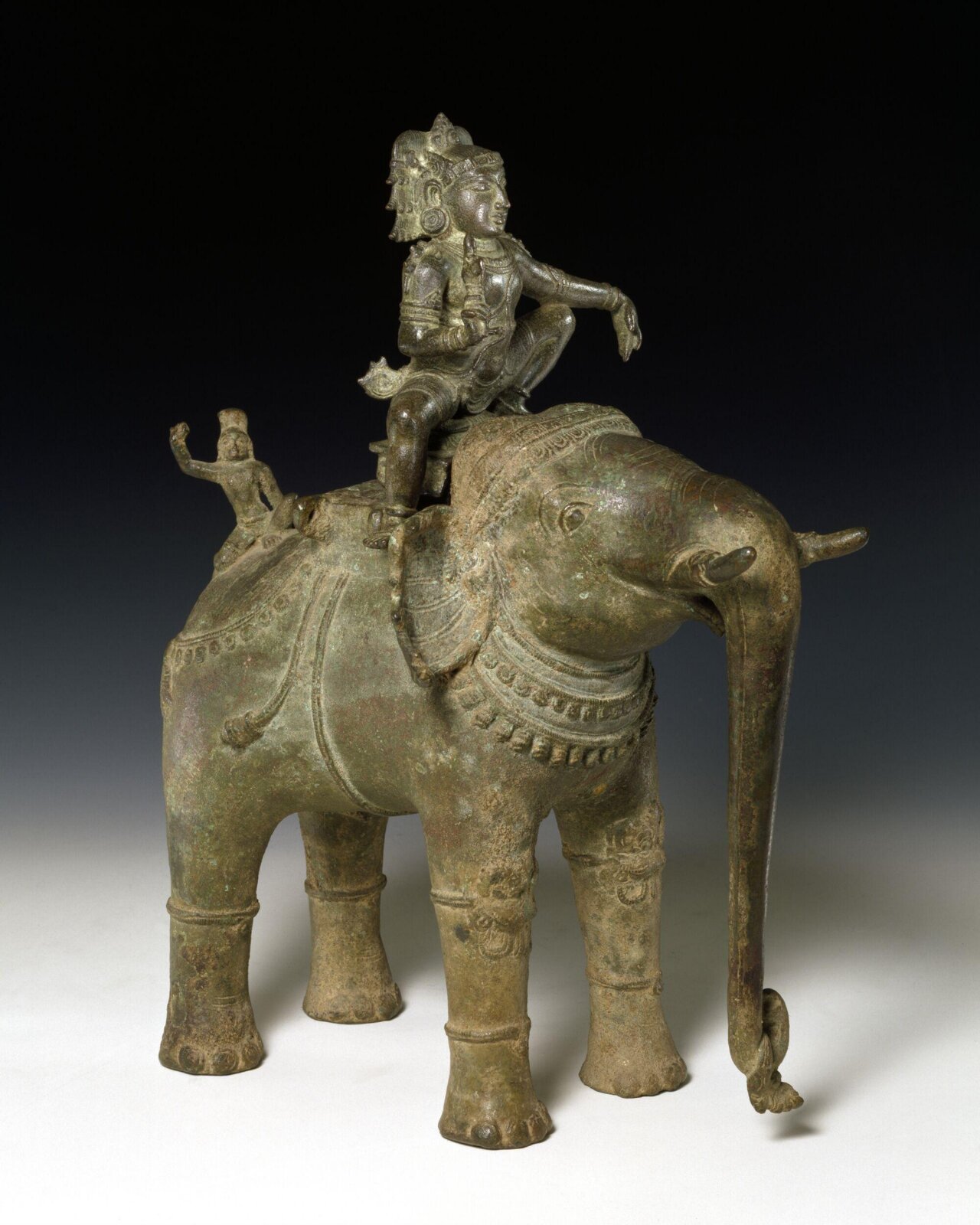
This elephant would probably have been made to carry a figure of the Hindu god Aiyanar or Ayannar, such as the V&A example, Museum no. IM.15-1939. Aiyanar is one of the most popular folk-deities of rural south India where he serves as the principal protective deity of village communities, especially from the malevolent forces that abound at night. His shrines are found in the countryside, they are usually located outside the boundaries of a village or town. They are readily identified by the painted terracotta horses found around the site, which have been offered to him by his devotees.
Read on
Aiyanar is generally worshipped as the son of Shiva, though his origins undoubtedly stem from a local hero (vira) cult deity. Legend attributes his birth to a sexual union between Shiva and Vishnu. As Vishnu is said to have seduced Shiva by assuming the female form of Mohini, a beautiful woman. Due to his parentage, Aiyanar is revered by both followers of Shiva and Vishnu. He is also referred to as Harahariputa, literally, the son of Hara (Shiva) and Hari (Vishnu). This reinforces the manner in which he bridges the two principle sects of Hinduism.
Aiyanar is exceptional because he is a village guardian deity, who has been elevated and absorbed into the Hindu pantheon. Processional bronze images of Aiyanar have been commissioned. He is seen here, seated in a relaxed posture (sukhasana) and is holding an elephant goad (ankusa). His radiating hair mimicks that of Shiva in his ascetic–yogic forms, and within the coils of his hair a cobra and crescent moon can be seen. These two emblems emphasise his close affiliation with Shiva. The elephant on which Aiyanar rides wears bell-garlands, and a small howdah upon which he sits. Behind him, holding on precariously is a smaller figure, presumably this is the elephant-keeper (mahout). A similar sculpture is held by the Government Museum in Chennai.
Victoria and Albert Museum
Scheda
- Numero di inventario
- IM.14-1938
What it shows
In catalogo
Fonti
- Victoria and Albert Museum: the museum's own open data · acquisita 7 giorni fa
- Immagine: Victoria and Albert Museum — © Victoria and Albert Museum, London