Nikolai Ge1831–1894
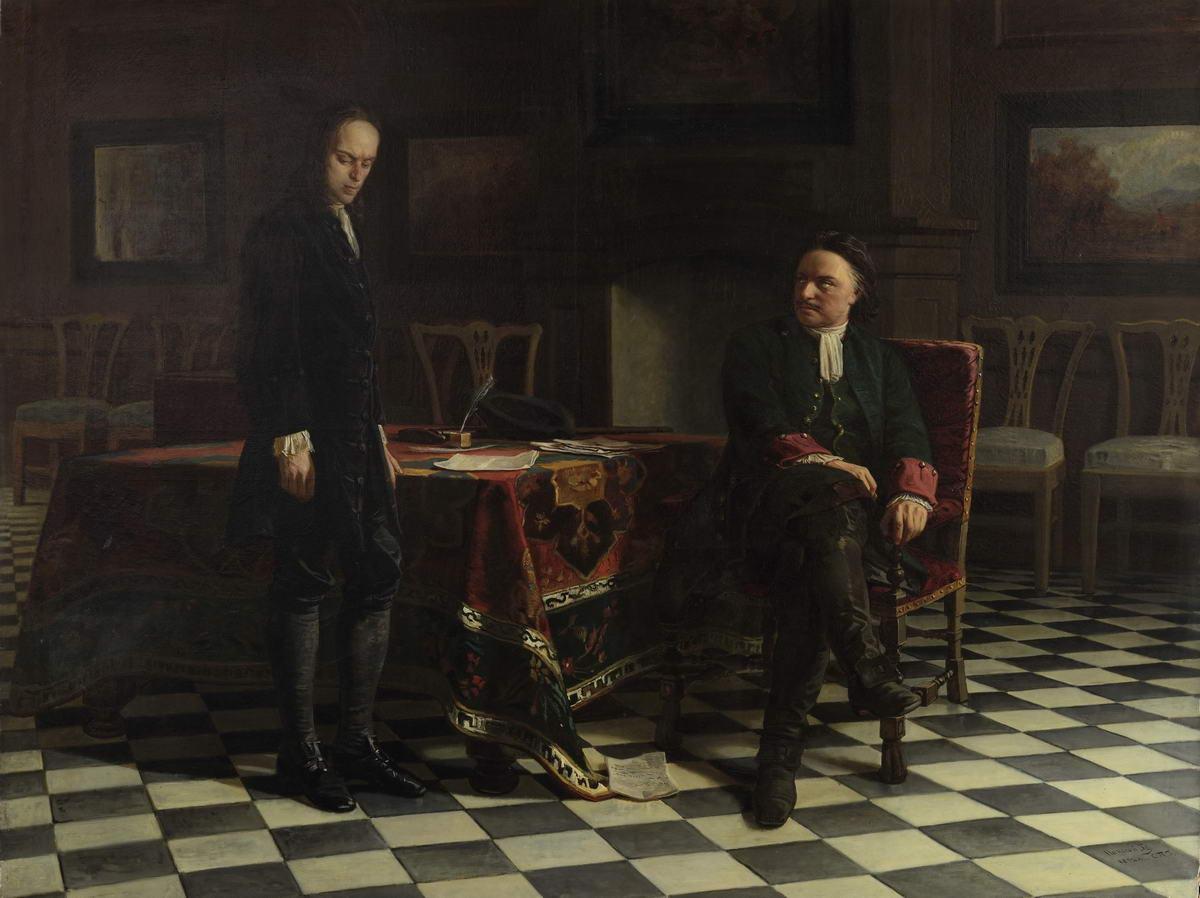
Peter the Great Interrogating the Tsarevich Alexei Petrovich at Peterhof
Si può ammirare?
Non si sa: il museo mantiene il riserbo

Galleria Tret'jakov
Mosca, Russia
Il proprietario è noto. Se oggi sia esposta, il museo non lo dice, e a indovinare non ci hanno insegnato.
- Fonte
- I dati di collezione del museo stesso
About the painting
The painting Peter the Great Interrogating the Tsarevich Alexei Petrovich at Peterhof was created by the Russian artist Nikolai Ge (1831–1894) and completed in 1871. The painting is stored in the State Tretyakov Gallery in Moscow (Inventory 2630). The dimensions of the painting are 135.7 cm by 173 cm (according to other data, 134.8 cm by 172.7 cm). Ge's work offers a psychological interpretation of a historical drama set in 1718. The painting depicts Peter I and his son Alexei Petrovich, who has been accused of preparing to seize power, in the interior of the Monplaisir Palace in Peterhof. Before pronouncing sentence, Peter I gazes into his son's eyes, still hoping to discern signs of remorse.
Read on
The painting was created by Ge for the inaugural exhibition of the Society for Travelling Art Exhibitions (Peredvizhniki), which opened in St Petersburg in November 1871. In particular, the artist's choice of theme was motivated by the approaching 200th anniversary of Peter the Great (1672–1725). Prior to the exhibition, the canvas was purchased from the artist by Pavel Tretyakov. Nikolai Ge painted several copies of the painting, one of which was purchased by Alexander II and is now part of the collection of the State Russian Museum.
Writer and critic Mikhail Saltykov-Shchedrin described the heroes of the canvas as follows: "Anyone who has seen these two simple, not at all spectacularly staged figures will have to admit that he has witnessed one of those amazing dramas that will never be erased from memory." Art critic Vladimir Stasov considered Ge's painting to be one of the best works in the 1st Travelling Exhibition, writing: "None of Mr Ge's previous paintings bore such a stamp of maturity and skill as this one." Art historian Alla Vereshchagina noted that the painting Peter the Great Interrogating the Tsarevich Alexei Petrovich at Peterhof was "the most important milestone" in the development of a new direction in Russian historical painting of the 1870s, associated with the artistic interpretation of the eminent man and his place in history.
Scheda
- Numero di inventario
- 2630
Fonti
- Galleria Tret'jakov: the museum's own open data · acquisita 3 giorni fa
- Immagine: Galleria Tret'jakov — Museum open access