 Egon SchieleAustria, 1890–1918
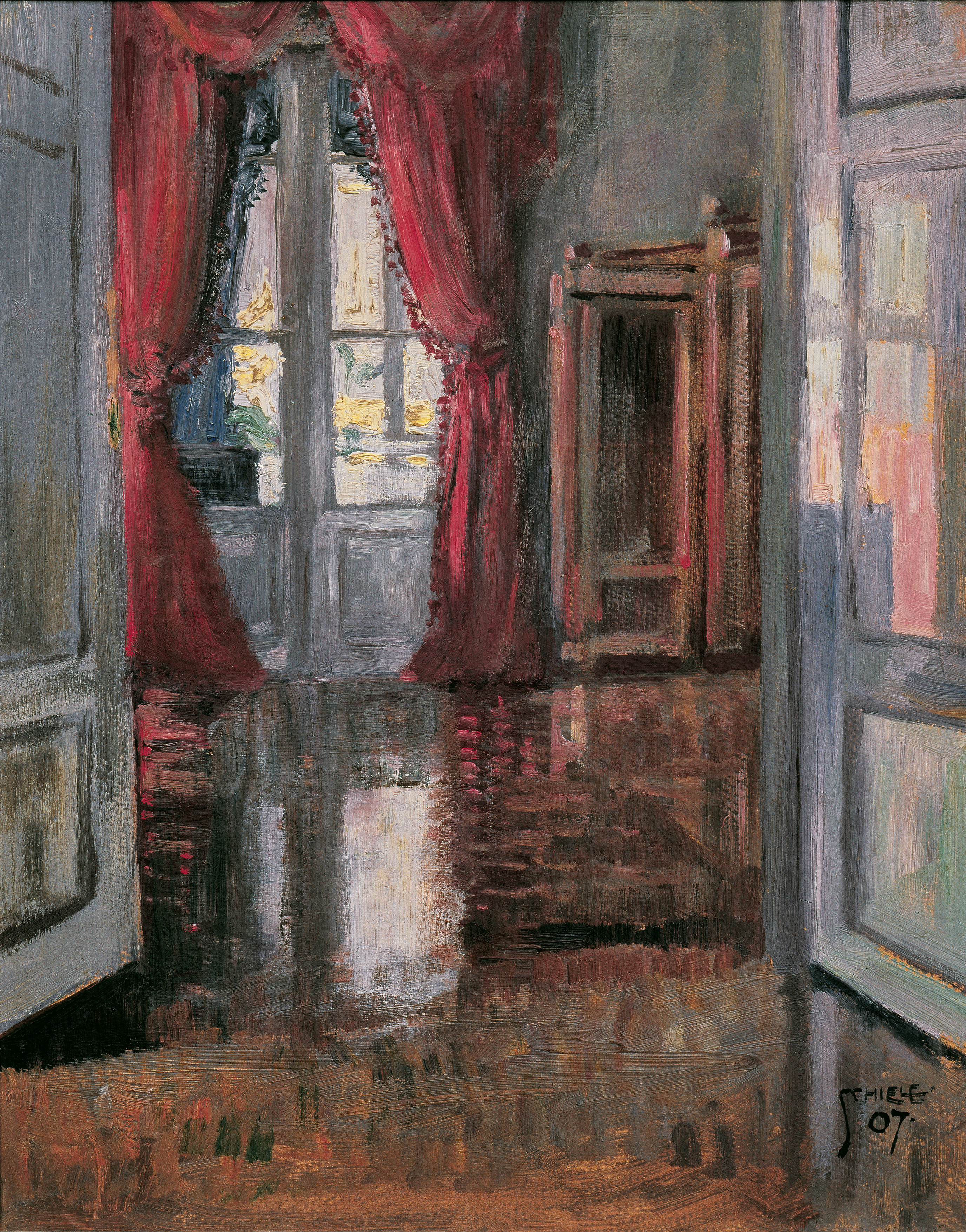
Interieur
Si può ammirare?
Non si sa: il museo mantiene il riserbo

Österreichische Galerie Belvedere
Vienna, Austria
Il proprietario è noto. Se oggi sia esposta, il museo non lo dice, e a indovinare non ci hanno insegnato.
- Ultimo cambio di stato
- 27 set 2026
- Fonte
- I dati di collezione del museo stesso
Scheda
Fonti
- Österreichische Galerie Belvedere: the museum's own open data · acquisita 3 giorni fa
- Immagine: Österreichische Galerie Belvedere — CC BY-SA 4.0
Nel frattempo, nella vita di Egon Schiele
Tutta la vitac. 1905
His father’s death and the family’s ruin
When Schiele was 14 his father died of syphilis, and the family, which had been fairly wealthy, was left impoverished: before his death the father, in a fit of insanity, had burned the railway stocks that would have supported them. His elder sister Melanie, hired as a ticket clerk at the local station, became the sole breadwinner.
after 1905
His uncle Czihaczek’s guardianship and the tutor Strauch
Schiele and his sister Gerti became wards of Leopold Czihaczek, the husband of their aunt and also a railway official: he wanted his nephew to follow in his footsteps but, recognising Schiele’s talent for drawing, allowed him a tutor, the artist Ludwig Karl Strauch. Later the uncle renounced his guardianship and Schiele depended on his mother’s support until it was cut off because his sister Melanie objected to the expense, which caused a rift in the family.
1907
Gustav Klimt: mentor and patron
In 1907 Schiele sought out Gustav Klimt, who generously mentored younger artists: Klimt bought his drawings, offered to exchange them for some of his own, arranged models for him and introduced him to potential patrons and to the Wiener Werkstätte. Schiele’s earliest works of 1907–1909 show strong similarities with Klimt’s, as well as influences from Art Nouveau.
1908
The first exhibition, in Klosterneuburg
In 1908 Schiele’s first exhibition took place in the town of Klosterneuburg near Vienna, where he had earlier attended school.
1909
Leaves the Academy and founds the Neukunstgruppe
In 1909, after completing his third year, Schiele left the Academy and, with other dissatisfied students, founded the Neukunstgruppe (“New Art Group”). Imitations of Klimt and Oskar Kokoschka are visible in his first works, but he soon evolved his own distinctive style.
1909
The 1909 Kunstschau: beside Klimt and Van Gogh
In 1909 Klimt invited Schiele to exhibit some of his work at the Vienna Kunstschau, where he encountered the work of Edvard Munch, Jan Toorop, Vincent van Gogh and others.