ManoharIndia
Painting
Mag men het zien?
Ontvangt momenteel niet

Victoria and Albert Museum
Londen, Verenigd Koninkrijk
Het hoort bij de collectie, maar is momenteel niet tentoongesteld.
- Gecontroleerd
- 7 dagen geleden
- Ongewijzigd sinds
- 25 sep 2026
- Bron
- De eigen collectiegegevens van het museum
About the painting
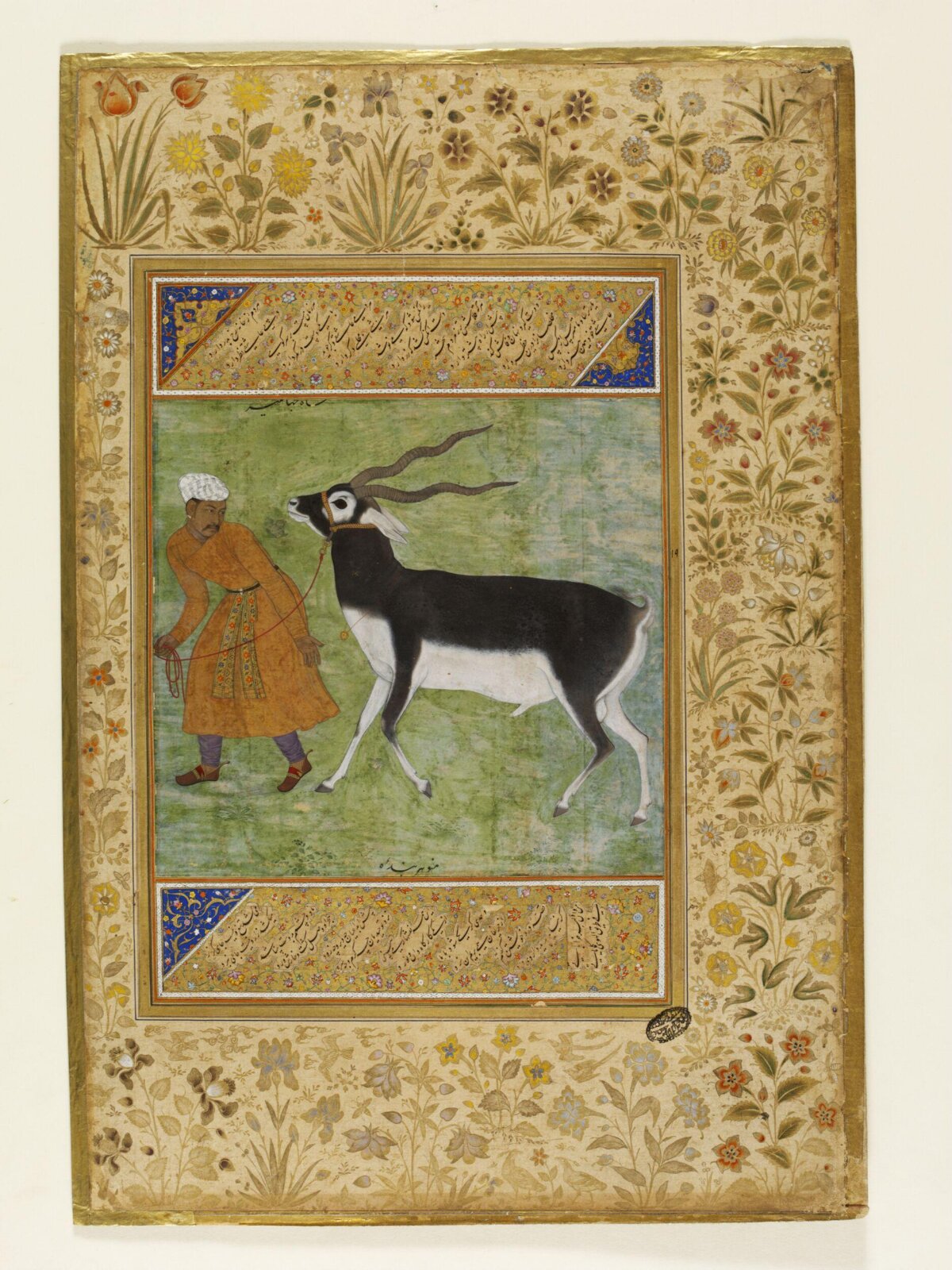
The study of an Indian black buck being led by its keeper was painted between about 1610 and 1615 by the Mughal court artist Manohar, who signed his work on the green ground at top and bottom of the painting. The posture of the keeper who bends one knee, crouching slightly, while looking over his shoulder, is conceivably inspired by the figure of Joseph in Albrecht Durer's engraving The Flight to Egypt. Engravings by, or after, Durer reached the Mughal court in the late 16th and early 17th centuries, brought mainly by the Jesuits who came from Portuguese Goa, and in several cases were copied directly by the imperial artists. Manohar has signed the page, with his name in a suitably humble position beneath the forelegs of the animal 'Manohar banda' and continues at the top of the painting 'Jahangir shahi'. He is therefore the servant, beholden to the king Jahangir.
Read on
Little is known of Manohar, but contemporary ascriptions to manuscripts attest to his having entered royal service under the Mughal emperor Akbar (r. 1556-1605) and he became one of the most important artists of his son and successor, Jahangir (r. 1605-1627). Floral borders were added to his painting late in the reign of Jahangir or early in the reign of Shah Jahan, and the page was preserved in a royal album which became dismembered at some unknown date. This folio was bequeathed to the museum by Lady Wantage in 1921.
Victoria and Albert Museum
Gegevens
- Inventarisnummer
- IM.134-1921
What it shows
In de catalogus
Bronnen
- Victoria and Albert Museum: the museum's own open data · opgehaald 7 dagen geleden
- Afbeelding: Victoria and Albert Museum — © Victoria and Albert Museum, London