 Viktor Vasnetsov1848–1926
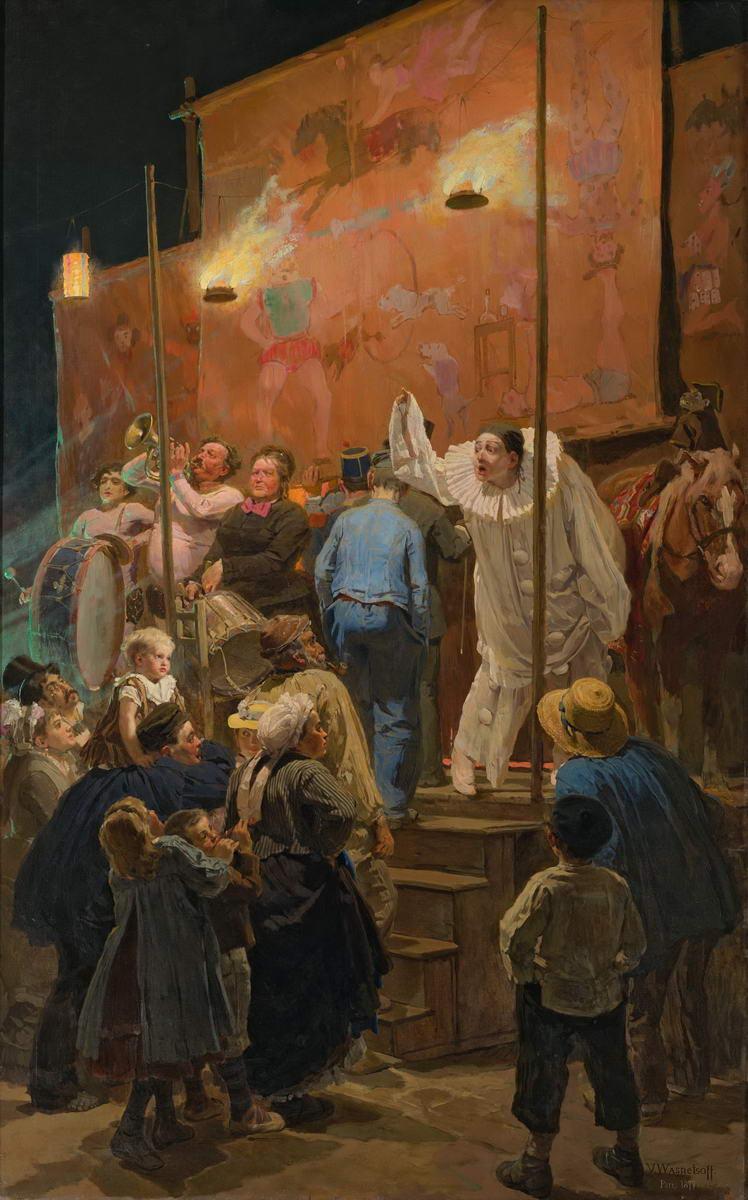
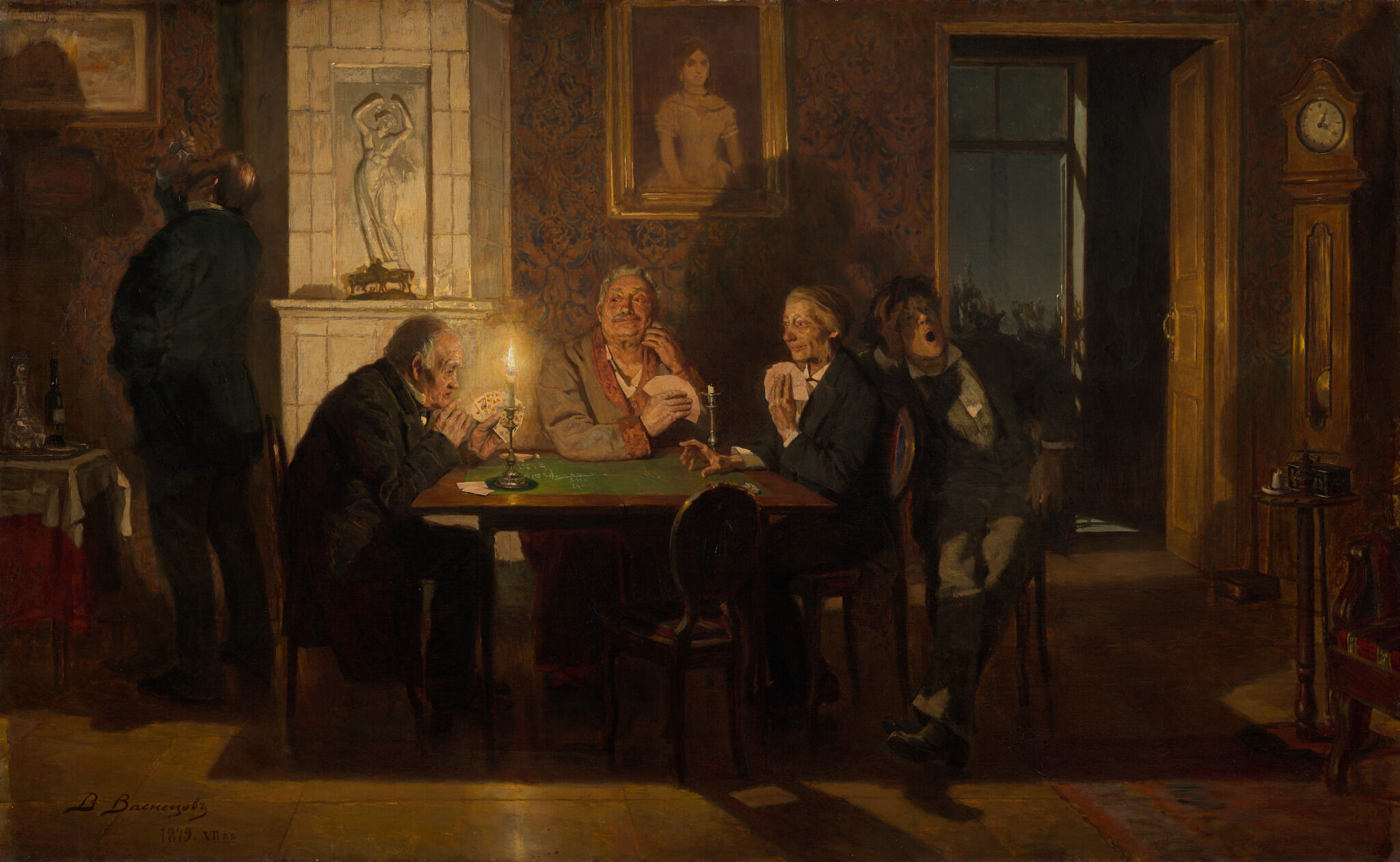
Преферанс
Mag men het zien?
Onbekend: het museum bewaart het stilzwijgen

Tretjakovgalerij
Moskou, Rusland
De eigenaar is bekend. Of het vandaag te zien is, zegt het museum niet, en gissen hebben wij niet geleerd.
- Bron
- De eigen collectiegegevens van het museum
Gegevens
- Inventarisnummer
- 5224
Bronnen
- Tretjakovgalerij: the museum's own open data · opgehaald 3 dagen geleden
- Afbeelding: Tretjakovgalerij — © State Tretyakov Gallery
Intussen, in het leven van Viktor Vasnetsov
Het hele leven1876–1877
Mamontov’s letter, homesickness and the first sketch for the “Bogatyrs”
In Polenov’s Paris studio he and Repin re-read a letter from Savva Mamontov calling the artists to Moscow; the letter sharpened his homesickness (“Alone, alone and alone!”), and it was there that the first painted sketch of the “Bogatyrs” was made.
November 1877
Wedding to Alexandra Ryazantseva
Before leaving for Paris he had proposed to Ryazantseva; the wedding took place in November 1877 in the Church of Saints Peter and Paul of the Semyonovsky-Alexandrovsky military hospital in St Petersburg.
1878
He moves to Moscow, the city of his life’s work
In 1878, his resolve strengthened by Mamontov’s letter, he moved to Moscow, the city to which most of his creative life would be tied: he settled in a small flat in 3rd Ushakovsky Lane near Ostozhenka, walked the city for hours admiring the Kremlin and St Basil’s, and until 1885 the family changed rented flats in Moscow six times.
1878–1880
Mamontov’s commission for the Donetsk Railway
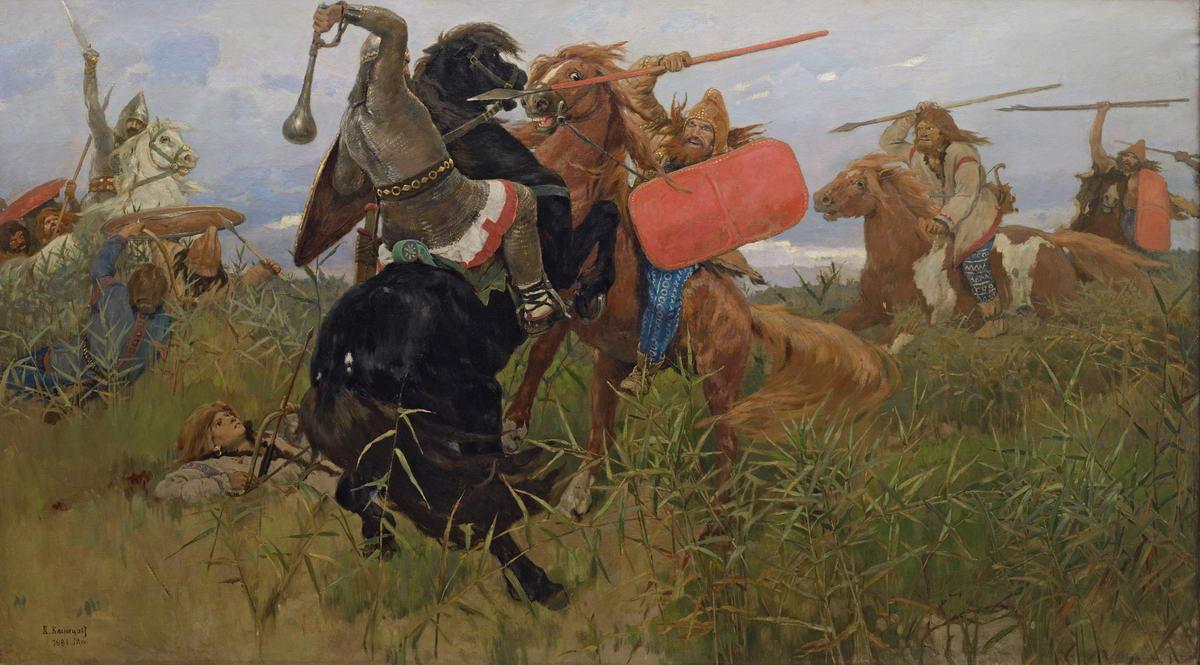
Repin brought him to the house of Savva Mamontov, who commissioned three fairy-tale pictures for the boardroom of the Donetsk Railway — “The Battle of the Russians with the Scythians”, “The Flying Carpet” and “The Three Princesses of the Underground Kingdom” (the princesses of gold, precious stones and coal); the princess Coal, a modest dark-haired girl in a black dress, was especially successful.
1878–1890 · Loopbaan
the Peredvizhniki
From 1878 he belonged to the Society of Travelling Art Exhibitions (the Peredvizhniki): he took part in its activity in 1878–1890 and exhibited with it until 1897; he was admitted for the realism and sharp social subjects of his genre paintings.
June 1880
His first visit to Mamontov’s Abramtsevo
In June 1880, with his brother Apollinary, he first came to Abramtsevo at Savva Mamontov’s invitation and joined the circle of Repin, Polenov, Serov and other artists, where he became one of the leaders of the national-romantic current.