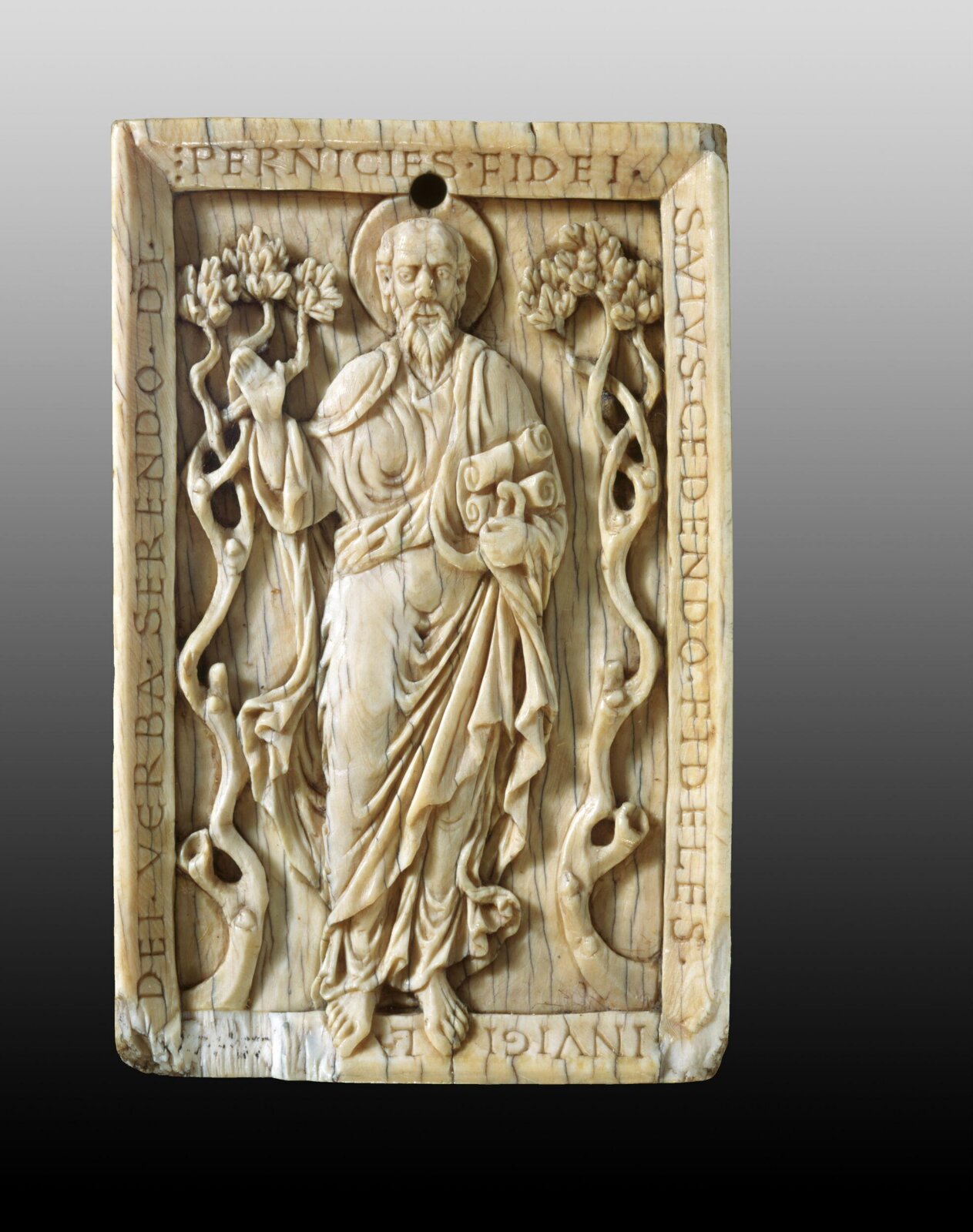
Saint Paul
Mag men het zien?
Ja, het ontvangt bezoek

Victoria and Albert Museum
ZaalSculpture, Room 111, The Gilbert Bayes GalleryLonden, Verenigd Koninkrijk
Publiek tentoongesteld. Wie daarvoor instaat, staat hieronder.
- Gecontroleerd
- 7 dagen geleden
- Ongewijzigd sinds
- 25 sep 2026
- Bron
- De eigen collectiegegevens van het museum
About the sculpture
This ivory panel can be related to German works produced around the end of the 12th and the beginning of the 13th century. A small group of ivories, including a 'Flight into Egypt' in the Museo Nazionale in Florence, and a 'Tree of Jesse', now shared by the Metropolitan Museum of Art in New York and the Louvre, possibly carved in Bamberg, provide some convincing parallels, especially interlaced branches of the trees beside St. Paul. Large-scale sculpture of the early 13th century provides some comparable works. It is not so much specific details that relate works but the spirit underlying them: the preaching St. Paul and the disputing prophets of the choir screen show a similar external expression, in their vitality and dynamism and in their swirling draperies, of the vehemence of their words. Compared with the solidity and dignity of the figures on the other ivories, this panel is clearly looking forward into the 13th century, nearer to the beginning of German Gothic sculpture, soon to emerge at Bamberg itself.
Read on
St Paul's normal attributes are a sword and a book, but the voluminous scroll he carries here, and the inscription around the border, would seem to bear particular reference to his Epistles. The plaque almost certainly therefore decorated the front cover of a copy of the Epistles of St Paul or - less likely - the Acts of the Apostles, where his conversions is described. Such books were widely popular in Germany at this date.
Victoria and Albert Museum
Gegevens
- Inventarisnummer
- 274-1867
What it shows
In de catalogus
Bronnen
- Victoria and Albert Museum: the museum's own open data · opgehaald 7 dagen geleden
- Afbeelding: Victoria and Albert Museum — © Victoria and Albert Museum, London