Drawing
Será possível contemplá-la?
De momento, não recebe

Museu Vitória e Alberto
Londres, Reino Unido
Pertence à coleção, mas de momento não está exposta.
- Verificado
- há 7 dias
- Neste estado desde
- 25 de set. de 2026
- Fonte
- Os dados da própria coleção do museu
Sobre a obra
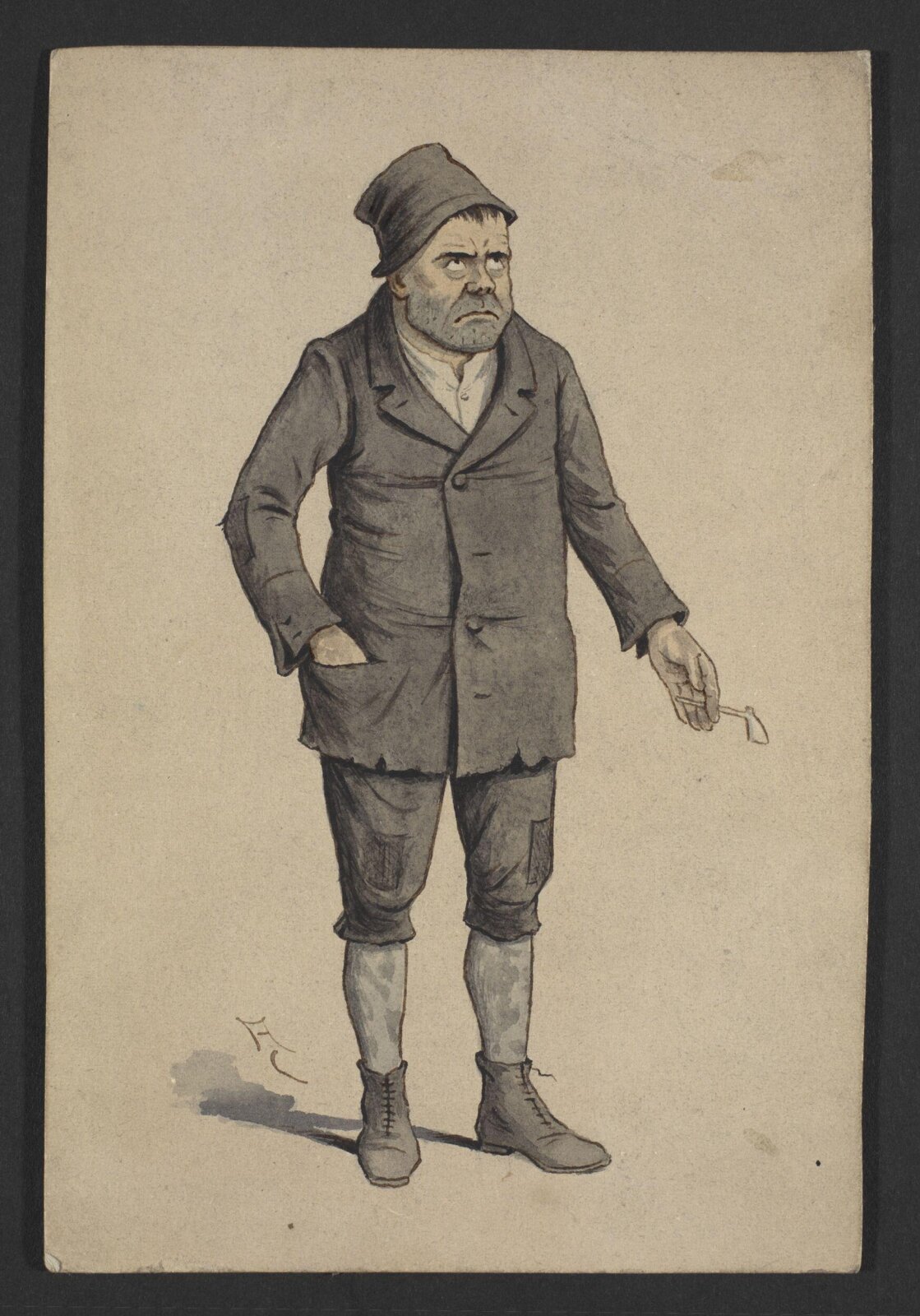
Watercolour drawing of the composer and singer W.G. Ross (d.1876) as he appeared when performing his most famous song, 'The Ballad of Sam Hall'. Signed by the artist, with the initials, A.C, mid to late 19th century.
W.G. Ross started his career as a compositor on one of the Glasgow newspapers, singing occasionally at local harmonic assemblies. He moved to London where he became a success at the Cider Cellars, Maiden Lane, with songs such as ‘The Lively Flea,’ ‘Jack Rag,’ and ‘Going Home with the Milk in the Morning’, before achieving major success with 'The Ballad of Sam Hall'.
Read on
The popularity of this song was such that Ross became one of the earliest stars of the nascent music hall, drawing huge crowds to the Cider Cellars to see him sing. Ross performed the song dressed in tattered clothes and a bedraggled hat, with a clay pipe clenched between his teeth, taking on the character of an unrepentant chimney sweep, sentenced to hanging for murder, on his last journey from Newgate to Tyburn gallows. The song was a version of the folk ballad 'Jack Hall' about a criminal, sold as a child to be a chimney sweep, who became a highwayman and was executed at Tyburn in December 1707.
With its lugubrious refrain: ‘damn his eyes’ Ross's song held a morbid fascination for his audiences and the journalist F.C. Burnand (1836-1917) remembered visiting as a boy and seeing men in adjoining rooms rushing to the concert hall to hear Ross sing 'Sam Hall' when his turn was announced, even if they had heard him do it fifty times before. Similarly, writing in 1858, J. Ewing Ritchie recalled that when 'Sam Hall' was sung: ‘horrible as the song was – revolting to all but blasé men, the room was crammed to suffocation – it was impossible often to get a seat, and you might have heard a pin drop.’
For a decade Ross continued to draw crowds, but he never repeated the success of 'Sam Hall' and his later years were spent as part of an unsuccessful theatre company in the provinces.
Museu Vitória e Alberto
Pormenores
- Número de inventário
- S.4600-2013
What it shows
No catálogo
Fontes
- Museu Vitória e Alberto: the museum's own open data · obtido há 7 dias
- Imagem: Museu Vitória e Alberto — © Victoria and Albert Museum, London