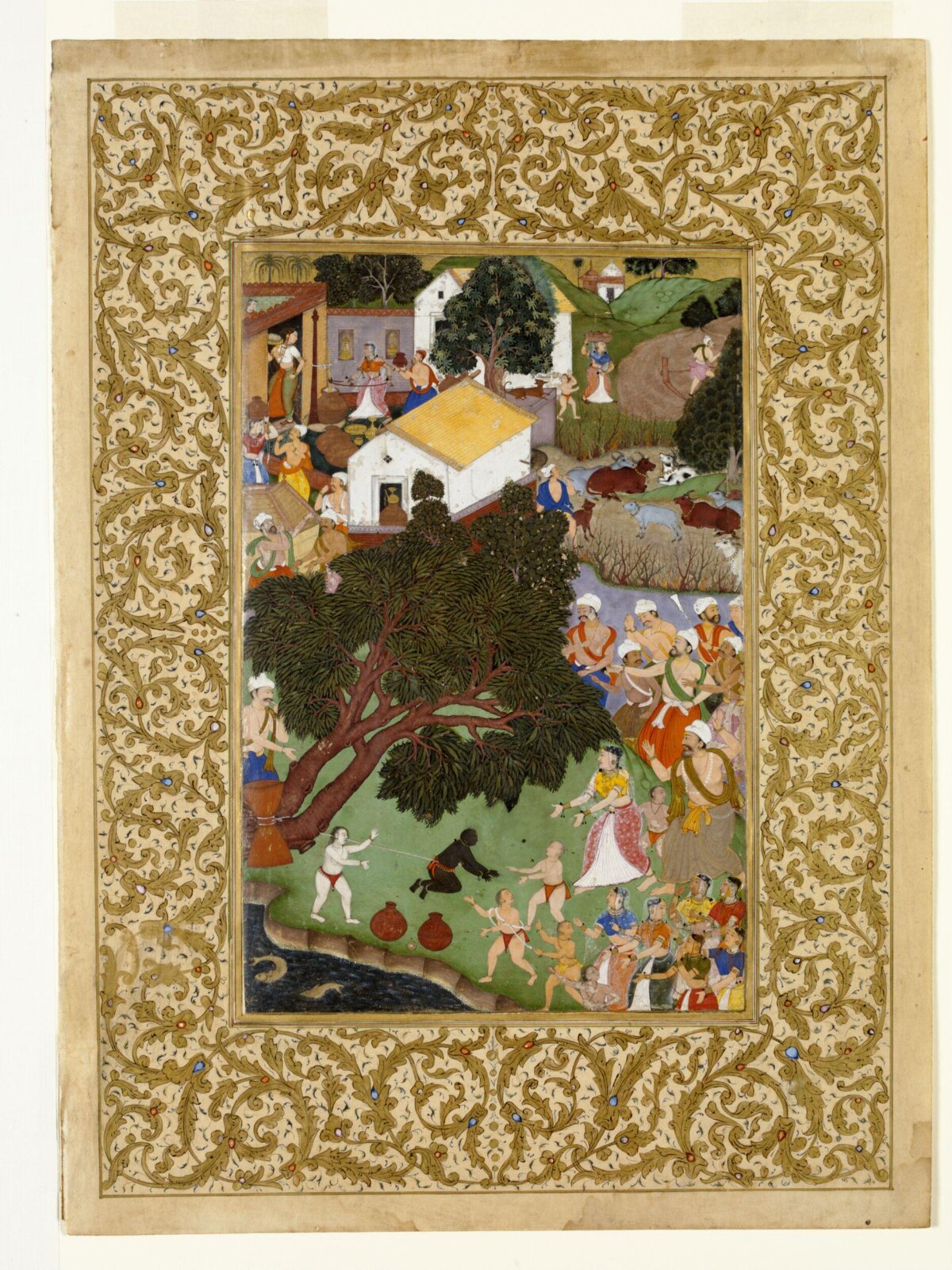
Krishna
Será possível contemplá-la?
De momento, não recebe

Museu Vitória e Alberto
Londres, Reino Unido
Pertence à coleção, mas de momento não está exposta.
- Verificado
- há 7 dias
- Neste estado desde
- 25 de set. de 2026
- Fonte
- Os dados da própria coleção do museu
About the painting
The Mughal emperor Akbar commissioned translations into Persian, the court language, of the great Hindu epics in the 1580s and 1590s. The royal copies were illustrated in the royal atelier. This painting is an illustration to the Harivamsa, or "Genealogy of Hari", the story of Lord Krishna.In its Persian translation, it was an appendix to the Razmnama ("Book of War"), the Persian version of the great Hindu epic the Mahabharata. The volume was completed in about 1590 but its pages were dispersed at an unknown date. The V&A has 6 folios from the manuscript (IS.2-1970 to IS.-1970). They were all given additional borders, probably in Lucknow in the 18th century, for moounting in an album.
Read on
In this illustration, the infant Krishna (identifiable by his blue skin) has been tied by his foster-mother Yasoda to a tree to prevent him from playing pranks, using a heavy mortar to anchor him. The baby easily crawls away, dragging the mortar and in doing so uprooting a pair of giant Arjuna trees. The trees were, in fact, the demigods Nalakuvera and Manigriva, sons of Kuvera, who had been cursed by the sage Narada. As soon as the trees fell thundering to the ground, they were freed from the curse. Yasoda, her husband Nanda, and the inhabitants of the village rush to witness the incredible scene, while daily life in the village continues peacefully in the background.
Museu Vitória e Alberto
Pormenores
- Número de inventário
- IS.2-1970
What it shows
No catálogo
Fontes
- Museu Vitória e Alberto: the museum's own open data · obtido há 7 dias
- Imagem: Museu Vitória e Alberto — © Victoria and Albert Museum, London